Places Foods Stories Newsletters
Loading...
Loading...
Loading...

No search results found for
“”

Make sure words are spelled correctly.

Try searching for a travel destination.

Places near me Random place

Popular Destinations

  • Paris
  • London
  • New York
  • Berlin
  • Rome
  • Los Angeles
Places Foods Stories Newsletters
Sign In Join
Places near me Random place
All Italy Ravenna Mausoleum of Theoderic

Mausoleum of Theoderic

The roof of this ancient mausoleum is made from a single Istrian stone weighing a massive 230 tons.

Ravenna, Italy

Tony Dunnell profile photo
Added By
Tony Dunnell
Email
Been Here
Want to go
Added to list
CAPTION
Sarcophagus on top level of Mausoleum of Theoderic.   Username.Ruge/cc by-sa 4.0
Roof of the Mausoleum of Theoderic.   Username.Ruge/cc by-sa 4.0
Mausoleum of Theoderic.   Σπάρτακος/cc by-sa 3.0
Lower level of the Mausoleum of Theoderic.   Username.Ruge/cc by-sa 4.0
Been Here
Want to go
Added to list

About

To the casual observer, the Mausoleum of Theoderic is far from being one of the most spectacular archaeological sites in Italy, or even near Ravenna. But when you learn that the roof is made of one single stone slab weighing 230 tons, and that no one is quite sure how the builders got it up there, things get far more interesting.

At the time of his death in 526 AD, Theoderic the Great had racked up an impressive number of titles: King of the Ostrogoths, ruler of Italy, regent of the Visigoths, patricius of the Roman Empire. With such a swathe of honors to his name, it was no surprise that he wanted to build himself a tomb that would be worthy of his accomplishments in life.

In contrast to the majority of buildings in and around Ravenna that date back to this period, which were typically built of bricks, the mausoleum was constructed of carved blocks of stone imported from Istria. These were used to create the structure's two decagonal levels, the lower level being noticeably narrower than the upper.

And then there's the roof: all 230 tons of it. Measuring about 35 feet in diameter and carved from a single piece of Istrian stone, it is rimmed with 12 pierced, projecting spurs, each inscribed in Latin with the name of an apostle. The triangular holes around the roof give it the appearance of a crown, and some historians have argued that heavy ropes were passed through these holes, allowing the builders to transport and then position the massive stone. That, however, remains an open question, and not the only mystery surrounding the Mausoleum of Theoderic.

Delving deeper into the form and function of the mausoleum, things quickly reach Dan Brown-like proportions. Archaeoastronomical investigations using 3D modeling have suggested that the orientation of the mausoleum, including its 17 windows of varying shapes and sizes, may well be aligned with important moments within the astrological year. On the day of the Annunciation, for example, the rising sun pours through a cross-shaped window onto the wall of the tomb. And at sunset on the days of the equinoxes, the sunlight illuminates scripted bands within the mausoleum.

Other enigmatic features within the largely bare interior of the mausoleum include a small apse and a sarcophagus. The function of the apse on the upper level has long baffled historians. It is too small to accommodate an altar or other significant piece, but nonetheless appears to be an important element within the tomb, its keystone bearing a large Latin cross, which is the only sculptural element in the interior.

The bathtub-like sarcophagus, meanwhile, once held the remains of King Theodoric. Made of red porphyry, the sarcophagus has four rings carved into its sides, as well as two lion heads. As for Theodoric, his bones were scattered—and his mausoleum converted into a Christian oratory—when Byzantine general Flavius Belisarius conquered the city in 540.

Places

Discover your next amazing Atlas Place.

Get more unusual and extraordinary places each week with the Atlas Obscura Places newsletter.

Your newsletter subscriptions with us are subject to Atlas Obscura's Privacy Policy and Terms of Use.

Know Before You Go

The Mausoleum of Theodoric is located just outside the town center of Ravenna, and is easy to reach on foot. Entry is €4 and tickets are available from a small building near the entrance.

Community Contributors

Tony Dunnell profile photo

Added By

Tony Dunnell

Published

August 15, 2018

Edit this listing

Make an Edit
Add Photos
Sources
  • http://maajournal.com/Issues/2016/Vol16-4/Full59.pdf
  • https://www.european-traveler.com/italy/the-mausoleum-of-theodoric-in-ravenna/
  • http://www.thebyzantinelegacy.com/mausoleum-theoderic
  • https://www.thevintagenews.com/2017/01/28/built-in-520-ad-as-his-own-tomb-the-mausoleum-of-theoderic-is-a-monument-exhibiting-roman-art-in-its-purest-form/
Related Tags

Archaeology Domes Mausoleums Tombs Ancient History Architecture Astronomy
Mausoleum of Theoderic
14 Via delle Industrie
Ravenna
Italy
44.425046, 12.209169
Get Directions

Nearby Places

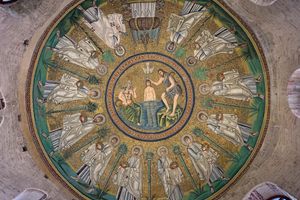
Arian Baptistry

Ravenna, Italy

miles away

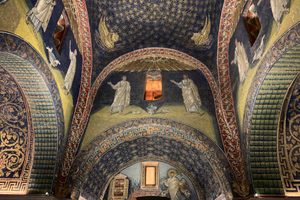
Mausoleum of Galla Placidia

Ravenna, Italy

miles away

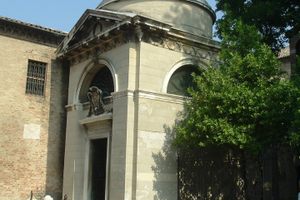
Dante's Tomb

Ravenna, Italy

miles away

Explore the Destination Guide

Photo of Ravenna

Ravenna

Italy

Places 10
Stories 1

Nearby Places

Arian Baptistry

Ravenna, Italy

miles away

Mausoleum of Galla Placidia

Ravenna, Italy

miles away

Dante's Tomb

Ravenna, Italy

miles away

Explore the Destination Guide

Photo of Ravenna

Ravenna

Italy

Places 10
Stories 1

Related Places

  • Zona Arqueológica Cempoala

    Zempoala, Mexico

    Zona Arqueológica Cempoala

    Palace, temple, and pyramid ruins mark the ancient Mesoamerican capital of Totonacapan.

  • Sunder Burj historic complex.

    New Delhi, India

    Sunderwala Burj

    This beautiful 16th-century necropolis marks an astonishing feat in heritage conservation.

  • A corridor in the Mountain View Mausoleum.

    Altadena, California

    Mountain View Mortuary and Cemetery

    This magnificent mausoleum is as much a work of art as it is a historic resting place.

  • Al-Qal'a, "The Castle."

    Es-Salt, Jordan

    Es-Salt

    This ancient town is full of stunning Ottoman architecture and streets so narrow trash collection is done by donkey.

  • The Roman theater seen from Amman Citadel.

    Amman, Jordan

    Roman Theater of Amman

    This exceptionally well-preserved ancient marvel also houses a small museum dedicated to Jordanian folk tradition.

  • Bibi Maryam Mausoleum

    Qalhat, Oman

    Bibi Maryam Mausoleum

    This lonely tomb is all that remains of a once-bustling ancient trade hub visited by Marco Polo.

  • Bean-shaped pillow with child design, Northern Song Dynasty.

    Guangzhou, China

    Ceramic Pillows at the Museum of the Nanyue King's Mausoleum

    Three floors above a 2,000-year-old royal tomb is a rare collection of ancient porcelain pillows.

  • The "face" of The Turtle as it currently appears.

    Niagara Falls, New York

    The Turtle (Native American Center for the Living Arts)

    One of “America’s Most Endangered Historic Places” is a building shaped like a giant turtle.

Aerial image of Vietnam, displaying the picturesque rice terraces, characterized by their layered, verdant fields.
Atlas Obscura Membership

Become an Atlas Obscura Member


Join our community of curious explorers.

Become a Member

Get Our Email Newsletter

Follow Us

Facebook YouTube TikTok Instagram Pinterest RSS Feed

Get the app

Download the App
Download on the Apple App Store Get it on Google Play
  • All Places
  • Latest Places
  • Most Popular
  • Places to Eat
  • Random
  • Nearby
  • Add a Place
  • Stories
  • Food & Drink
  • Itineraries
  • Lists
  • Video
  • Podcast
  • Newsletters
  • All Trips
  • Membership
  • Feedback & Ideas
  • Community Guidelines
  • Product Blog
  • Unique Gifts
  • Work With Us
  • About
  • FAQ
  • Advertise With Us
  • Advertising Guidelines
  • Privacy Policy
  • Cookie Policy
  • Terms of Use
Atlas Obscura

© 2026 Atlas Obscura. All Rights Reserved.