

About
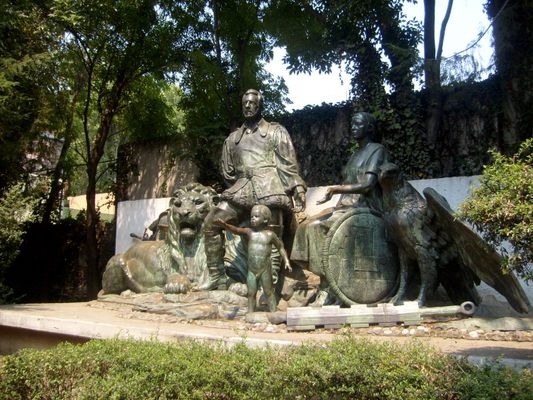
Sitting to the right is an indigenous woman clothed in the cotton blouse or "Huipil" and flowing "cueitl" dress worn in Mexico from the time of the Prehispanics to the present day. Propped up against this lady's side is a large feather-embroidered war shield, its serpentine patterns suggesting the Aztec warrior class. The Aztec symbology is corroborated by the large golden eagle which perches with its talons upon a fallen obsidian-bladed war mace or "macuahuitl" nearby.
On the left of the scene stands a broad-shouldered man dressed in the Southern European attire of the 16th century: a long-sleeved "camisa" shirt, jerkin, breeches and large leather riding boots. Reclining nearby is a gigantic male lion, its mane seemingly flowing in the wind and one of its paws stretched out menacingly. Behind this animal can be seen a pile of military accessories including a rapier sword known as an "espada ropera" in Spain and the steel Morion helmet typical of the conquistadors.
But the most haunting figure is undoubtedly that of a wide-eyed male child who displays the facial features of both parents. The child stands in the foreground and lifts one of his open-palmed hands towards the viewer as if beckoning them to acknowledge the scene. Look up at the other statues and you will notice that both the man and woman seem to be ushering the child with their hands forward for the scrutiny of the observer.
The statue once stood in the centre of Coyoacan close to where the house that was built and inhabited by the conquistador Cortes stands to this day. However, due to protests and threats of vandalism, it was quietly moved by the city government to its current location.
Community Contributors

Added By
Published
June 19, 2026