About
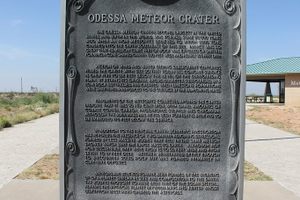
Along with the more famous Barringer Meteor Crater in Arizona, the Odessa Meteor Crater is remarkable in that it is one of the few impact structures that is actually still partially visible from the surface. This is as opposed to most larger craters, which have long since eroded and are only detectable through disturbed rock. Unlike the Barringer Crater, the Odessa Crater has been partially filled in by silt in the 63,000 years since its formation. That fact has left it only 15 ft deep today, as opposed to 100 ft when it first formed.
This crater was first discovered by the son of a rancher in 1892. At first, it was believed to be the remnant of a blowout hole formed by an eruption of gas. It was not until the 1920s that the site's true nature was uncovered, when geologists identified rocks from it as meteorites. It is now known that the crater is one of a number of impact sites in the region formed from the breakup of a single meteor, the rest of which are now completely filled. Those include two smaller sites immediately adjacent to the Odessa Meteor Crater.
Community Contributors
Added By
Published
August 7, 2026