About
During World War Two, several Italian prisoner-of-war (POW) camps were founded near Wells, Somerset. The British government had built around 1,500 camps to house Italian and German prisoners of war, many of whom had been captured in the Middle East and elsewhere. Towards the end of the war, POWs were allowed to work on local farms. Serving as a vital source of labour, particularly in agriculture, some were selected to live at the farms or estates and many consequently became close to the local population.
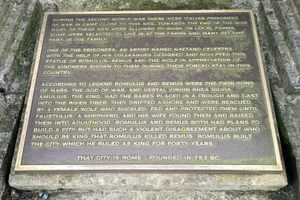
In the 1940s, one such former Italian POW, Gaétano Claudio Celestra, commonly known as Gaetano Celestra, worked for Philip Robert Wellstood White at the Beechbarrow estate. Celestra had worked as a builder and stonemason in Tunis before the war. In the summer of 1946, Wellstood White tasked Celestra with repairing a stone wall that ran along the main Bristol to Wells road (now forming part of the A39 road). A stray German bomb from the Bristol Blitz had created a crater in the field behind it. In the span of three months, Celestra erected a neoclassical sculpture of Romulus and Remus in gratitude to Wellstood White as well as the local people whom he had grown fond of during the Second World War.
Celestra’s statue of Rome’s legendary birth now stands along the A39. Although it may be easily missed by unassuming passersby, the work has been featured in festivals and has found a place in various exhibitions as well as in the media. In its admiration, the local community has been a financial source for its repairs throughout the years. The statue serves as a testament to the many Italian POWs who bonded with the local community following their capture.
Community Contributors

Added By
Published
June 19, 2026