About
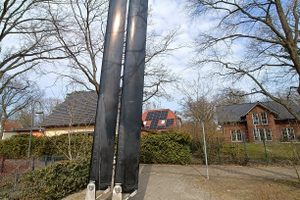
If you leave Berlin via the AVUS and pass the former border checkpoint Dreilinden, you can catch a glimpse of the object for only a brief moment—only those who know it is still there will notice it. On the left, directly at the city limits and half hidden by a barrier meant to shield the residents of Kleinmachnow from the highway’s noise, stands a strange special-purpose vehicle on a pedestal, painted pink. It is a silent and now almost forgotten witness of the Cold War.
In the past, before the fall of the Berlin Wall in 1989, as soon as you had endured the elaborate and time-consuming transit controls by the GDR border troops, you were immediately reminded of who was in charge in the GDR by a Soviet-made tank placed on a pedestal along the transit route. The gun barrel of the Stalin tank, type IS2, was strictly aimed at West Berlin—a reminder of the Red Army’s victory, a demonstration of military strength and the superiority of socialist ideology, as well as a deliberate threat and provocation.
The political leadership of the GDR claimed that this tank was among the first to reach Berlin in 1945 and thus ended World War II. As early as 1945, a monument was erected in honor of the fallen soldiers of General Leljuschenko’s tank army on Potsdamer Chaussee, the former Reichsstraße 1 between Aachen and Königsberg and in the American Sector of West Berlin. Due to protests and acts of vandalism by West Berliners during the Berlin Blockade 1948 and East Berlin uprising on 17.6.1953, the tank monument was relocated twice and finally, in 1969, placed in a prominent position on the left side of the outbound highway on GDR territory.
On November 9, 1989, everything changed—the Wall fell. As part of the Two Plus Four Agreement, the Soviet Army dismantled the tank on December 20, 1990, leaving only the pedestal behind.
In 1992, the artist and sculptor Eckardt Haisch (born 1941) placed a pink-painted Soviet-made snow loader, type S-4M, on the pedestal as a reminder of the peaceful revolution of 1989. Choosing the snow loader might be a funny reference to political tawing after the long, frozen conflict between East and West. The installation is now a protected monument.
In the early 1990s, with the fall of the Iron Curtain, militaristic symbols of Soviet power were also ironically reinterpreted and altered in other places. For example, after the withdrawal of the Red Army, a student in Prague painted a tank pink in the city center.
It is tragic that today, once again, there is rearmament and saber-rattling. What we need again today, are pink tanks that shoot only marshmallows.
Know Before You Go
It's a bit tricky to get to the tank monument. Look for the new waterworks Kleinmachnow at Rudolf-Breitscheid-Strasse, for there it a short stroll.
Community Contributors

Added By
Published
November 24, 2025