Places Foods Stories Newsletters
Loading...
Loading...
Loading...

No search results found for
“”

Make sure words are spelled correctly.

Try searching for a travel destination.

Places near me Random place

Popular Destinations

  • Paris
  • London
  • New York
  • Berlin
  • Rome
  • Los Angeles
Places Foods Stories Newsletters
Sign In Join
Places near me Random place
All Belgium Liège Tombe de la Famille Nagelmackers

Tombe de la Famille Nagelmackers

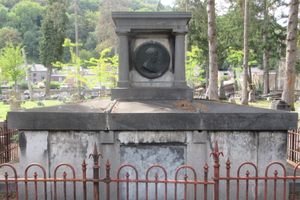
Tucked away in an unassuming cemetery lies the grave of Georges Nagelmackers, the founder of the Compagnie des wagons-lits (and thus, of the Orient Express).

Liège, Belgium

D duaner profile photo
Added By
duaner
Email
Been Here
Want to go
Added to list
CAPTION
The front view of the grave. Georges Nagelmackers’s epitaph is at the bottom left.   duaner / Atlas Obscura User
Georges Nagelmackers’s epitaph.   duaner / Atlas Obscura User
Georges Nagelmackers photographed by Nadar.   Nadar
Entrance of the Cimetière de la Diguette (with the grave visible through the door open).   duaner / Atlas Obscura User
  duaner / Atlas Obscura User
Overview of the cemetery.   duaner / Atlas Obscura User
Been Here
Want to go
Added to list

About

Angleur is a neighbourhood in the south of Liège. It is a one-hour-and-15-minute drive west of Brussels. The area itself is not particularly interesting; it is a residential neighbourhood located between Sart-Tilman Hill and the railway lines in the Ourthe Valley. However, visitors may be surprised to discover two castles amongst the houses: Château Péralta and Château Nagelmackers. The latter was purchased in the 19th century by the renowned Belgian banking family Nagelmackers. They also donated a plot of land in 1864 to create the town’s new cemetery, the Diguette Cemetery. It is therefore no surprise to find the family grave there.

The engineer and industrialist Georges Nagelmackers is among the family members buried there. He founded the Compagnie Internationale des Wagons-Lits and the original Orient Express. However, achieving this success was far from plain sailing. In fact, things got off to a rocky start: in 1867, his father sent him to the United States to hide away after he expressed his desire to marry his cousin. During his time there, he became interested in Pullman's night trains, and to develop the idea further, he also gathered feedback from passengers with a view to creating an improved version. He returned to Belgium convinced he had a brilliant idea. However, as soon as he returned, he was put in charge of the family's blast furnaces and mine. While working there, he developed his project and, in April 1870, published an explanatory brochure in which the term 'sleeper carriages' ("wagon-lit") appeared for the first time. Unfortunately, the Franco-Prussian War broke out in July 1870, dashing any hopes of bringing the project to fruition. Furthermore, his family were hostile to the project and cut him off financially.

However, Georges Nagelmackers did not allow himself to be discouraged. Thanks to the support of King Leopold II of Belgium, he managed to run the first sleeper carriage he had built between Paris and Vienna in November 1872. This inaugural journey was a success. However, after several advances, financial difficulties began to mount up once again.

While he was in London looking for funding, he had a fateful encounter with the American Colonel William D'Alton Mann. Mann had filed a patent for a 'sleeping carriage' that differed from the Pullman design, but this too had failed to catch on. The two men joined forces and founded the 'Mann’s Sleeping Carriage Company' on 4 January 1873. They invented a carriage whose compartments opened onto a side corridor, providing access to toilets at the end of the carriage — a design still used in sleeper carriages today. Mann persuaded the Prince of Wales — the future King George V — to travel to his brother's wedding in Saint Petersburg in one of these carriages. This publicity ensured the company's initial success.

On 4 December 1876, the two partners established the International Sleeping Car and European Express Company. As King Leopold II had contributed financially to this project, the two lions that flank the Belgian national coat of arms were added to the company's logo.

1883 was a turning point for the company. Mann returned to the United States and sold his shares to King Leopold II. Meanwhile, Georges Nagelmackers extended the Paris–Vienna line as far as Constantinople (which would not take the name 'Istanbul' until 1930). He named this new route the 'Orient Express' – and so began the legend.

Nagelmackers died on 10 July 1905 at his château in Villepreux, near Versailles, France. Following the funeral, his body was taken back to Belgium and buried in the family tomb at Diguette Cemetery in Angleur. His name has now been all but forgotten. Few people know that this grand tomb in a small, unassuming cemetery is the final resting place of the man who created the legendary Orient Express.

Places

Discover your next amazing Atlas Place.

Get more unusual and extraordinary places each week with the Atlas Obscura Places newsletter.

Your newsletter subscriptions with us are subject to Atlas Obscura's Privacy Policy and Terms of Use.

Know Before You Go

The Diguette Cemetery is located at the end of Rue Devant l’Aîte in Angleur. The Nagelmackers family grave can be found in the first aisle on the left as the cemetery is entered.

Community Contributors

D duaner profile photo

Added By

duaner

Published

November 4, 2026

Edit this listing

Make an Edit
Add Photos
Sources
  • https://inventairepatrimoine.wallonie.be/fr/inventaire-regional-du-patrimoine/fiche/62063-INV-2498-01
  • https://fr.wikipedia.org/wiki/Georges_Nagelmackers

Related Tags

Railroads Trains Graves
Tombe de la Famille Nagelmackers
44 Devant l'Aîte
Liège, 4031
Belgium
50.609334, 5.60395
Get Directions

Nearby Places

Fort de la Chartreuse

Liège, Belgium

miles away

Tour Cybernétique (Cybernetic Tower)

Liège, Belgium

miles away

Cointe Observatory

Liège, Belgium

miles away

Explore the Destination Guide

Photo of Liège

Liège

Belgium

Places 9

Nearby Places

Fort de la Chartreuse

Liège, Belgium

miles away

Tour Cybernétique (Cybernetic Tower)

Liège, Belgium

miles away

Cointe Observatory

Liège, Belgium

miles away

Explore the Destination Guide

Photo of Liège

Liège

Belgium

Places 9

Related Places

  • The depot’s restoration was part of the creation of a nationally recognized 55-block Historic District.

    Fernandina Beach, Florida

    Amelia Island Welcome Center

    An illuminating look at Fernandina Beach’s industrial past at a one-time train depot.

    Sponsored By Amelia Island, Florida
  • Colorado Train Museum

    Golden, Colorado

    Colorado Train Museum

    More than 100 steam and diesel locomotives bring Colorado’s rail heritage to life.

  • Gettysburg Railway operates restored 1950s-era railcars on journeys throughout Adams County.

    Gettysburg, Pennsylvania

    Gettysburg Railway

    Travel back in time aboard a restored 1950s-era railcar.

  • Collection of trains on display in the former rail yard.

    Haapsalu, Estonia

    Railway and Communications Museum

    Explore 150 years of Estonian rail history in a terminal once built for Tsar Nicholas II.

  • Old locomotive a blue, angry face awaits on the tracks with the railway station in the background

    Yerevan, Armenia

    Children's Railway

    These ruins of a Soviet children's railway station have a haunted atmosphere.

  • The older engine.

    Dalat, Vietnam

    Dalat Railway Station

    This 1930s train station still gets hundreds of visitors a day despite the fact it only makes a 7-kilometer journey.

  • Vaser Valley Forestry Railway

    Vișeu de Sus, Romania

    Vaser Valley Forestry Railway

    The last active narrow-gauge forest railway in Europe.

  • Interior of the historic roundhouse.

    Baltimore, Maryland

    The B&O Railroad Museum

    At the birthplace of American railroading, a world-class collection of historic trains.

Aerial image of Vietnam, displaying the picturesque rice terraces, characterized by their layered, verdant fields.
Atlas Obscura Membership

Become an Atlas Obscura Member


Join our community of curious explorers.

Become a Member

Get Our Email Newsletter

Follow Us

Facebook YouTube TikTok Instagram Pinterest RSS Feed

Get the app

Download the App
Download on the Apple App Store Get it on Google Play
  • All Places
  • Latest Places
  • Most Popular
  • Places to Eat
  • Random
  • Nearby
  • Add a Place
  • Stories
  • Food & Drink
  • Itineraries
  • Lists
  • Video
  • Podcast
  • Newsletters
  • All Trips
  • Membership
  • Feedback & Ideas
  • Community Guidelines
  • Product Blog
  • Unique Gifts
  • Work With Us
  • About
  • FAQ
  • Advertise With Us
  • Advertising Guidelines
  • Privacy Policy
  • Cookie Policy
  • Terms of Use
Atlas Obscura

© 2026 Atlas Obscura. All Rights Reserved.

Keep Reading

Create a free Atlas Obscura account to unlock the rest of this story and explore more extraordinary places.
Create a Free Account or Log In