About
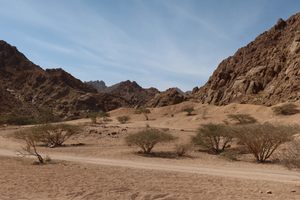
Located in the Harrat Khaybar lava field in Saudi Arabia, Umm Jirsan is a 1500-meter-long lava tube system, with tunnels that are as much as 12 meters tall and 45 meters wide, and is estimated to have been formed nearly 3 million years ago.
Lava tubes form when cooling rivers of lava leave behind large openings in the earth's crust. It had previously been suspected that early humans might have used these caves as places to cool off during migration in the arid Arabian Peninsula, but Umm Jirsan has provided archeologists with the first definitive evidence that human activity took place inside these tunnels.
When scientists at the Max Planck Institute explored this cave in 2009, they were fascinated by the hundreds of thousands of bones in the 1.5 km long cave. There were remains of up to 14 different animals, including human skullcaps. A more recent study, published in 2024, has revealed the discovery of human artifacts, like cloth pieces, wood carvings, and stone tools, in the cave system. Researchers even uncovered panels of engraved rock art dating back to around 4500 BCE. It is estimated that humans began using the Umm Jirsan tunnels over 7,000 years ago.
Khaybar is an oasis town located 153 kilometers north of Medina, from which visitors can set off for the Harrat Khaybar lava field and Umm Jirsan lava tubes. Access to the caves includes driving over rough terrain - Umm Jirsan is 20+ kilometers from the main road and 3-4 kilometers along a dirt road in the desert. Guided tours are available and recommended.
Know Before You Go
Joining a guided tour is recommended.
Community Contributors

Added By
Published
October 15, 2025
Sources
- https://www.cnn.com/2024/05/08/world/lava-tube-stone-age-arabia-scn
- https://www.smithsonianmag.com/smart-news/extensive-desert-lava-tubes-sheltered-humans-for-7000-years-archaeologists-find-180984189/
- https://www.arabnews.com/node/2019491/saudi-arabia
- https://journals.plos.org/plosone/article?id=10.1371/journal.pone.0299292