About
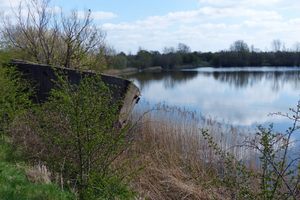
On the bank at the northern end of this fishing lake lies a large concrete barge, an important historic artefact from WW2. This unpowered barge (or lighter), with its wide beam and a small quantity of steel reinforcement, is similar to the wrecked concrete vessel built in WW1, known as MV Creteblock ( https://www.atlasobscura.com/places/wreck-of-the-mv-creteblock) which is also featured on Atlas Obscura. This one was constructed in Hull and used in Hull docks during WW2. Bombing had destroyed the dock warehouses so, as well as being used for transportation, such unpowered barges were used as temporary storage for various cargoes.
During WW2, with steel in short supply, concrete was used for the building of boats and barges (reverting to a technology that had been used even before WW1). This barge at Winthorpe is the only visible example in the UK of the 35 concrete barges that were constructed by shipbuilders Tarran Industries in Hull during 1944 and 1945. Because of their immense size, being very heavy and broad, the lighters required deep water, wide-arched and high enough bridges to move their cargo and they could not pass the full length of the Trent.
Similar technology was used to build the Mulberry Harbour for D-Day (https://www.atlasobscura.com/places/mulberry-harbour-at-arromanches). Concrete barges fitted with kitchens were also used as mobile canteens for troops arriving in Normandy in the days after the landings. The US Navy even had refrigerated concrete barges (which they used as mobile ice cream factories in the Pacific theatre).
After the Second World War this Tarran concrete barge was moved upriver but, unable to pass under Trent Bridge at Newark, it was moored in the centre of Winthorpe Lake (a redundant gravel pit) until a decision could be made about its use. During a storm in the 1950s the barge broke its anchorage and was blown onto the east side of the lake where it now can still be found.
As a safety feature a hole was made in the barge so that it could not be refloated by the local kids. Its wooden deck has now rotted away and the vessel has trees growing from its hold. In fact, trees and shrubs are encroaching quite a lot from the land side and best views of the barge are across the water from the opposite bank. It would probably be possible to climb into the hold once one had penetrated the undergrowth. The metal brackets along the side which would facilitate this once held baulks of timber as protection for the concrete.
The concrete barge is not the only wrecked barge at the lake. The channel, on the south side of the lake where vessels entered the lake, was blocked up by sinking a redundant iron barge and filling it with stone. At least one other iron barge is present on the periphery of the lake and there are rumours of others at the bottom of the lake.
A new, much narrower, channel was constructed on the north-west side of the lake. This channel now permits water to pass through from the River Trent in times of high water levels, thus helping to reduce flooding further downstream.
Although the barge here is the only one of the Tarran type still visible in the UK, a fleet of 16 concrete barges of a slightly different design can be seen shoring up the flood defences at Rainham Marshes on the River Thames.
Know Before You Go
The lake is not easy to find, and using the postcode you can find for the angling club for a sat-nav location will not help. Find the Lord Nelson pub in Wilthorpe village and then head along Holme Lane until just after the railway level crossing where you can usually park on the left. Go through the metal gate and ascend to the top of the River Trent flood defence bank. Follow the path along the bank in a northerly direction (along the Trent Valley Way footpath). When the River Trent bends away from the flood bank, carry on along the top of the bank. When you reach a metal gate, pass through it and start looking for a path down the bank to the left to cross a wooden stile to enter the environs of the lake. You will need to circle the lake in an anti-clockwise direction; you will soon find the concrete barge. Take note that full vehicle access from Holme Lane is only permitted for angling club members and the gate is locked.
Apart from the historic value of this site, the wildlife is good, particularly the birds, and it is worth a visit in its own right.
Community Contributors

Added By
Published
June 19, 2026