Here Lies Charlotte Temple, the Woman Who Never Existed
Why have so many people made the pilgrimage to a fictional character’s grave?

Listen and subscribe on Apple Podcasts, Spotify, and all major podcast apps.
Dylan Thuras: Hi, Allegra. Hello. How are you doing?
Allegra Rosenberg: I’m good, Dylan. How are you?
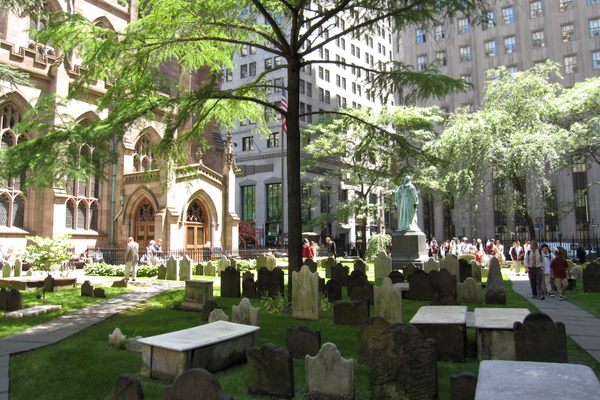
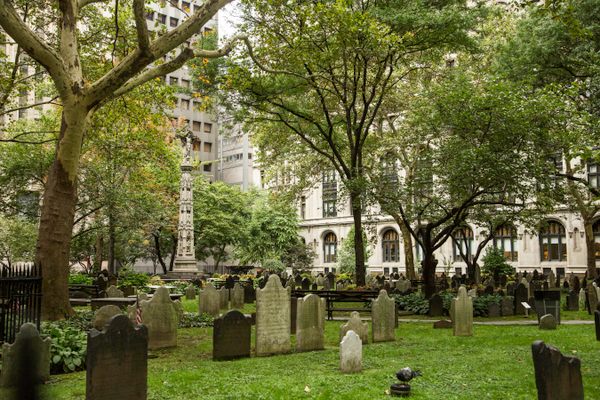
Dylan: I am good. So, I’m going to ask you some questions and have you help paint a picture of this particular place we’re visiting today. I’m a tourist in New York City in the 1800s. So, you know, like, top hat, dressed fancy. I don’t know. And I’m there to visit a very specific graveyard called Trinity Churchyard in Lower Manhattan. It’s a really famous place already back then. It has a bunch of very famous people buried there. It’s got Alexander Hamilton. But actually, I look and I see that all these people are gathered around this one specific grave. What is going on over there? What is this scene that I’m looking at?
Allegra: Well, there is a grave that’s the only one in the churchyard that’s marked out with flowers. And that’s so people can easily find it because the caretakers are sick of people coming up to ask where this specific grave is. The people that are coming up to this grave, they’re men, they’re women, maybe even newly married couples hand in hand. And they’re leaving more flowers. They’re leaving cards. They’re even crying at this grave.
Dylan: So obviously, this is someone in this big deal grave site. Whose grave is this?
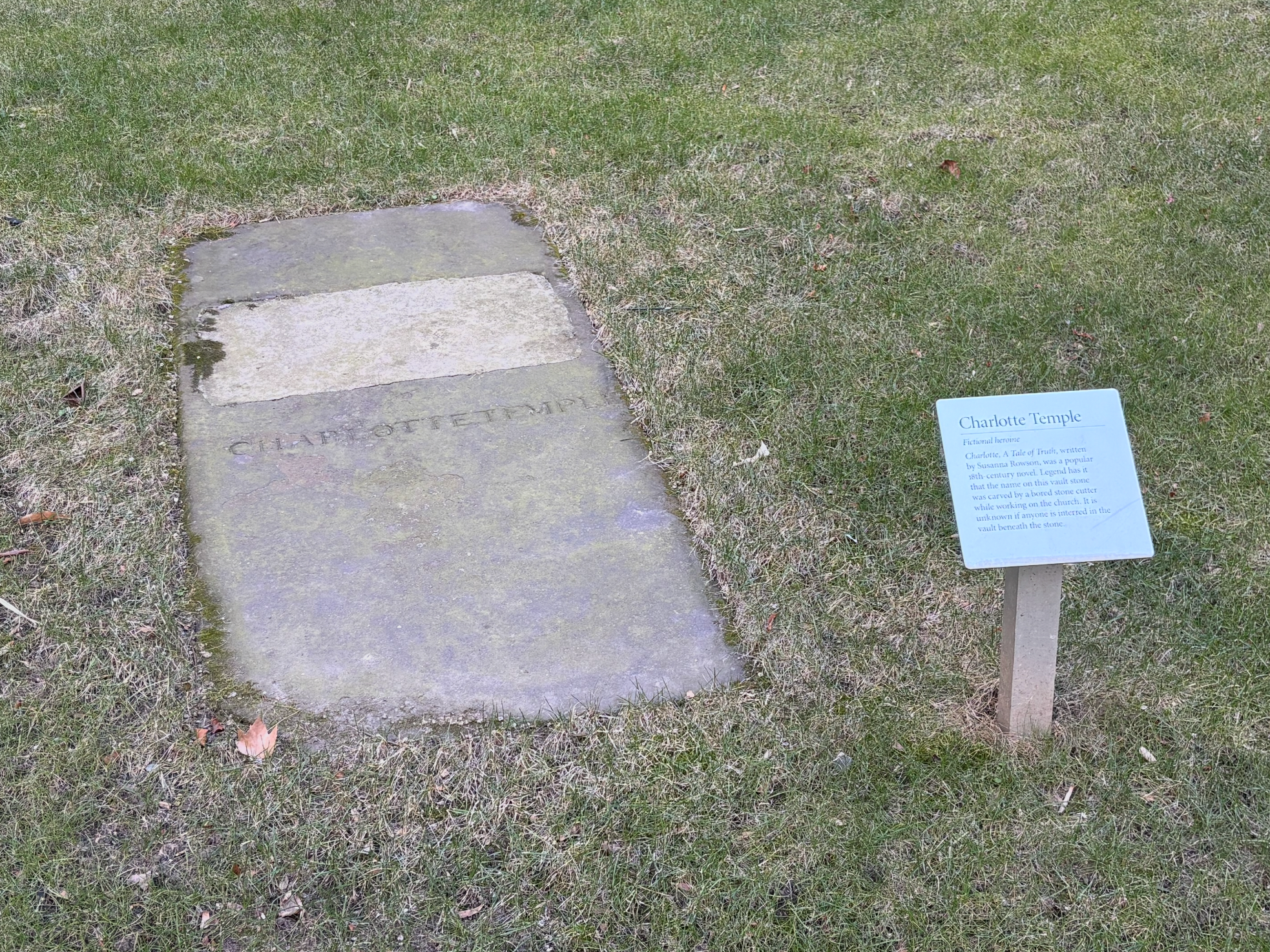
Allegra: Well, so here’s the thing. The gravestone says Charlotte Temple. But Charlotte Temple is a fictional character. She never existed. And there’s nobody actually buried in the grave.
I’m Dylan Thuras, and this is Atlas Obscura, a celebration of the world’s strange, incredible, and wondrous places. Today, we visit a strange gravestone inside a very famous cemetery. And we learn what this particular gravestone with no one under it, and in fact, a name of a person who never even existed, says about fandom, about pop culture, and about the strange nature of human beings.
This is an edited transcript of the Atlas Obscura Podcast: a celebration of the world’s strange, incredible, and wondrous places. Find the show on Apple Podcasts, Spotify, and all major podcast apps.
Dylan: So Allegra, in addition to being Atlas Obscura’s community editor, you are writing a book about the history of fandom. But you’re looking deep into the roots of fandom. You’re going like way, this is way before Taylor Swift. This is kind of into the old-timey fandom world. So what are some examples of early origins of fandom culture?
Allegra: Well, yeah, that’s the thing. It goes back further than most people think. Lord Byron had a fleet of obsessed fangirls writing him letters. Charles Dickens, he had people lining up for hours to watch his readings. There was public outcry when Arthur Conan Doyle killed off Sherlock Holmes. It’s a whole thing.
Dylan: Yeah, it’s interesting because in all of these, you see things that feel really modern, right? Even the beat, like getting angry at an author for betraying the world that they’ve built, which is, you know, is a strange thing, but it also has really deep roots. So how did you get into this? How did you develop this interest in fandom?
Allegra: Well, I have always been a fangirl, and I’ve always been a nerd. So when I get into something new, you know, that has a long history, like Doctor Who or the Beatles, I’m so interested in going back and looking at who were sort of the first fans that liked this thing, and in what ways were they like me, and in what ways weren’t they like me? And that has continued as I’ve gotten deeper and deeper into history, just led me down more and more interesting paths where I keep finding all of these incredibly fascinating fandoms from earlier and earlier in history that just keep resonating so deeply with my own experiences as a fan. So my research is all about bringing those stories to light, and Charlotte Temple’s grave is such a fantastic example because it seems like something right out of modern day fandom.
Dylan: Let’s return to the Trinity Churchyard and this strange gravestone. Tell us, why are all these people here to celebrate this fictional woman? Who was the mysterious Charlotte Temple?
Allegra: Charlotte Temple, she was the title character in a 1971 novel by Susanna Rowson called Charlotte, A Tale of Truth. It was also published under the name Charlotte Temple in some places.
Dylan: You know, unfortunately, this is one fandom that fell off over time because I am completely unfamiliar with this story. What’s the kind of basic overview of the plot?
Allegra: Yeah, I mean, I had never heard of it either. But basically, the story is that Charlotte is this naive teenage British girl who gets seduced by the villainous rake, Lord Montraville. And he takes her to America and then abandons her when he goes off to marry another woman, because he hadn’t married Charlotte. He marries another woman and then goes off to fight in the Revolutionary War. And so after being abandoned, she dies penniless in wintry New York City after giving birth to an illegitimate child. And the book ends with her father arriving too late to save her from her fate.
Dylan: This is a bummer of a story, but it seems like it must have been also incredibly popular, like a real tearjerker, a kind of ultimate, you know, Lifetime movie vibe of books.
Allegra: Absolutely. I mean, it’s the exact same kind of thing that’s just playing on people’s heartstrings. It was so popular. I mean, it was the best selling novel in America for half a century, for decades, right up until the release of Uncle Tom’s Cabin. So that’s a long time.
Dylan: What? That’s crazy. It’s crazy I’ve never heard of this book. Like, it’s wild that it was bestseller for decades. What was it about it that it really hit people? Obviously, it’s got these huge sort of pulling on your heartstrings, these emotional resonances. But was there something else that made it kind of really work for people of the time?
Allegra: Yeah, like one theory, and I find this so interesting, is that the story appealed to all different kinds of Americans because it was the story about this young, vulnerable woman being faced with difficult circumstances in New York after betrayal by a powerful Englishman. And that was kind of parallel to the story of America, which was such a new country at the time. And, you know, the book was published first in England, and it did okay. But it wasn’t until it made it to the United States that it really took off. So, you know, in Charlotte Temple, American readers, they saw not only like these sort of this personal moral and like, you know, this sort of like, you know, relatable, tear-jerking sadness, but actually in a larger sense, kind of like their country’s struggle for independence in this post-revolutionary era. And so as a result, Charlotte herself kind of became a bit of a folk hero.
Dylan: Yeah, I hadn’t thought about that. But like the English cad is like the perfect foil, like he’s like the perfect villain for an American audience. And yeah, I mean, America at this time is still an emerging nation. It’s maybe not always the easiest place to live. So maybe, yeah, people are seeing themselves in this woman’s desperate struggles to survive.
Allegra: Yeah.
Dylan: Maybe this is a silly question, but like, are a lot of people reading these kinds of novels at the time? Has literature become a major form of public entertainment at this point?
Allegra: Absolutely. So the 18th century saw the rise of the novel. And America was a particularly literate country. So novels were the hot thing, you know, in England, but also across the pond. And throughout the 18th century, there were these books that were just total smash hits. Samuel Richardson’s Pamela, Henry Fielding’s Tom Jones. These are all books about the life story of one main character and all their trials and tribulations, which is definitely the formula that Charlotte Temple fits in.
And you had women writers finding success as novelists. You had Maria Edgeworth. And then at the very end of the century, she inspired Jane Austen to write her own books. But the thing is that reading novels in particular was kind of scandalous. I mean, like not scandalous, it’s just trashy. I guess it was the equivalent of like, I guess watching reality TV today, like super, super popular, but people might look down on you for doing it, especially if you’re a woman.
This idea of being enraptured by fiction was, you know, not given a lot of credit by intellectuals, right? There was this thought that everyday readers, especially women and young people, they didn’t have the discernment to tell what was real and what wasn’t, and that novels were basically big lies.
So the moral of a novel was so important because it had to justify telling what was essentially a big lie that people would believe. The author had to be imparting this really serious message. So in Charlotte Temple, it’s all about the dangers facing young women, the consequences of succumbing to temptation.
Dylan: So people fall in love with this book. They fall in love with Charlotte. They, you know, come to visit Charlotte’s gravestone. What is going on here? Like there’s no—this is not a gravestone above someone else. It’s not a gravestone of someone else named Charlotte Temple. Like, what did they think they were doing when they came to visit this gravestone?
Allegra: Well, that’s the thing is that plenty of people did think she was real, especially because the author always insisted that Charlotte was based on a real person. So a lot of the, you know, sort of articles and the writing around the book at the time was people trying to figure out, like, who is she based on? I mean, that’s something that people still do today is like, oh, who is this character in the novel based on?
But after over a century of curiosity, Trinity Church actually investigated the grave, you know, this was in the last 20 years, and they pried up the top of the slab to see if there was a burial vault of any kind underneath. They even stuck a camera down in there and just, no, it’s just dirt. There is nobody buried down there. Maybe there was some inspiration for the character of Charlotte Temple from somebody real, but whoever that was, they’re certainly not in the grave.
Dylan: It’s very savvy to be like, “Oh, this is a real person, but I’m not going to tell you who it is.”
Allegra: It’s a marketing strategy. It gets people talking.
Dylan: Totally. And they can also project it sort of onto the people they know and onto themselves. It’s like, “no, no, it’s real. It’s true.” Okay, so we’ve established that there’s nothing under there. It’s a bunch of dirt. How did this gravestone get there? This is a very sought after place to be buried. It is in the center of what was Manhattan even at the time. This is kind of pretty centrally located. It’s an esteemed cemetery. How did this strange fictional gravestone get in there?
Allegra: So there is an official sort of line, I guess it’s an official theory that is told by the church guides today, because of course there’s no proof, but most likely the gravestone was the work of a stonecutter who was involved in the reconstruction of the church. This was in the 1840s. So it’s already, you know, 40, 50 years after the book was published and it’s still remembered so well that a stonecutter, a fan of the book was like, “Wouldn’t it be cool if this was here?”
Dylan: Interesting. It sounds like there’s another theory. You’re like, “That’s the official theory.” What’s the unofficial theory?
Allegra: I kind of like this one more. I don’t know if it’s any likelier, but it’s a little more interesting. So in the 1840s, the era of tourism was beginning, right? And regular people, thanks to the trains basically, and the affordability of travel, they’re starting to go places and guidebooks to places like New York City are beginning to be published. And Charlotte Temple’s grave might’ve been the original kind of tourist trap.
You know, at the time there were some really, really popular theatrical adaptations of Charlotte Temple’s story being put on by impresarios like P.T. Barnum. And so some suspect that it was P.T. Barnum himself who paid the Trinity stonecutter to carve the slab so that he could then make another buck giving tours. I think that’s a great story, although there’s no proof.
Dylan: I fully subscribe to this theory. It is much funnier and also fully a thing that P.T. Barnum would do. He was such a crafty little sneak. I love this theory. It also kind of jives with what we’re talking about, which is, it feels distinctly modern. It’s like the version of the ice cream museum or something where it’s like a thing made specifically so tourists will come and be like, oh, we got to do this thing. It’s riding on the coattails of all this like accumulated cultural knowledge. I really like that.
Allegra: And just like the ice cream museum, they might’ve gotten there and went, “So that’s it?”
Dylan: Yeah. “This sucks. There’s a long line and there’s nothing to do here.” Okay. So what is the state of the gravestone today? Is it still there? Can you visit it? Do people still come and see it?
Allegra: Well, it’s definitely still there. And when I visited, I was told by the person from Trinity Church that professors from local universities will often bring their students there to explain the phenomenon of Charlotte Temple and sort of, you know, what I just talked about, what she represents about American literature, novel reading culture. But yeah, the book, you know, you’d never heard of it. It’s really not remembered at all. So people are not coming there for Charlotte’s sake and as a sort of fandom pilgrimage. Now it’s sort of a monument to, you know, literary history and the fascinating sort of forgotten tales of America’s reading culture.
Dylan: Yeah, it is really fascinating because it represents, again, these sort of things that maybe we think of as particularly modern currents, this kind of fandom where the line between real and unreal really sort of starts to blur and the fans want it to blur in a certain way. How unique is this? Are there other fictional grave sites that have become similar cultural phenomenons?
Allegra: Well, yeah, I mean, like, so since Charlotte Temple’s grave, there have been a bunch. I think probably the one that happened around the same time was when Little Nell died, the Charles Dickens character. There was a villager in the village that she was purported to be buried in in the book who similarly constructed a grave and I believe charged people to come see it. And then a few decades after that, the Reichenbach Falls in Switzerland, where Sherlock Holmes, you know, “died,” immediately became a spot for people to sort of travel to because of its place in literature.
My personal favorite, because I’m a big Doctor Who fan, is that in Cardiff, Wales, there’s a shrine to Ianto Jones from the Doctor Who spin-off Torchwood. So he died in, you know, in the show in this one place. And literally since 2009, there has been a quite large shrine to him in a central part of the city that is absolutely still a pilgrimage point for fans of that franchise.
Dylan: You know, there’s something beautiful about this kind of fandom. I mean, there’s something so lovely about the idea that, like, across hundreds of years of history, this notion of, like, reading something or experiencing a story strikes you so deeply that you kind of, you know, want to actually, like, make a pilgrimage somewhere to combine your life with this imagined world, this imagined life. I mean, you are an expert on fandom. You are a fan of many different fandoms, Doctor Who obviously among them. What do you make of all this? How do you think about this?
Allegra: Well, I think the most important thing is in the fact that we use the word pilgrimage to describe it, right? And that’s a much, much older word than fandom is. And it describes something, you know, sort of religious and devotional. And it connects us with people throughout history that went somewhere, you know, far from their home in order to feel connected to something bigger than themselves, something that they were passionate about.
So I think that is a really, I think that’s a really interesting part of it. And I think literary tourism has been a thing for hundreds of years. People were rocking up to the houses that, you know, Rousseau stayed in and the birthplace of Dante. And it’s always been a big deal to sort of get close to the thing that you love in any way that you can. And to either take something with you, whether it’s a memory or a souvenir, or even sort of leave a mark, right? You know, leave a flower or a card or some graffiti.
Dylan: Yeah. Have you ever been to, have you ever made a pilgrimage to a fictional grave?
Allegra: Well, I went to the grave of John Irving in the Dean Cemetery in Edinburgh, Scotland. I mean, technically he’s a real person. He was a polar explorer who died on the Franklin expedition, but he’s also a character on the show that introduced me to that bit of history. It’s a show called The Terror. And that show means a lot to me. So it was definitely for me a pilgrimage in the way that visiting Charlotte Temple’s grave was to her fans. It was really cool to be there.
Dylan: Yeah. I also have not visited the grave of a fictional person, but I do think I will, when I’m in the city, I’m going to go see Charlotte Temple. And I would like, maybe I’ll read the book, try to read the book on, you know, my commutes back and forth.
Allegra: I would love to hear how it holds up.
Dylan: That was Allegra Rosenberg. She’s Atlas Obscura’s community editor, and you can read her piece about Charlotte Temple and a bunch of her other excellent pieces on the website. We will put links in the show notes and go see the grave of Charlotte Temple. The Trinity Churchyard is open to the public from 8:30 to 4. Wander in, take a look, you know, commune with the ghost of a fictional character. Go say hello.
Listen and subscribe on Apple Podcasts, Spotify, and all major podcast apps.
This episode was produced by Manolo Morales. Out podcast is a co-production of Atlas Obscura and Stitcher Studios. The people who make our show include Doug Baldinger, Kameel Stanley, Johanna Mayer, Manolo Morales, Amanda McGowan, Alexa Lim, Casey Holford, and Luz Fleming. Our theme music is by Sam Tyndall.



Follow us on Twitter to get the latest on the world's hidden wonders.
Like us on Facebook to get the latest on the world's hidden wonders.
Follow us on Twitter Like us on Facebook