The Museum of Playable Trash Bin Instruments
You too can play a coconut ukulele or 10-foot airplane fuel tank drums—no experience required.
Listen and subscribe on Apple Podcasts, Spotify, and all major podcast apps.
Dylan Thuras: I went to school in a small college in Vermont called Bennington, just about 600 and some people in the middle of the woods, at least when I was there. And because of this, there was not always a ton to do. So as a young, mischievous person, you were occasionally looking for, I don’t know, things to get into, little adventures to have on this small college campus.
I had heard a story. On the very top of the main campus dining hall, there was an attic, a locked third floor. But I had heard if you could get in there, there was something fantastical inside. And so one evening after everyone was gone and it was quiet, I went up and found a way into a room that had a little transom window open into that attic space. And I climbed on in.
I saw these crazy looking contraptions. I didn’t know what they were at first until I went over and tapped them or started pulling a string. I realized they were instruments. As it turns out, this was not a completely unique experience.
For years, students at Bennington had been whispering about this locked room, occasionally breaking in and getting a glimpse of these pretty magical creations. These strange objects were all created by a Bennington professor named Gunnar Schonbeck. And he expanded the very idea of what an instrument could be. He expanded it to include that we might all be instrument makers and that absolutely everyone is a musician.
I’m Dylan Thuras, and this is Atlas Obscura, a celebration of the world’s strange, incredible, and wondrous places. And today, we are going to join Gunnar Schonbeck’s orchestra.
This is an edited transcript of the Atlas Obscura Podcast: a celebration of the world’s strange, incredible, and wondrous places. Find the show on Apple Podcasts, Spotify, and all major podcast apps.

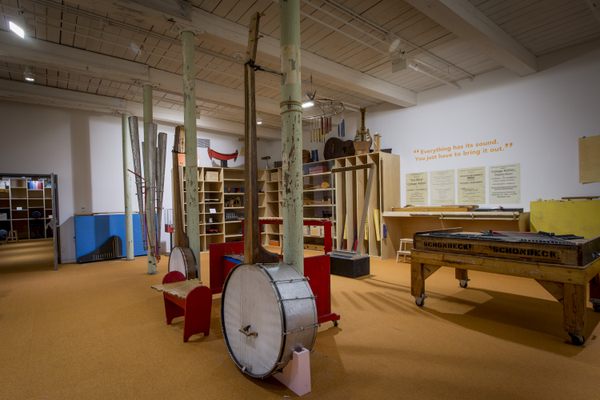
Dylan: So, you no longer have to break and enter to get a look at Gunnar Schonbeck’s one-of-a-kind musical instruments. Instead, you can head to the Massachusetts Museum of Contemporary Art, or MASS MoCA. And there, you can not only see all these instruments, but you can play them.
Mark Stewart: The nine-foot banjos are irresistible.
Dylan: This is Mark Stewart. He’s the curator of the exhibit of Gunnar’s instruments at the museum. And the room is filled with all of these crazy contraptions that look like they came out of someone’s dreams. There are these huge oversized drums made from airplane fuselages. There are racks of wheel hubs and scrap metal turned into these delicately hung chimes. There are ukuleles made from coconuts, and all brightly painted and visually delightful. And then, there’s the banjo.
Mark: Gunnar, he looked at a concert bass drum, big 36-incher, and said, “Well, that could be a banjo, too.” And boy, oh, boy, he delivered. Nine feet tall, strung with piano wire. My favorite way to play it is with the mallet, hitting the strings and the drum head itself. It makes a tremendous, wonderful sound.
Dylan: Mark takes a particular joy in playing with this collection. He is a musician himself. He makes his own found musical instruments, and he’s toured with Paul Simon for years as a guitarist and the musical director for the band.
His parents were musical as well. According to Mark, they had rather far-ranging musical interests, and he grew up playing and singing medieval Renaissance music with his family. I imagine something a little like The Partridge Family, but like with lutes and fussy frillied collars.
Mark: We couldn’t go on skiing vacations, but we could sing Schurz and, you know, Orlando di Lasso.
Dylan: Mark was exposed to this wide range of musical instruments because of his parents’ eclectic music tastes, and eventually he became a professional musician himself. He moved to New York City in the ’80s, and he started to hear stories from his musician friends about this wild instrument maker.
Mark: They were always wonderfully creative, open-minded folks, and then we’d be talking and, oh, of course, they went to Bennington. And most of them had had an interaction with this extraordinary fellow, Gunnar Schonbeck. And they would tell stories of these fantastical instruments and wonderful community events with music and dance and fellowship.
So I had heard these stories for years. He used to put ads in the paper, “Want to be in an orchestra concert? No experience required.” What a fantastic invitation.
Dylan: This was the first time Mark heard the name Gunnar Schonbeck. If you put Gunnar’s name into an internet search, you actually won’t find that much information. But over the course of his lifetime, Gunnar created thousands of musical instruments. He was born in Springfield, Massachusetts in 1917. His parents were originally from Sweden. His dad was a tailor. His mom was a baker.
And just like Mark, the Schonbecks were a musical family. Everyone played something. They would put together these impromptu orchestras in the living room. They played mandolins with the neighbors. Or maybe they’d sit down for an after-dinner jam session on recorders.

Music was family. It was a way of connecting with one another. Gunnar could play all sorts of musical instruments, but there was one that really called to him: the clarinet. By age 16, he played with the Boston Symphony Orchestra and taught clarinet at Smith College. He was building up his resume as a classical musician, playing with big orchestras around the country and studying with some of the preeminent clarinetists of the day.
But Gunnar started to question these rules around what counted as music and who was a musician. And when he was just 28 years old, he got a job at Bennington College teaching classes on acoustics and experimental orchestra. And he started to tinker with the idea of a musical instrument.
Mark: There are things all around us that make sound. We have things that are extraordinary, like the piano and the saxophone, that are incredibly versatile. There are things that do one thing perfectly. The cowbell is a great example. Just whacking that thing, it’s gonna do what a cowbell is gonna do. You can pick something up on the street, and if it makes a good sound, that’s a musical instrument.
Dylan: Gunnar turned his basement into his workshop and started putting together flower pots and fire extinguishers and airplane fuselages, anything he could find to create these different kinds of sounds.
Mark: And Gunnar, he had a great nose for sound. It had to be very simple, but it had to make a fantastic sound, had to make a sound that would delight the player and then ultimately delight the people who are listening to it.
Wondering, “What’s this gonna be? What’s this gonna do?” And then satisfying that curiosity. That’s fundamental. And then once that “ah” happens, then you want to see what can I do with this crazy sound, this hysterical sound, this beautiful sound, whatever it happens to be.
Dylan: Some of them are musical hybrids, like a Japanese violin strung with piano strings. Others are just pure imagination. And for instruments made out of junk, they feel like they might not make beautiful sounds, but somehow he was able to coax out this surprising range of tones from these trash bin instruments.
There isn’t really a right way to play any of these instruments. There’s no body of work around them. I mean, how do you play a piece of plywood? What’s the notation? That sense of discovery, of play, was key to Gunnar’s idea. If there’s no right way to play an instrument, anyone can play them.
And when you see these pieces, these contraptions, something almost instinctual kicks in. I certainly had that reaction looking at his incredible instruments that were stored in that Bennington attic. Mark took us on a little tour of Gunnar’s instruments. His personal favorite is best described as something that looks like a little colorful metal shrub.
Mark: It’s almost like a musical anvil. I think it’s an old scuba tank or some kind of fuel tank. And then festooned with these fantastic old pieces from a truck’s leaf springs. So these pieces of curved metal, all brightly colored, different colors. And I think that’s the one I went to first. And I grabbed two leather mallets, just started really whacking it, and it responded. Instruments, they love to be played.
Dylan: Then there are these towering 10-foot conga drums. They’re made out of old airplane fuel tanks. And they’re so big, you have to climb this little platform just to play them.
Mark: It’s a great spot to lead a jam because everyone can see you, you can see everyone.
Dylan: This communal joy and experience of shared music was at the heart of Gunnar’s philosophy. This feeling that he got playing with his family band in his living room growing up. He wanted to share that with everyone.
At Bennington, he would teach his students, many of them who were not musicians, how to build their own instruments, letting them explore and create without any rules. He made so many instruments with his students that he started storing them around in barns.
Each semester, he would invite students and the community to discover and play these instruments in a concert. He put ads out in the paper. Gunnar taught at Bennington for over five decades, and in that time, he invited hundreds, thousands of students and community members to join his orchestra. No experience required.
Mark: People tell themselves all the time that they’re not a musician. I hear it all the time. “I’m not a sound maker.” Gunnar wanted to show people who they already were. The understanding that music is for everyone. The understanding that we are all, as human beings, born with this wonderful birthright, which is to be sound makers.
Dylan: Gunnar died in 2017, and I was never able to take a class with him. We just barely overlapped when I was there and when he was still teaching there. But he left behind these barnfuls and attics of instruments. And they were, as I saw them up in the attic, just kind of there collecting dust.
But some of his students and his fans, they got to work—including Mark. He heard that these scrapyard instruments might be headed for the landfill, so he helped to arrange this exhibit at the museum. Not all of the instruments could be saved, but 200 of them were put on display. And put on display in a way that visitors can come and experience them with each other.
Mark: This is a community experience. Of course, that can be tiny and beautiful and magical, or it can be exuberant and chaotic and glorious. Let’s see what these things do when they can really rip. See what you do when you can really rip on this instrument, really get down. People just—they shake their heads and say, “What just happened?”
Dylan: If you’re ever in North Adams, Massachusetts, go visit the No Experience Required exhibit at MASS MoCA. The museum is open Wednesday to Monday. It is just a great place. Thank you to Mark Stewart and Gunnar’s daughter, Katy Schonbeck, for sharing their music and their stories with us.
Listen and subscribe on Apple Podcasts, Spotify, and all major podcast apps.
This episode was reported by Alexa Lim. Our podcast is a co-production of Atlas Obscura and Stitcher Studios. The production team includes Doug Baldinger, Kameel Stanley, Chris Naka, Gabby Gladney, Manolo Morales, Baudelaire Ceus. Our technical director is Casey Holford. This episode was mixed by Luz Fleming. And our theme and end credit music is by Sam Tyndall.
This story originally ran in 2023; it has been updated for 2025.


Follow us on Twitter to get the latest on the world's hidden wonders.
Like us on Facebook to get the latest on the world's hidden wonders.
Follow us on Twitter Like us on Facebook