The Tale of Hachiko, Japan’s Most Loyal Dog
Warning: this one’s a tear-jerker.

Listen and subscribe on Apple Podcasts, Spotify, and all major podcast apps.
Annie Eubank: It’s easy to get lost in Shibuya, practically a city in its own right. This district is the fashion heart of Tokyo, where you come to see and be seen, to shop and hang out. So if you’re meeting up with a friend, often you pick a specific place or a landmark.
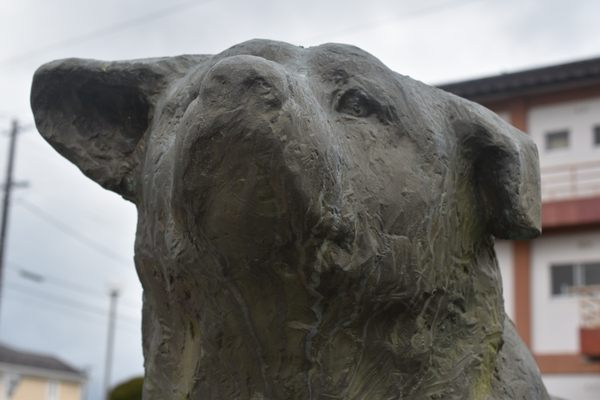
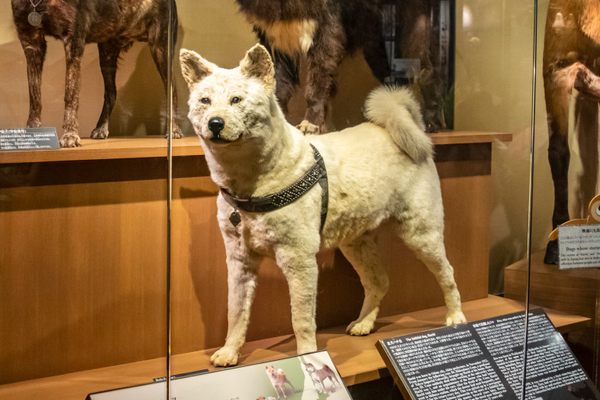
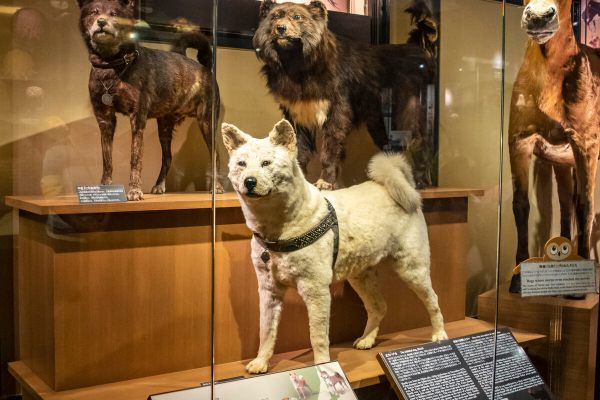
In Shibuya, your friends will often text or tell you, meet me at Hachiko. Just out of exit 5 of the Shibuya train station, there’s a courtyard. In the middle of that courtyard is a bronze statue of a curly-tailed dog. Perched on top of a six-foot cement pedestal, this dog sits on its back legs, front legs straight as if sitting in full attention with one folded bronze ear. This is Hachiko. Hachiko was a perfectly normal golden Akita dog, born 100 years ago. But in his lifetime, Hachiko became a nationwide sensation.
I’m Annie Eubank, and this is Atlas Obscura, a celebration of the world’s strange, incredible and wondrous places. Today, the story of Hachiko. Heartbreak, inspiration, and a touch of Hollywood.
This is an edited transcript of the Atlas Obscura Podcast: a celebration of the world’s strange, incredible, and wondrous places. Find the show on Apple Podcasts, Spotify, and all major podcast apps.

Annie: One day in 1924, a professor from Shibuya, Japan, traveled to a rural farm. This professor, Ueno Hideyasaburo, was an elegant-looking gentleman, a little balding. And he loved dogs. That day, he picked up a squirmy two-month-old puppy, an Akita, a Japanese dog once bred for hunting. He named this particular Akita “Hachi,” “eight” in Japanese, a lucky number. The “ko,” which means sir or lord, was tacked on later. Hachi-ko. Hachiko.
The professor taught at the university in central Tokyo, but he lived in Shibuya. Every day, he took the train to the university, where he was a distinguished professor of agricultural science. And every morning, little Hachiko trotted to the station by the professor’s side. Every evening, Ueno boarded the train back to Shibuya, disembarking at 5 p.m. sharp. Waiting for him in the courtyard, always, was Hachiko.
One spring evening, in May of 1925, Hachiko trotted over to Shibuya Station, as he had done every day over the last year. He sat in his usual spot and waited. And waited. But the professor never came. He never even made it onto the train. He had died of a stroke in his classroom while teaching. As night fell, Hachiko still sat outside Shibuya Station.
After the professor’s death, his family tried to find Hachiko a new home several times, but nothing worked. Often Hachiko escaped, running back to the professor’s house. Finally, the professor’s elderly gardener adopted the dog, and Hachiko found himself not too far from Shibuya Station once more. And this is where you should get ready for your heart to break.
Every day, at 5 p.m., Hachiko trotted over to Shibuya Station, sat in his usual spot, and waited for the professor. Days turned into months, and months into years. In the heat of the summer, in the bitter cold of the winter, every day Hachiko sat at the station, and he waited.
Hachiko went almost entirely unnoticed. People just saw a dog sitting around and assumed he was a stray. There were even accounts of people kicking and beating Hachiko. But it didn’t deter him, and eventually, someone did notice. A man named Saito Hirokichi. Saito was a writer, a landscape architect, but most importantly, he was a dog lover. He was actually the founder of the Society for the Preservation of the Japanese Dog. And he was especially interested in Akitas, and as you might remember, Hachiko was an Akita. Disembarking at Shibuya Station one day, he spotted Hachiko, and ended up following him home to the gardener’s house. Soon, he pieced together Hachiko’s story, and in 1932, seven years after the professor’s death, Saito published an article in a popular Japanese newspaper.
The headline read, “The Story of a Lovable Old Dog: A Seven-Year Expectant Wait for a Master Who is No Longer of this World.”
This article made Hachiko famous. Soon, people came to the station to feed him, photographers captured him, and his barks were even recorded for posterity. Hachiko’s name became national shorthand for endurance and faithfulness. In 1934, Saito and other fans of Hachiko raised money and had the statue of Hachiko installed outside of Shibuya Station.
Amidst all his fame and attention, Hachiko, regular as clockwork, trotted to and from the station every day, to sit in his usual spot and wait for the professor. Then, just months after the statue was unveiled, Hachiko was found lying in a Shibuya street. He had terrible cancer and heartworm. He died on March 8, 1935.
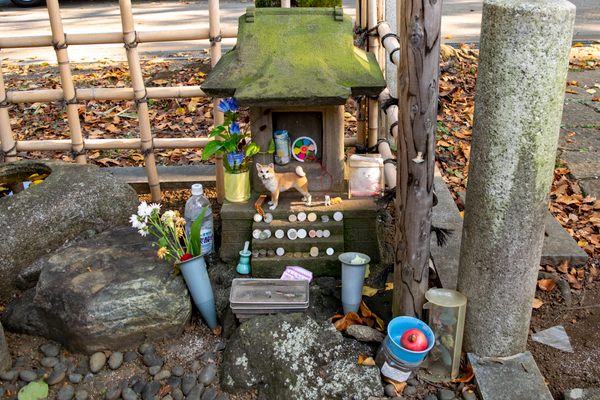
For nearly 10 years, Hachiko had sat outside the station, waiting for the professor to step off the evening train. Finally, they were reunited. Hachiko’s ashes were laid to rest at the foot of the professor’s grave in a Tokyo cemetery. He got his own gravestone, too, etched with the words, “The loyal dog, Hachiko.” As for how far Hachiko’s fame would eventually spread …
Richard Gere: Hachi, Hachi … oh, that’s a good name, I like that.
Annie: That is Richard Gere in the 2009 tear-jerker, Hachi: A Dog’s Tale. This movie is an adaptation of a 1987 Japanese movie, but set in Woonsocket, Rhode Island, with Richard Gere as the professor. There have been other movies about Hachiko’s life. There have been children’s books, TV specials. And there’s also a number of other statues, including one in Woonsocket, Rhode Island.
But the most significant tribute to Hachiko is still the statue outside of Shibuya station. It’s now well-known as a meeting place for locals. And it’s also been called Japan’s most famous piece of public art. A quick side note: This statue of Hachiko is not the original. That statue ended up melted down for its metal during World War II, but it was replaced as soon as possible by the original sculptor’s son in 1948.
But this particular statue still holds the most power because of where it is: In the same courtyard where almost a century ago, a loyal dog sat at full attention, waiting for his professor to step out of Shibuya station. And through this statue, he waits there forever.
If you want to go meet someone at Hachiko, you can visit atlasobscura.com and we’ll tell you how to get there. The link is in the episode show notes.
Listen and subscribe on Apple Podcasts, Spotify, and all major podcast apps.
Our podcast is a co-production of Atlas Obscura and Witness Docs. The production team includes Doug Baldinger, Chris Naka, Kameel Stanley, Dylan Thuras, Sarah Wyman, John DeLore, and Peter Clowney. Our theme and end credit music is by Sam Tyndall. This episode was mixed by Luz Fleming and John DeLore.
This story originally ran in 2021; it has been updated for 2025.





Follow us on Twitter to get the latest on the world's hidden wonders.
Like us on Facebook to get the latest on the world's hidden wonders.
Follow us on Twitter Like us on Facebook