The Mail Rail Below London
Beneath the streets of London, there’s a secret subway for snail mail.

Listen and subscribe on Stitcher, Apple Podcasts, Spotify, and all major podcast apps.
Dylan Thuras: Hey, everybody. I hope you enjoyed this week of Underground Stories. If you missed some, you can go check them out. You know, we’ve got sewers. We’ve got citrus groves. There is a whole world under there.
If you have a favorite underground place, a cave or a tunnel that you explored, I would love to hear about it. Give me a call at 315-992-7902 and leave a message with your name and story. Or just record a voice memo and email it to me at hello@atlasobscura.com.
Okay. Now we head underground one more time.
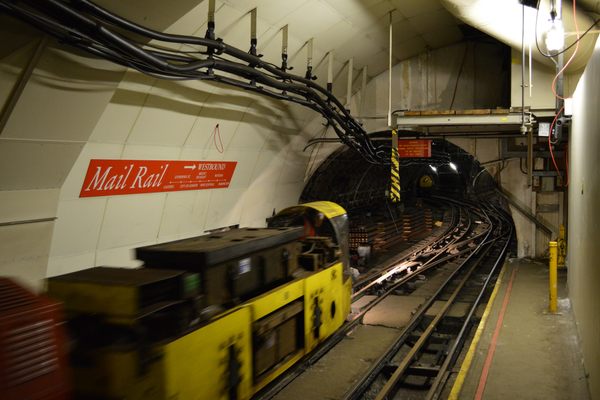
We’re underneath the city of London, 70 feet underneath it, to be exact. And we’re standing on the edge of a railway platform. It looks a little bit like we’re about to get on the tube. But on second glance, the tunnel extending off into the distance is a little bit small.
Behind us, workers are milling around, killing time with darts. And then a train chugs into view.
But the train has no conductor. It has no riders. There’s no people on it at all. And the train is really small. It’s this caterpillar of carts that reach about waist height. But instead of seats, each of its carts is piled high with giant lumpy cloth bags.
The workers spring into action. They hoist the bags onto their shoulders and toss them off to the side. And in a flash, the train whisks away again.
I’m Dylan Thuras, and this is Atlas Obscura, a celebration of the world’s strange, incredible, and wondrous places. And today, we are taking you to London’s Other Underground, a railway built for one purpose and one purpose only: to keep the city’s mail coming on time. We take a trip on the London Mail Rail after this.
This is an edited transcript of the Atlas Obscura Podcast: a celebration of the world’s strange, incredible, and wondrous places. Find the show on Apple Podcasts, Spotify, and all major podcast apps.

Dylan: Shipping these days is an arms race. Who can deliver the fastest? Whether it is groceries or Christmas presents or just a bagel from the deli on the corner, the speed of delivery is the name of the game.
Commercial Clip 1: Fast isn’t fast enough. Your critical deliveries demand a team that is ready to snap into action.
Commercial Clip 2: We’re holiday ready with fast and reliable delivery serving every address in America.
Commercial Clip 3: Free two-hour grocery delivery, now with Prime.
Commercial Clip 4: Now this is the FedEx same day robot. Look at this thing. This is the future. Oh my gosh!
Dylan: Believe it or not, back in England in the early 1900s, things were not so very different. But instead of sweatpants and deli sandwiches, we are talking about letters. Before text, before emails, letters were the main form of communication. And people sent a lot of them.
Chris Taft: Most ordinary people didn’t have a telephone. Telegrams were commonplace, but they were quite expensive and they were only for short messages. You couldn’t send a long message by telegram. So, written communication was how people transacted business, how people stayed in touch with friends and family. Postal communication was absolutely essential at that time.
Dylan: This is Chris Taft. He’s the head of collections at the U.K. Postal Museum in London, which is home to the mail rail. Since back then mail was so important, especially for businesses …
Chris: It had to be quick. People couldn’t wait days and weeks for letters. It had to be fast. And of course, as more people started to use it, they had the risk of slowing it down. So finding ways of keeping the speed up was really important.
Dylan: The problem was the streets of London did not exactly cooperate. Visibility was bad because of the foggy weather and the terrible smog from pollution back then. And although cars were starting to come on the scene at the turn of the century, most traffic was still horse-drawn carts. And it was slow.
Chris: People are quite surprised when you talk about congestion on the streets of London in the beginning of the 20th century. But it wasn’t to do with sheer volumes of traffic. It was just to do with the slowness of the traffic. Poor quality roads in some cases and lots of horse-drawn vehicles. So it was taking too long to get post from the offices, the sorting offices, the mail centers, to the railway stations.
Dylan: So the government began to look for solutions underneath the city streets. In the mid-1800s, the government experimented with my personal favorite mail delivery method: pneumatic tube. These chutes would use pressurized air to suck the mail in and carry it where it needed to go.
Unsurprisingly, these turned out to be a little bit too expensive and impractical to cover the amount of ground they needed. They were clearly the coolest method. But by the early 1900s, technology had progressed enough that there was now another option: an underground electric railway. Chris says that it worked essentially like a big model train.
Chris: Turn the power off, switch the battery off, the train would stop. Put the power back on, the train would move. The trains were given power, they moved along the line. As they reached the station that they needed to stop at, the power was switched off, the train would stop. It would be unloaded with mail, loaded with new mail. Power would be switched back on, the train would move on to the next station.
Dylan: Construction began in 1914 on a new network, six-and-a-half miles of tunnels underneath London. The tunnels were dug out and ready for rails when in 1917 construction ground to a halt.
It was due to the high material costs during the First World War. But the tunnels themselves came in handy for another use. They stored valuable artwork from the National Portrait Gallery and the Tate Museum during the aerial bombardments of the city.
When the mail rail finally opened in 1927, just in time for the big Christmas rush, it was an engineering triumph. It cut delivery time across London from a few hours to just 30 minutes. And it didn’t just speed up delivery of post within London, but all across Britain. London at the time was the hub for lots of mail from all over the country.
Chris: The purpose of this railway, the mail rail, was to link together parts of London. So it wasn’t so much about moving mail just within London, it was moving mail across the country, providing that kind of link in the chain.
Dylan: Once the mail rail came online, here’s the kind of journey a letter would take through London: After dropping it in a post box, the letter would end up at one of the city’s sorting offices. There were six linked on the mail rail.
There, a sorter would pick it up. This was a person’s job. They would look at the address and figure out what direction it needed to go in, what railway it needed to link up with. This was done manually, no machines. This was quite a specialized position. You had to have a lot of address data in your head.
Then, once the bin was full and ready to go, it would head down to the mail rail, which ran on a very strict schedule, practically nonstop, 22 hours a day.
Chris: It was a high-pressure environment. It had to be done very quickly. The train would pull into the station. They would have a very short amount of time to get the containers off, get the next containers on, and the train to go again. It was a slow, gentle process.
Dylan: The efficiency of the mail rail allowed for enormous volumes of mail to be moved, very quickly, for decades.
Chris: The average train would hold about 200 bags of mail. Obviously, a mail bag could contain anything from a dozen items to hundreds of items. At its peak, it was something like 4 million items a day into the system.
Dylan: Four million pieces of mail a day. The rail zipped along with its millions of pieces of mail through the ’40s, the ’50s, the ’60s. And as the system got more efficient, it also got more popular. And as it got more popular, there was more pressure to make it even faster and even more efficient.
In the ’60s, there was a push to begin automating this sorting process. But the machines were not sophisticated enough to read these long, complicated, handwritten addresses. So they needed addresses to be simplified, boiled down to a few letters or numbers about where they generally needed to go. This, of course, led to … Drumroll, please … Postcodes.
In the U.S., we call them zip codes. Now a machine could quickly read this short postcode and shoot the letter off where it needed to go.
Chris: So by the mid-1990s, the number of sorting offices in London that they needed was going down. This wasn’t because volumes of post were going down. The opposite. In fact, volumes of post were still very, very high at that time. But machines were sorting post much more quickly, meaning instead of having six sorting offices in the center of London, they could manage with two or three.
Dylan: There were other changes, too, like a new railway hub built outside the city center for trains carrying mail. This meant that a lot of the country’s mail didn’t need to be routed through central London anymore. And with fewer sorting stations to connect and less mail entering the city, the mail rail started to make less and less sense logistically. So in 2003, the post office decided it was lights out for the mail rail. The little electric mail engine that could powered down.
For about a decade afterward, the mail rail sat dormant and unused underneath the city of London. But in 2015, the U.K.’s Postal Museum began to look at the possibility of firing the trains back up again. Not to deliver mail, but as an attraction in the Postal Museum.
Today, if you visit the Postal Museum, you can actually take a ride on the mail rail. New trains have been outfitted with seats for passengers. Although, since the tunnels were never built with people in mind, it is still a little bit of a squeeze.
Chris: It’s not designed for comfort, really. It is cramped, it’s very narrow, and you’d be, you know, squashed in there.
Dylan: The 15-minute ride swoops you through the old postal tunnels, many of which have been left just as they were when the mail rail closed down. In the future, who knows what pieces of today’s delivery landscape will become museum relics. Anyone up for a quick ride on an Amazon delivery drone? Anyone? Anyone?
Special thanks to Chris Taft and Thomas Harrow-Smith from the Postal Museum.
Listen and subscribe on Apple Podcasts, Spotify, and all major podcast apps.
Our podcast is a co-production of Atlas Obscura and Witness Docs. This episode was produced by Amanda McGowan. The production team includes Doug Baldinger, Chris Naka, Kameel Stanley, Willis Ryder Arnold, Sarah Wyman, Manolo Morales, Baudelaire Ceus, Gianna Palmer, Tracy Samuelson, John DeLore. Our technical director is Casey Holford. This episode was mixed by Luz Fleming. Our theme and end credit music is by Sam Tyndall.
This story originally ran in 2023; it has been updated for 2025.




Follow us on Twitter to get the latest on the world's hidden wonders.
Like us on Facebook to get the latest on the world's hidden wonders.
Follow us on Twitter Like us on Facebook