
Los Angeles is good at making you step around things.
Cones. Construction. Potholes. A folding chair saving a parking spot that may or may not be legally enforceable. A mysterious locked door. A metal box on the sidewalk that looks official enough for you not to ask questions.
So when a gray electrical cabinet showed up on a corner in the Arts District, most people did what people in Los Angeles are trained to do.
They stepped around it.
Which, technically, was part of the gag.
“Not to be corny,” says artist S.C. Mero, “but you just don’t know what’s in something unless you look inside it. A person, or even ourselves. I think there’s kind of a beautiful message in that.”
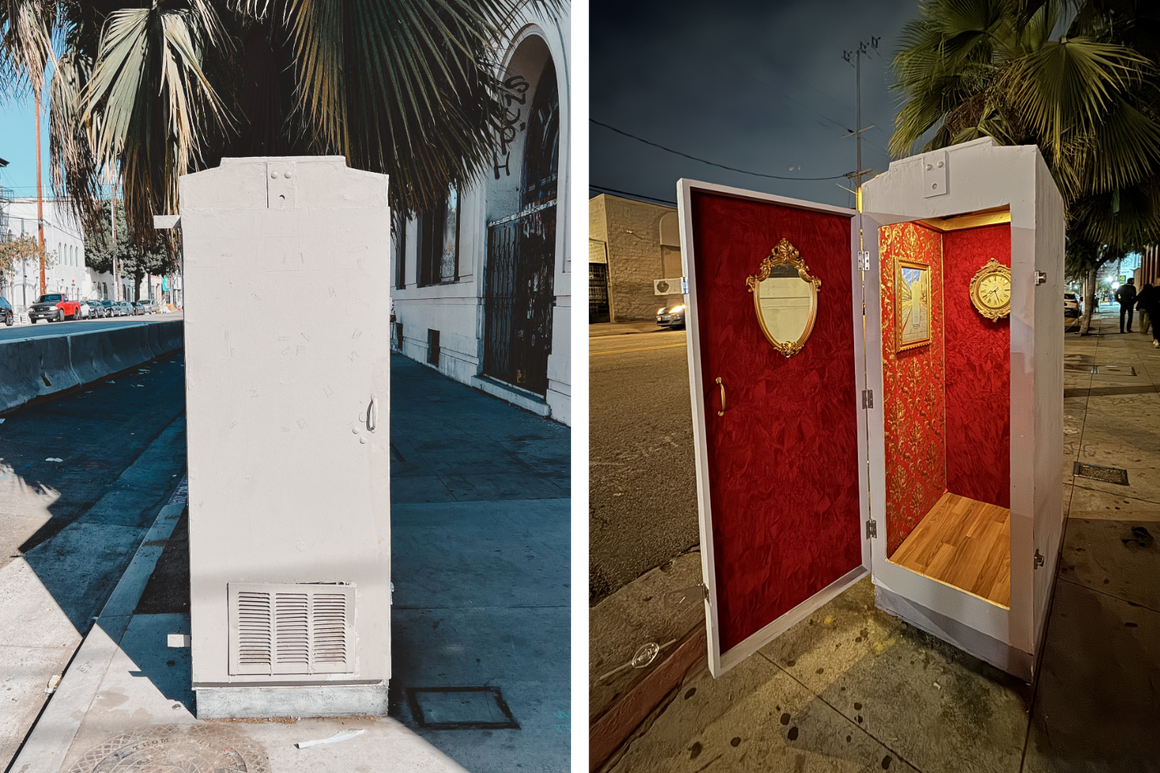
Because if you walk by that corner at the right time, this unassuming box might open. Lights might come on. Someone might roll out a red carpet. A performer might step inside.
And suddenly you are standing on the sidewalk, inches away from a show you did not know you had tickets to.
This is the Electrical Box Theatre, quite possibly the tiniest theater in all of Los Angeles (maybe the world?).
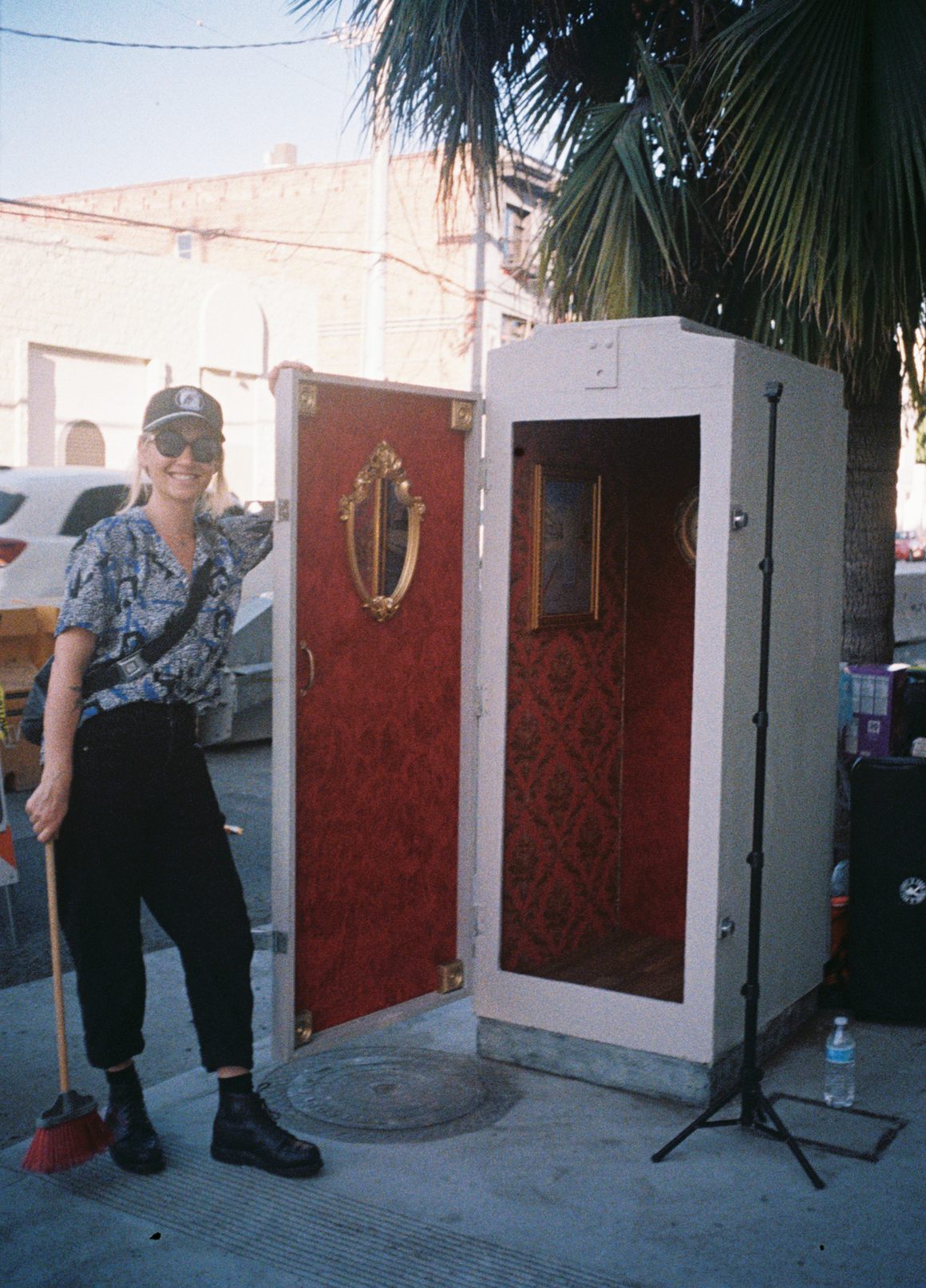
It is about six feet tall and three feet deep, just big enough to announce itself, hold one performer, and make you feel like you have been let in on a secret. Inside are velvet-lined walls, a clock to keep showtime, of course, and two framed photos of itself (if you are going to be a tiny theater disguised as city infrastructure, you should have a strong sense of self).
The Electrical Box Theatre was created by downtown artist S.C. Mero, and you do not need tickets to attend. You mostly need timing, curiosity, and the willingness to stop walking when the city gives you a reason.
Mero had been carrying the idea around for years—maybe ten, she told me. Around the time artists were painting electrical boxes around the city, she started thinking about what she would do with one.
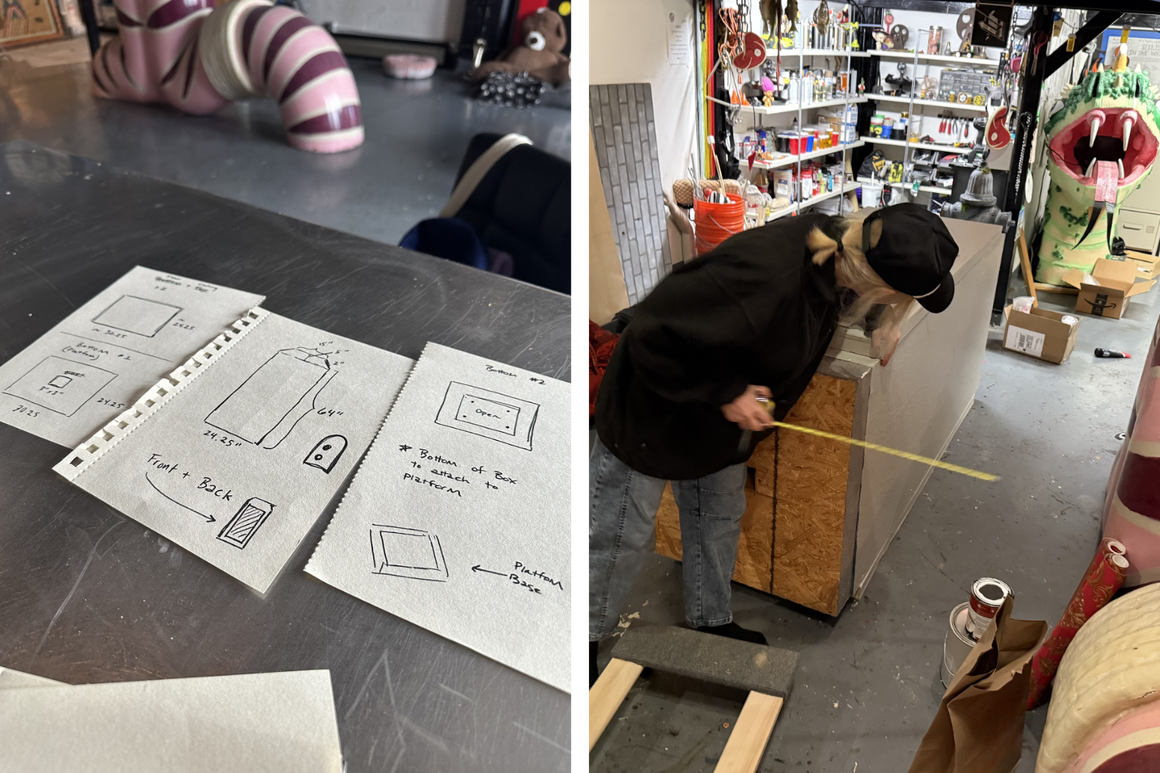
“I’m more of a sculptor,” she said, “so I thought it would be cool to make one that was fake that people could go inside, and that there was something inside that was different and unique and that people had to discover.”
That is very Mero. She is not just placing art in the city. She is messing with the agreement we have all quietly made with it.
This is a box. That is a curb. That is a thing I ignore.
Mero looks at that and says, maybe not.
The piece also works because most people do ignore it. That sounds like a problem, but it is actually part of the strategy.
“Most of the people, 99 percent of the people who are walking by this box think it’s real, so they’re not paying attention to it,” she said. “So it has a better chance of living.”
The tiny theater sits on a corner that already means something to her. This block has been the backdrop for several of Mero’s pieces, including a giant mailbox, a giant location pin, and a giant parking meter (“giant” meaning around 13 feet high). Objects that usually sit quietly in the background suddenly became enormous, ridiculous, and impossible to ignore.
The Electrical Box Theatre works a little differently. It is not oversized. It does not tower over you.
It waits.
That might be why I like it so much. The other pieces make you look up. This one makes you look closer.
The 13-foot pieces started with a pole. There used to be a street pole on the corner without a sign on it, just standing there, which is exactly the kind of thing Mero notices. She had already been putting art inside street poles earlier in her career, slipping signs into them and watching them get removed. This time, she wondered what would happen if she built something around the pole instead.
“I wonder if I actually just build a sculpture around it,” she remembered thinking. “Just put a whole sculpture on top of it, if they’ll notice or if it’ll stay.”
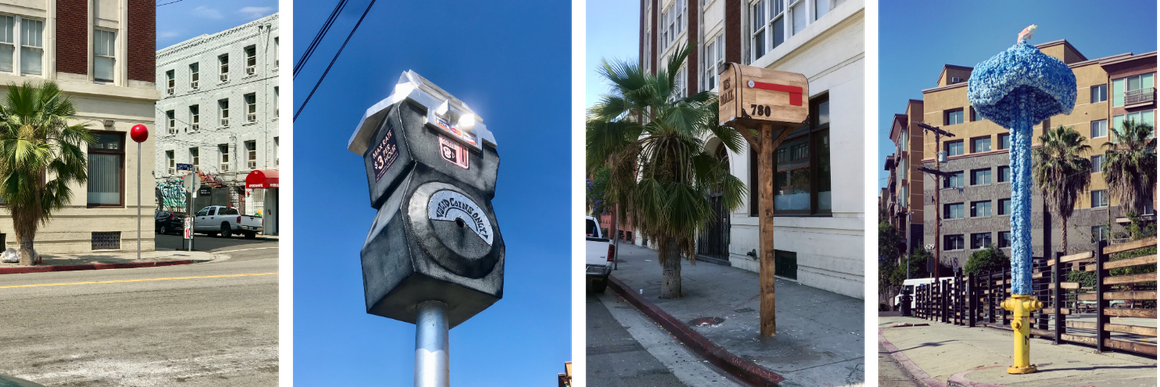
The first one was the location pin. Then came the parking meter. Then the mailbox and the hydrant. Eventually, the city noticed. The originals are gone now, but Mero laughed when she told me that means she can say she got away with it.
The corner itself is not random; Hewitt and Traction has a deeper history in the Arts District, and Mero knows that. She sees the theater as part of a longer line of artists using the neighborhood as a living surface.
“This corner, Hewitt and Traction, is a really iconic and historic location for artists,” she said. “That’s why it’s called the Arts District. It’s literally this intersection.”
She pointed to the building nearby and talked about the artists who lived there, the old jazz club, Al’s Bar, the parties, the street takeovers. Downtown art history does not always get preserved cleanly in plaques or brochures. Sometimes it survives because someone remembers what used to happen there. Sometimes it survives because someone keeps doing things on the same corner.
“I’ve just heard a lot of stories of the things that artists did back then,” Mero said, “and I always felt inspired. Even though it’s kind of a bummer because there’s just not as many artists who live here, I just want to be able to continue that.”
That stuck with me.
Because the Electrical Box Theatre is funny, yes–a secret theater inside a fake utility box should be funny. But it also feels like a small refusal. A way of saying there is still room for the handmade thing, the strange little thing, the thing that should not fit but does anyway.
Since opening night, all kinds of artists have performed inside the box. Local musicians. Mimes. Clowns. Experimental performers. And a burlesque show, which is the one I joined Mero for.
I spent time with her as she was setting up that night. By day, the box looked almost normal. Maybe a little suspicious if you knew what to look for, but still close enough to city infrastructure that people walked by without giving it much attention.
Then the setup started.
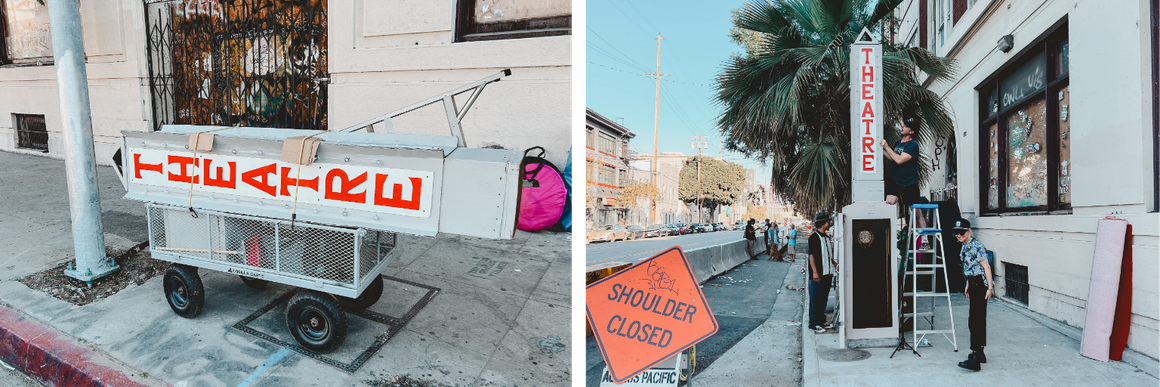
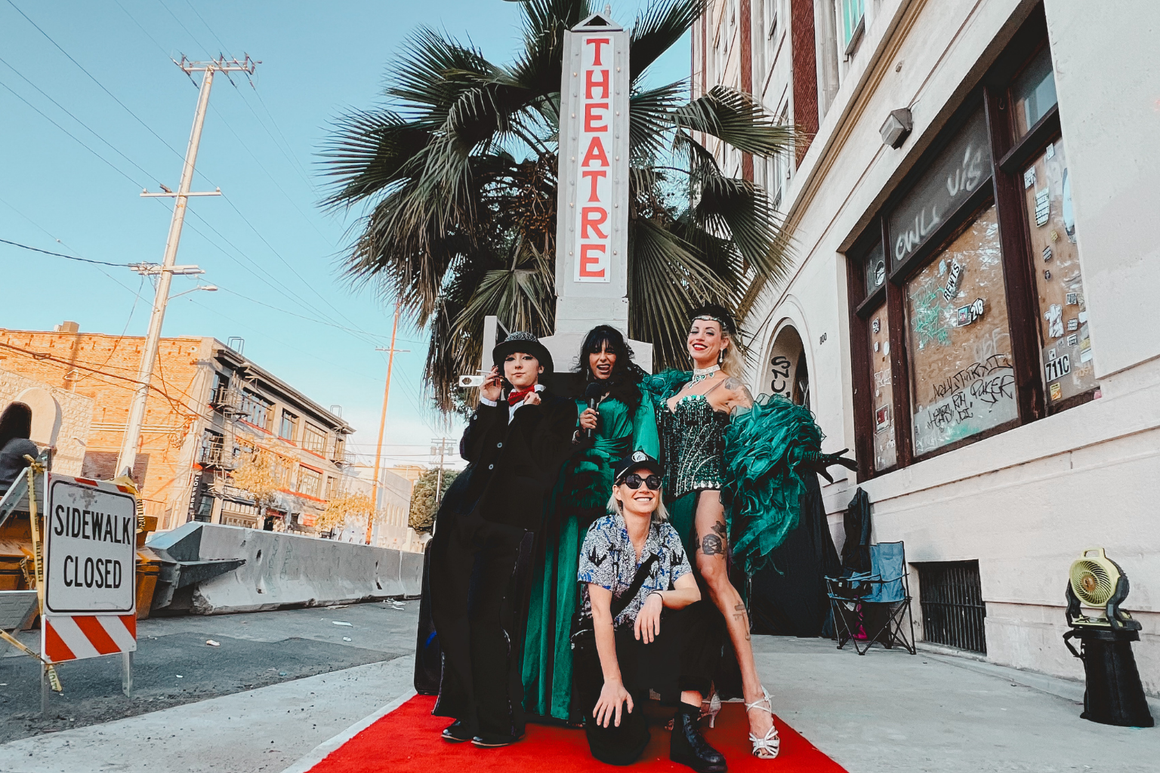
Performers arrived. Friends helped. The theater marquee went up, complete with lights. Someone rolled out a red carpet. The sidewalk shifted from something people passed through into somewhere people gathered.
While the performers got ready, I spoke with the show’s producer and one of the performers, Lady Maralou.
“Burlesque performers are so used to having shows in nice places,” Lady Maralou told me. “They’re not used to having it in a street-style form with a street artist, especially in downtown LA.”
That was part of what excited her about the box. It put burlesque somewhere unexpected, outside the usual ticketed room, in front of people who may never have planned to see a burlesque show at all.
“Downtown LA is big on street art and art in general,” she said. “We’re all here trying to make it, and there’s no better way to collaborate and have people come through. Anything we can put on for the neighborhood, or for other creatives to meet each other, I love it.”
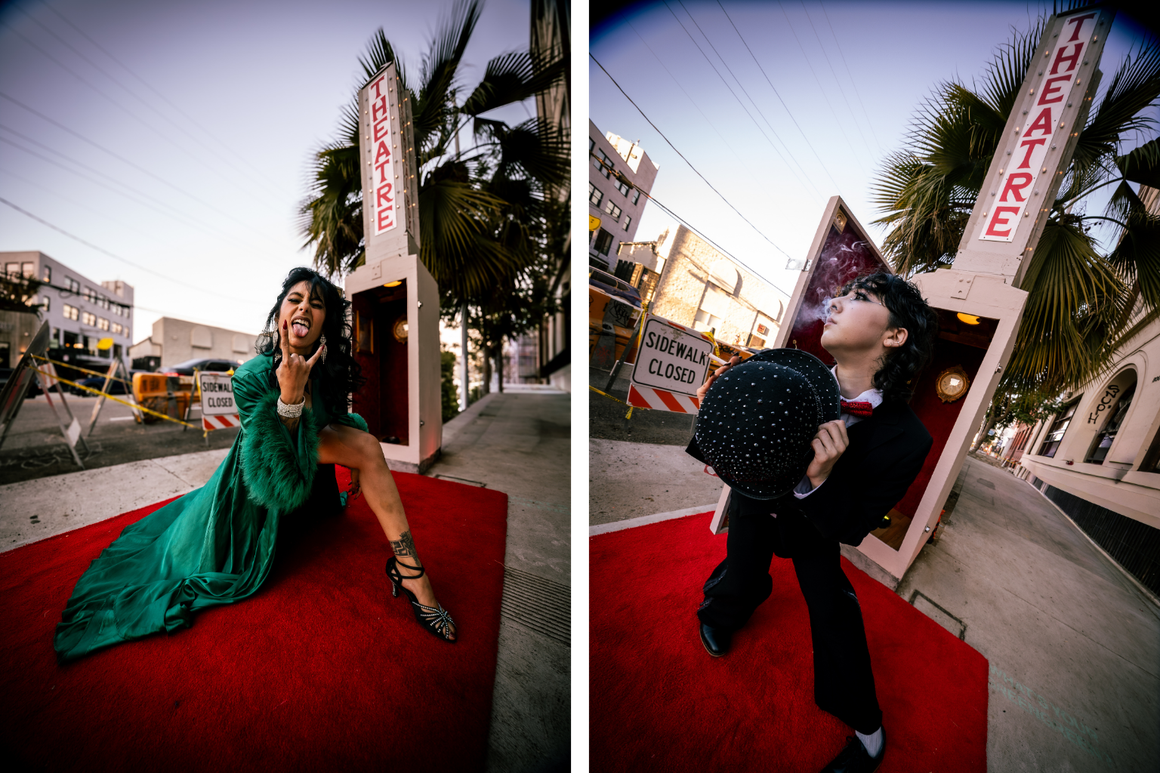
She found the Electrical Box Theatre through Instagram. At first, she thought maybe they could do something small. Then it became, no, let’s actually make this a thing. Bring in performers. Highlight them. Let people stumble into the art form by accident.
I like that part. The accident of it.
Because not everyone is going to buy a ticket to a burlesque show. Not everyone is going to walk into a gallery. But someone might be on their way to dinner, see a woman stepping into a six-foot fake electrical box, and think, hold on, what is happening over there?
For her, that mattered. Burlesque is old, she said, and often misunderstood or flattened into something it is not. Bringing it to the street opened it up.
And the performers are not just using the box. They are completing it.
“It’s a participatory art piece,” Mero said. “If it was just me with the box, it’d be sitting there closed. It’s the people that are opening it up and performing there that are making the art live.”
She told me the whole thing has exceeded her expectations and that the performers seem to understand what the box can do.
“I can see that they like bringing their talent to the people,” she said. “There’s something magical about coming up on art when you weren’t expecting it.”
That is exactly it. The surprise is not extra. It is the point.
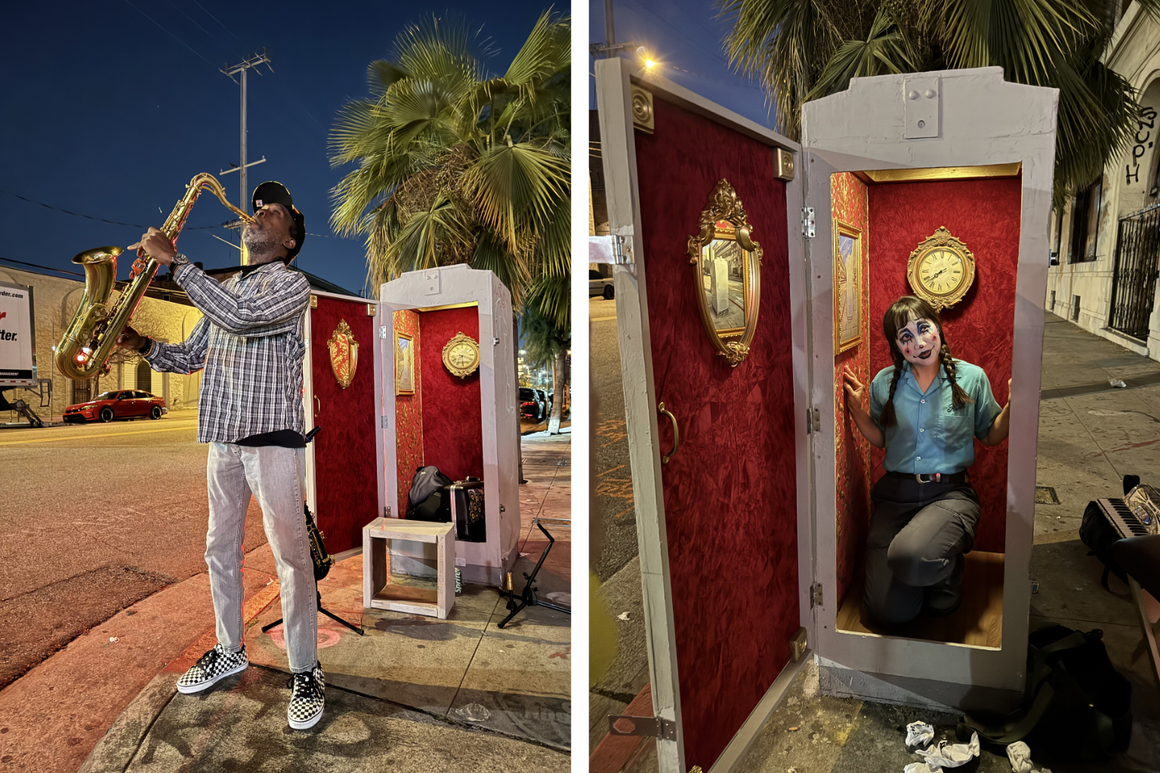
Performers of all kinds are welcome in the space, and the theater works like a tiny busking stage. If someone wants to perform, they can message Mero directly. The access code is sent the day of the show, and performers are encouraged to put out a tip jar, share their Venmo, pass a hat, whatever makes sense for the act.
Which feels right. A tiny theater disguised as an electrical box should not be too easy to enter. It should require a little trust. And if someone is brave enough to climb into a six-foot box and perform for strangers on the sidewalk, yes, please tip them.
Like most of Mero’s work, the Electrical Box Theatre is also temporary.
I know temporary art is part of the deal. Still, I want the magical thing to stay where I found it. But the maybe-not-forever part is doing some of the work.
“I think the good thing about it being temporary is it really is almost a better representation of life,” Mero said. “Because life is temporary. Nothing lasts forever, and it encourages people to enjoy it while it’s here.”
Public art often comes with an expiration date, especially public art that is actually public, actually outside, actually vulnerable to weather, people, rules, landlords, city changes, and whatever else Los Angeles decides to throw at it. Mero knows this. She has made work that appears, changes the corner, and then disappears. Or gets moved. Or gets remembered by people who swear they saw it once and now cannot prove it.
When it is gone, she said, maybe it lives on in a story, or a legend, or a myth. And maybe that is enough. Or not enough, but still something.
Standing there, watching a tiny theater come alive on a downtown sidewalk, I kept thinking about how little it takes to change the rules of a place.
Not forever. Not officially. Not with permits and a ribbon cutting and a render of what the neighborhood will look like in 2032.
Just for a night.
A door opens. Lights turn on. A performer steps inside. People stop.
Mero is careful about saying what she hopes people feel. She told me she hesitates to hope for a reaction, which I liked. But she has noticed something in the performers.
“For the people who performed here, they feel really empowered,” she said. “We’re used to expecting people to come to us all the time with our art. Like, I’m having a show in this gallery, or I’m having a show in a museum. But this is a way of people bringing their talent to people and injecting it in their daily lives.”
That is the thing the box does. It interrupts regular life, but gently. It does not demand that you be an art person. It does not ask whether you know the right names or have the right context. It just opens on the sidewalk and lets you decide if you are staying.
“People who might go to art shows or might go to museums, that’s a small demographic of people,” Mero said. “So this opens it up to just the everyday common person.”
After that, the city feels a little less settled. The locked doors seem less final. The gray boxes look less boring. You start to wonder what else you have been walking past because it did too good of a job pretending not to matter.
That is the gift of the Electrical Box Theatre.
It does not ask you to believe in magic. It just opens the door.


