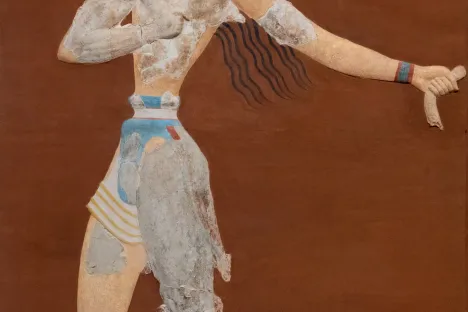
By that point in the museum I'd already seen a lot. Minotaur imagery everywhere, walls of weapons, the little gold bee pendant everyone photographs. I was moving at a decent pace, giving each case its few seconds and moving on. Then I hit a room near the end and stopped anyway: a small statue, breasts bare, raised arms, a snake gripped in each hand. What was that?
Short answer: Nobody really knows.
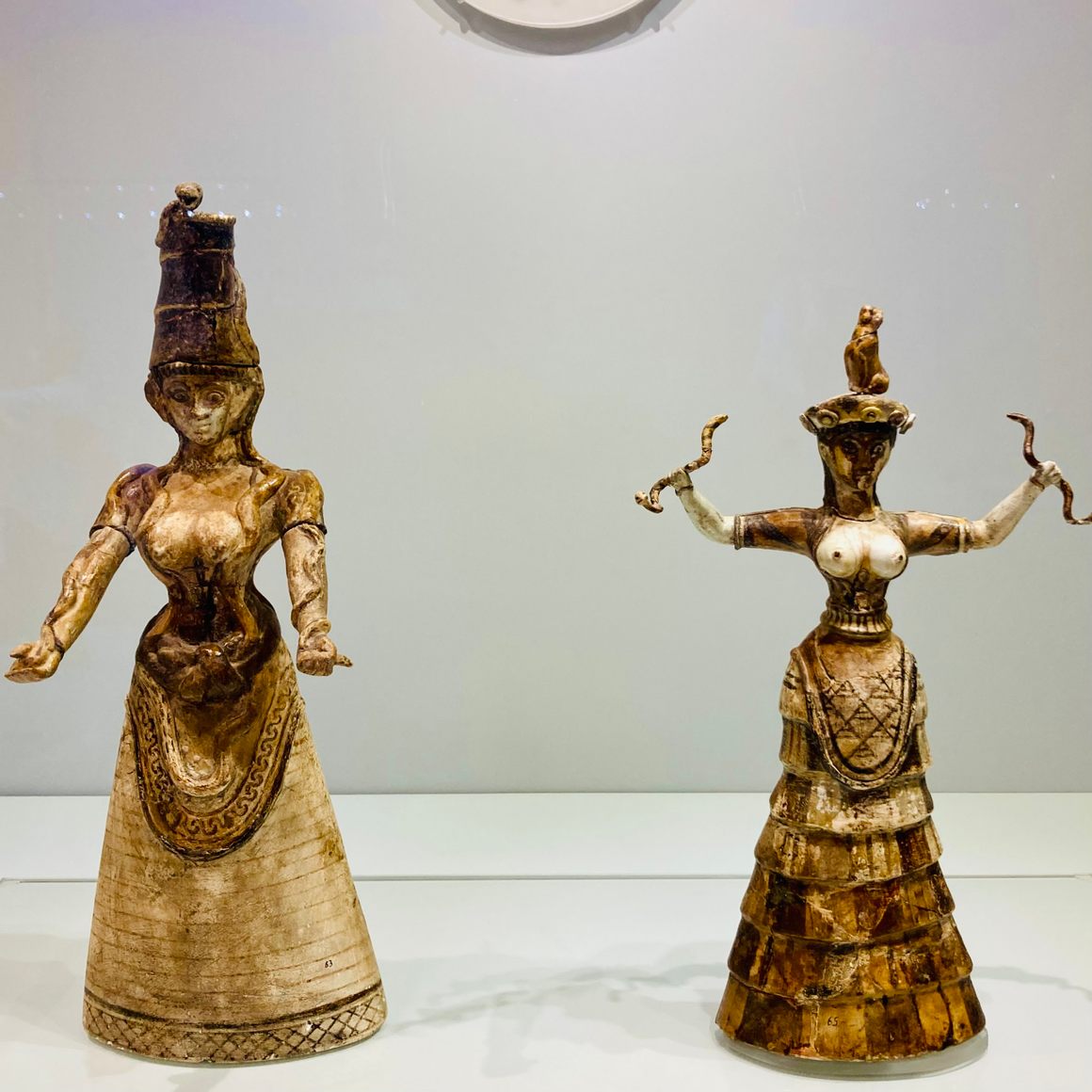
Look closer and she's not alone : women in flounced skirts, dressed almost identically. Some hold snakes out in each fist. On the biggest of them, the arms don't hold the snakes at all, they're wrapped in them, coiling up from wrist to shoulder like the snakes are part of the costume rather than a prop she's carrying. The English-language placards are careful with their wording. "Goddess or priestess." "Possibly linked to." "Interpreted as." The room seemed confident about almost nothing except that these figures mattered, and that women, specifically, were at the center of whatever this was.
Most of it traces back to a single find: a sealed pit beneath the palace of Knossos, opened by Arthur Evans' team in 1903, holding fragments of six or seven similar faience figures, buried on purpose alongside other ritual objects around 1600 BCE. Only two came out intact enough to stand as full figures again. Those are the two everyone photographs, restored with a fair amount of guesswork by a conservator named Halvor Bagge, missing heads and arms and headdress ornaments quietly filled back in. I didn't know that standing in front of them. I found it out later, and it changed how I looked at the photos I'd taken.
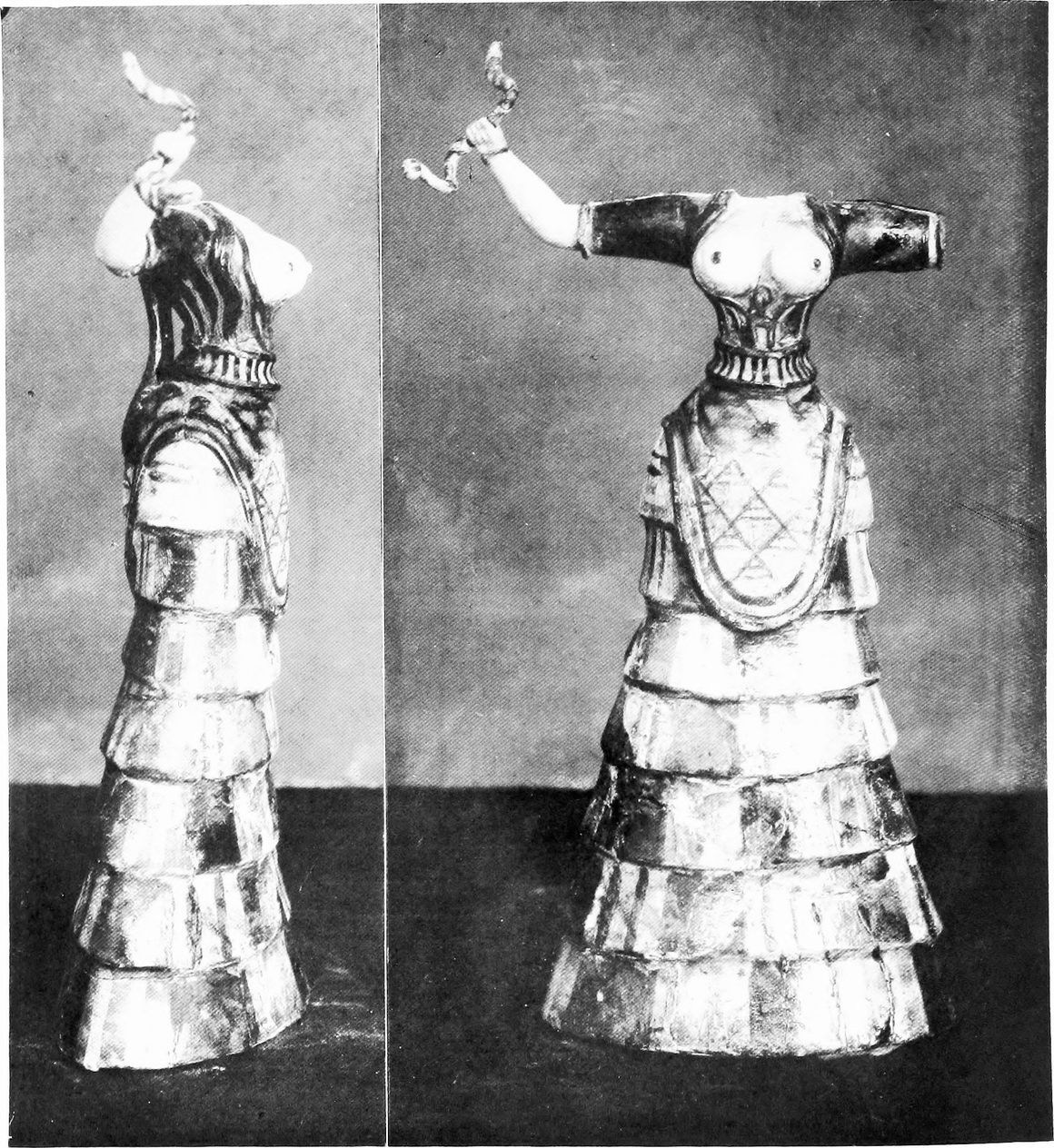
What I do know is that Evans didn't walk into that pit with an open mind. Nineteenth-century anthropology was already obsessed with the idea of a lost prehistoric matriarchy, and Evans, who'd lost his own mother as a child, according to several of his biographers, arrived at Knossos already inclined to read any female figure as a goddess, and any goddess as one more face of a single Great Mother worshipped across the ancient Mediterranean. Whatever he pulled out of the ground, he read through that lens, the same instinct that later had him pouring concrete pillars and repainting frescoes at Knossos itself, rebuilding the palace to match the civilization he'd already pictured in his head. For thirty years he was the one writing the guidebook, so the reading stuck.
Decades later, the archaeologist Marija Gimbutas, who spent much of her career arguing that prehistoric Europe had once worshipped goddesses before patriarchal religions swept in, picked the theory up and ran further with it, folding Crete into that much larger, older idea. Her version found a real audience in the feminist spirituality movement of the 70s and 80s. Knossos became, for a while, something like its lost capital.
None of which tells me who these women actually were. Linear A, the script the Minoans wrote in, still hasn't been deciphered. There's no line of text anywhere explaining who's being represented, or worshipped, or invoked. Everything in that room is a reading of a reading: fragments interpreted by Evans in 1903, reinterpreted by Gimbutas decades on, now sitting behind glass with careful, hedging English captions for whoever wanders through in 2026. Including me, not knowing any of this at the time, just standing there thinking: something was clearly happening here. I have no idea what.