
I went to the Heraklion Archaeological Museum before I went to Knossos. That order matters, because it's the reason I spent my visit to one of the most famous archaeological sites in the world a little bit furious.
In the museum, I stopped in front of the Prince of the Lilies. It's one of those frescoes you've seen on postcards without ever really looking at it: a young man, crowned with lilies and peacock feathers, striding forward against a red background. It's stunning. Genuinely, "Wow, this survived thirty-five centuries" stunning.
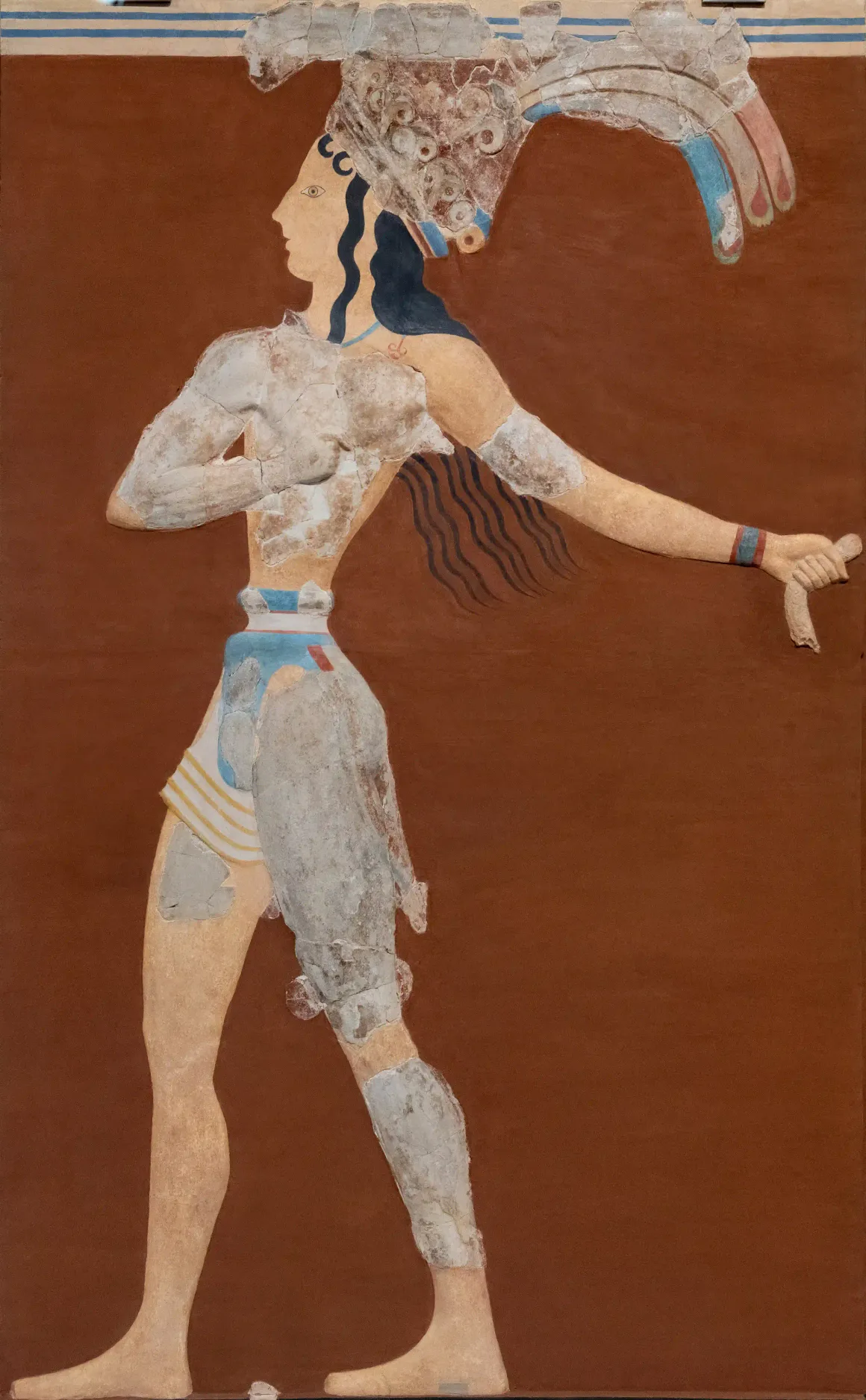
Then I read the panel next to it.
The stunning part is maybe a quarter of what you're looking at. The rest is reconstruction: plaster and paint, filled in around a handful of surviving fragments, based on what archaeologists thought the missing pieces probably looked like. Not "probably" in the strict sense either. More like: educated guessing, done by people with a very specific idea in mind of what Minoan civilization should look like.
I remember standing there doing the math. How do you get from a few painted fragments to a full, confident, museum-worthy human figure? And the honest answer, once you start pulling on that thread, is: you don't, not really. You invent the rest and you call it restoration.
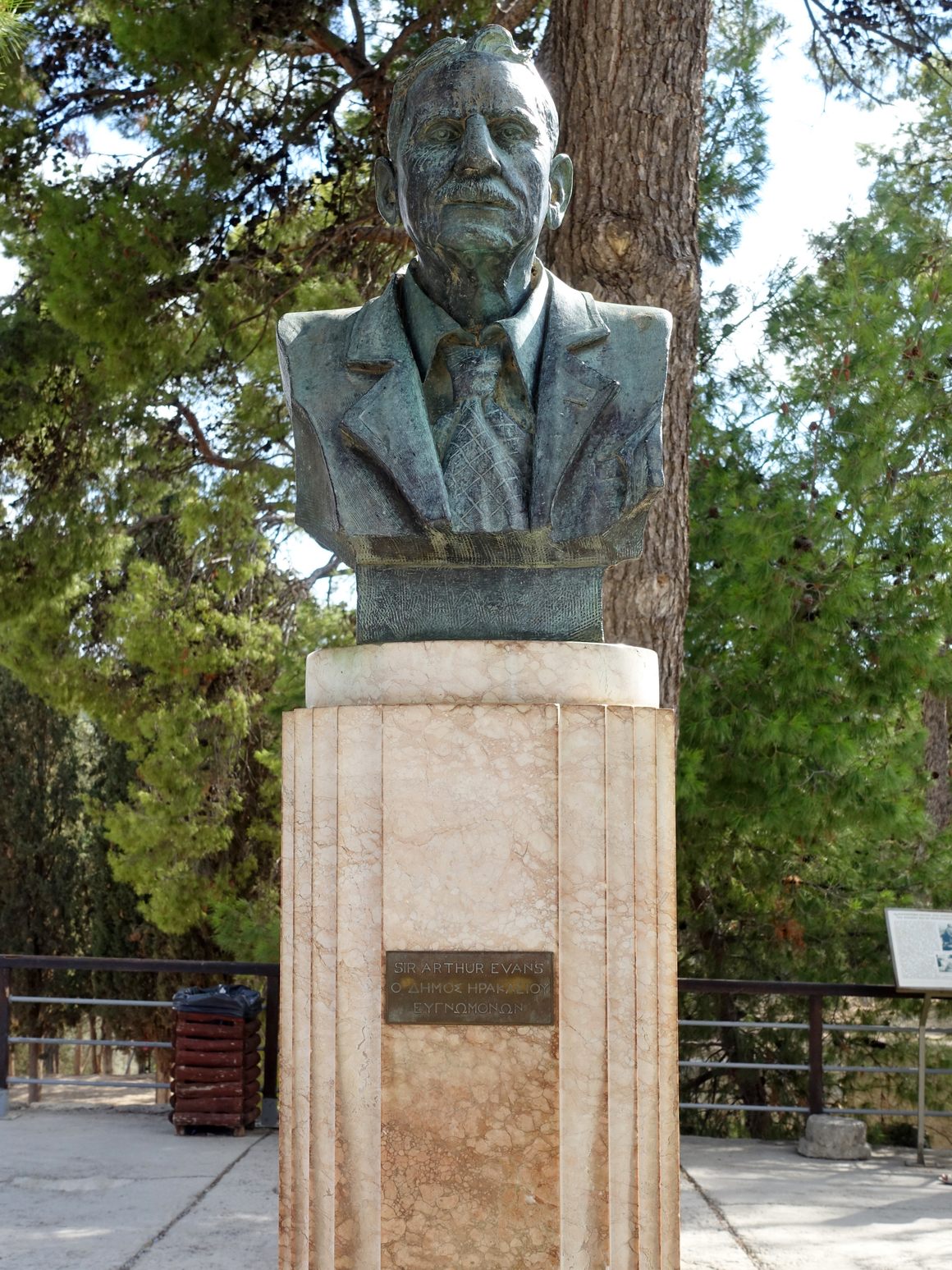
That's when the name Arthur Evans starts showing up everywhere, and once you know to look for it, you can't stop seeing it.
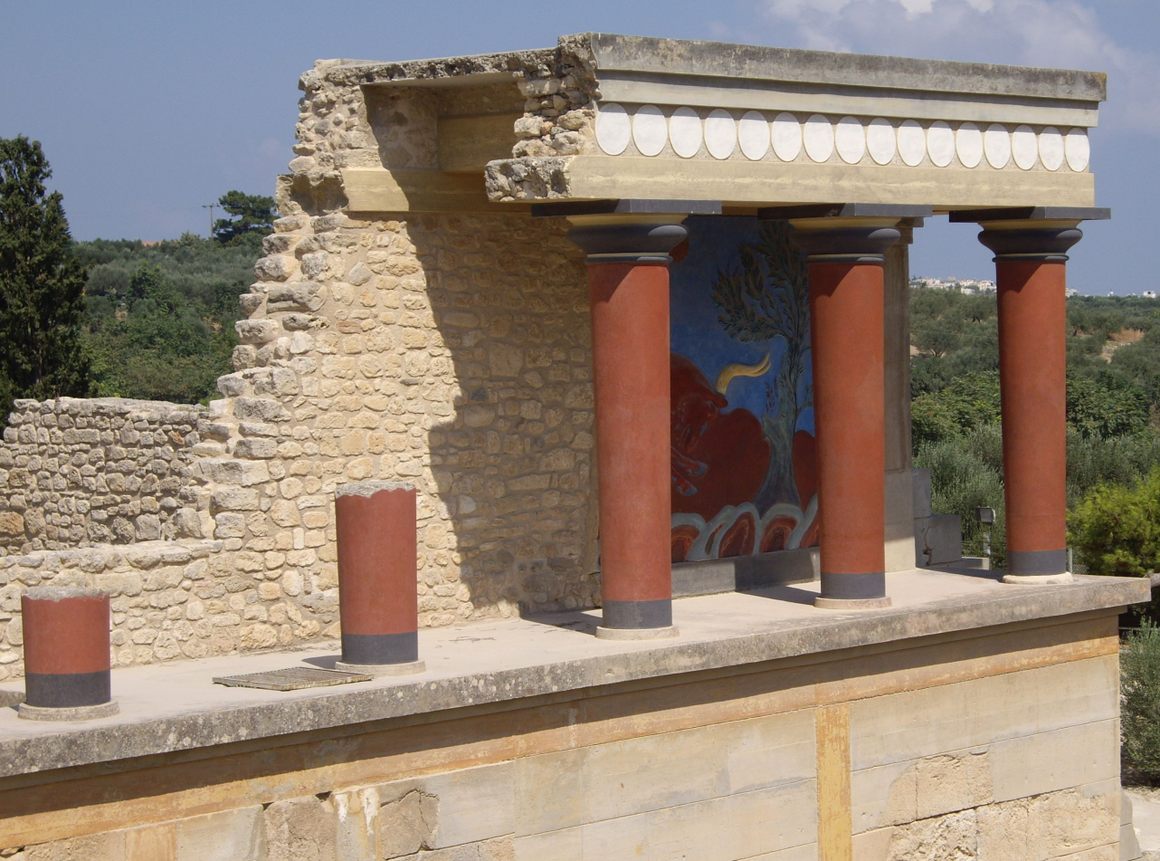
Evans was the British archaeologist who bought the site of Knossos in 1900, on the strength of family money from the paper mill his father owned, and who spent the next thirty years excavating it and then rebuilding it. He's the one who coined the word "Minoan" in the first place, naming an entire Bronze Age civilization after a king who, as far as we know, only existed in myth. He decided this was the palace of Minos. He decided what the missing frescoes looked like. He decided that concrete, poured into columns and painted terracotta red, was an acceptable stand-in for wood that had rotted away three thousand years earlier.
I went to Knossos the next day already knowing all of this, and it changes how you walk through the place. Those famous red columns, the ones in every photo of the site, are not ancient. They're Evans's guess at ancient, built in the 1920s and 30s out of reinforced concrete, because that was the modern material available to his architects at the time. One visitor in the 1930s reportedly said the restored palace looked like "garages and public lavatories." I understood exactly what he meant, and I also couldn't stop taking pictures.
It's not just the concrete, either. It's the labels. Evans didn't just rebuild rooms, he named them, with a confidence that has aged badly. The "Throne Room" has an actual stone seat in it, so the name stuck, but most archaeologists today think it was closer to a shrine than anything a king sat in to hold court, possibly presided over by a priestess rather than Evans's imaginary priest-king. Next to it, a sunken little room he called "Ariadne's Bath" and filed under ritual purification, because there was no plumbing and bathing didn't make sense to him there, so he decided it was religious instead. Downstairs, the "Royal Apartments" sit at the bottom of four flights of stairs, next to the craftsmen's workrooms, which is a strange place to tuck away your royalty if you think about it for more than a few seconds. Evans clearly didn't. He named first and dug up the doubts later, except the doubts were mostly other people's, decades after he'd already poured the concrete and printed the guidebook.
Here's the tension I couldn't shake, and honestly still haven't: I was angry. Genuinely angry, in a way I didn't expect to be, about how much original information got overwritten by one man's confidence. Every guess Evans poured in concrete is a guess we can no longer test against the thing itself, because the thing itself is now buried under his interpretation of it. That's not a small loss. That's data you don't get back.
And at the same time, standing in the Central Court with a hundred other tourists, I couldn't pretend the concrete wasn't also, by now, its own kind of history. Knossos has been "the restored Minoan palace" for over a century. People have proposed there. Books have been written about the restoration itself as a subject, separate from the Bronze Age it claims to represent. The over-imagination is baked in so deep it's arguably as much a chapter of the site's story as it is a flaw in it: what happens when a wealthy, brilliant, deeply opinionated Edwardian gentleman gets to build the ancient world he wants to see.
I don't think I resolved anything, standing there. I think what I landed on is that Knossos isn't really one site. It's two, stacked on top of each other: a Bronze Age palace we understand only in fragments, and a very early-20th-century monument to how badly one man wanted those fragments to add up to a story. You can be furious at the first and fascinated by the second in the same afternoon. I was.
I'll say this too, because it's the kind of thing that gets me every time: I have a genuine, borderline embarrassing love for founding myths, the stories cultures tell about where they came from. Minos, the Minotaur, the labyrinth, all of it fictional as far as anyone can prove. And yet a real archaeologist spent his fortune and his life trying to make the fiction stand up in poured concrete. If that's not a founding myth in its own right, I don't know what is.

