Places Foods Stories Newsletters
Loading...
Loading...
Loading...

No search results found for
“”

Make sure words are spelled correctly.

Try searching for a travel destination.

Places near me Random place

Popular Destinations

  • Paris
  • London
  • New York
  • Berlin
  • Rome
  • Los Angeles
Places Foods Stories Newsletters
Sign In Join
Places near me Random place
All Italy Veroli Fasti Verolani

Fasti Verolani

A Roman calendar dating to the first century is tucked away in a small town alley.

Veroli, Italy

LatiumMirabile profile photo
Added By
Jan Claus Di Blasio
Email
Been Here
Want to go
Added to list
CAPTION
The Fasti Verolani.   LatiumMirabile / Atlas Obscura User
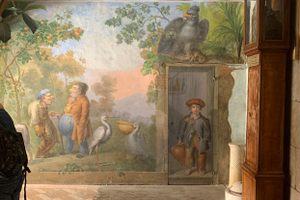
The courtyard of Casa Reali in Veroli.   LatiumMirabile / Atlas Obscura User
The town of Veroli.   enricohl
Been Here
Want to go
Added to list

About

Set against a wall in the courtyard of Casa Reali, a late medieval house in the town of Veroli, in the Italian region of Lazio, is an exceptional archaeological find: the Roman calendar known as Fasti Verolani.

The marble plaque was discovered in 1922 as a sealing stone for a tomb in a paleo-Christian necropolis discovered in the same spot. Camillo Sciacca Scarafoni, a local scholar, reconstructed the calendar from 60 fragments.

Three columns are preserved. For each month, Ian(uarius), Feb(ruarius), and M(artius), the calendar lists the public and religious festivities, market days, and main events. The kalendae (the first day of the month or new moon), nonae (the fifth or seventh day, or half moon) and idus (the thirteenth or fifteenth day or full moon) are listed, along with the initials for the nature of each day: fasti dies (F) were days on which business could be conducted, dies comitialis (C) were days on which assemblies could be held, dies nefasti (N) were days on which official transactions and assemblies could not be held on religious grounds, and dies nefasti publici (NP) and dies endotercisi (EN) which had similar restrictions.

The feriae (or, roughly, holidays) were divided in feriae publicae and feriae privatae. At the bottom of the calendar is also the number of days per month.

The calendar can probably be dated to the period following the death of Augustus (A.D. 14) and before the death of Livia in , since the January 17 is listed as: "FERIAE EX S(enatus) C(onsulto) QUOD EO DIE AUGUSTA NUPSIT DIVO AUG(usto)." This implies that Augustus had been deified and his wife, Livia, had received the title of Augusta from her husband, but was still alive then. 


Places

Discover your next amazing Atlas Place.

Get more unusual and extraordinary places each week with the Atlas Obscura Places newsletter.

Your newsletter subscriptions with us are subject to Atlas Obscura's Privacy Policy and Terms of Use.

Community Contributors

LatiumMirabile profile photo

Added By

LatiumMirabile

Published

June 4, 2020

Edit this listing

Make an Edit
Add Photos

Related Tags

Roman Calendars Archaeology Alleyways
Fasti Verolani
17 Via Vittorio Emanuele
Veroli, 03029
Italy
41.691357, 13.417783
Get Directions

Nearby Places

Pozzo d'Antullo

Collepardo, Italy

miles away

Farmacia della Certosa di Trisulti

Collepardo, Italy

miles away

Cascata Grande di Isola del Liri

Isola del Liri, Italy

miles away

Explore the Destination Guide

Photo of Italy

Italy

Europe

Places 1,157
Stories 112

Nearby Places

Pozzo d'Antullo

Collepardo, Italy

miles away

Farmacia della Certosa di Trisulti

Collepardo, Italy

miles away

Cascata Grande di Isola del Liri

Isola del Liri, Italy

miles away

Explore the Destination Guide

Photo of Italy

Italy

Europe

Places 1,157
Stories 112

Related Stories and Lists

17 Alleyways with Hidden Histories

List

By Jonathan Carey

Related Places

  • Les Cinq Tombes (The Five Graves)

    Geer, Belgium

    Les Cinq Tombes (The Five Graves)

    A unique collection of five Roman burial grounds right next to the road.

  • Jet Bear

    Malton, England

    Jet Bear

    This small figurine of a bear tells us a lot about the value of jewels and funerary practices in Roman Britannia.

  • A soloist performing at the amphitheater of Bosra

    Busra, Syria

    Black Amphitheater of Bosra

    One of the world's best-preserved Roman amphitheaters is also one of the most unusual; it's made of black volcanic rock.

  • Necropolis of Sant'Andrea Priu

    Bonorva, Italy

    Necropolis of Sant'Andrea Priu

    A Nuragic tomb, a Roman tomb, and a Byzantine Church, all hidden inside a rock.

  • The archaeological site in Sisak, Croatia.

    Sisak, Croatia

    Siscia in Situ

    One of the major cities of Late Roman provinces, now in ruins of small scale.

  • A closer look at the excavation, from the left side of Kandlerova ul

    Pula, Croatia

    Quarter of Saint Theodore

    An excavation site that signified Hercules in Pula, and a glimpse into the city's Roman history.

  • This section of columns still stand to their original height.

    Durrës, Albania

    Durrës Byzantine Forum

    One of the best examples of a Byzantine period monument in Albania.

  • Woerden Elagabal Inscription

    Woerden, Netherlands

    Woerden Elagabal Inscription

    This ancient stele gives a testimony to the presence of the Syrian sun god Elagabalus on the Roman Empire's western frontier.

Aerial image of Vietnam, displaying the picturesque rice terraces, characterized by their layered, verdant fields.
Atlas Obscura Membership

Become an Atlas Obscura Member


Join our community of curious explorers.

Become a Member

Get Our Email Newsletter

Follow Us

Facebook YouTube TikTok Instagram Pinterest RSS Feed

Get the app

Download the App
Download on the Apple App Store Get it on Google Play
  • All Places
  • Latest Places
  • Most Popular
  • Places to Eat
  • Random
  • Nearby
  • Add a Place
  • Stories
  • Food & Drink
  • Itineraries
  • Lists
  • Video
  • Podcast
  • Newsletters
  • All Trips
  • Membership
  • Feedback & Ideas
  • Community Guidelines
  • Product Blog
  • Unique Gifts
  • Work With Us
  • About
  • FAQ
  • Advertise With Us
  • Advertising Guidelines
  • Privacy Policy
  • Cookie Policy
  • Terms of Use
Atlas Obscura

© 2026 Atlas Obscura. All Rights Reserved.