About
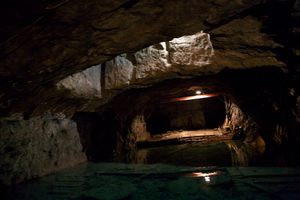
Extensive archaeological excavations completed in this striking geologic formation outside Baden, Austria, helped bestow the term "Baden culture" upon a Copper Age civilization that once lived in the central Danube region. In the course of these 1920s excavations, early Neolithic ceramics, a clay spoon from the Lengyel culture, ceramic parts from the Bronze Stone Age, jewelry from the Copper Age, and part of a coin from the Roman Emperor Gratian were found. This proves a long history of settlement in this area. However, the name "Baden culture" was only introduced in 1956 by the Hungarian archaeologist Janos Banner. The cave has been a natural monument since 1973 and is now also popular for bouldering.
A less scientific local legend explains how the cave and its giant boulder centerpiece came to be. Long ago there was a very large and heavy rock formation in the narrow Wolfstal, a valley near Baden. Not even the power of 100 horses could move the rock. The devil thought that this would be the ideal place to prove his strength, and after making his way to the rock, he put it on his head like a hat. He ran around proudly, shouting: “Who can defeat this rock like me? Not even the one who made it will succeed.” Suddenly a bright light shone and God appeared. He took the rock formation from the devil's head and put it on his little finger. Then he put it down where it is today. The devil was blinded by the light, and ashamed of his boastfulness. He retreated into the cave that had just formed and was never again seen in this area.
Even today, you have a completely clear view of the sky through the large hole in the ceiling of the cave. And you can see exactly where the devil's head and the little finger of the Lord God used to be.
Related Tags
Know Before You Go
The cave can be reached at any time, coming from Baden via a narrow path.
Community Contributors

Added By
Published
July 20, 2026