How One Woman Retraced Her Ancestry to a Single Enslaved Girl
A family history 300 years in the making.

Listen and subscribe on Stitcher, Apple Podcasts, Spotify, and all major podcast apps.
Thomalind Polite: I was 19. I was still in college and I wasn’t really, you know, I wasn’t a history buff and, you know, of course slavery, we all knew of slavery, all knew of the history. But I went to a predominantly white high school, so it was like one chapter and that was it.
Baudelaire Ceus: This is Thomalind Polite. Back in 1992, Thomalind was a freshman at South Carolina State, which is about an hour and a half from where she grew up in Charleston. One day, as she’s going about her business, her dad calls.
Thomalind: My dad’s like, “I need you to come over the weekend.”
Baudelaire: When Thomalind gets home, she walks in to find her dad standing over her kitchen table. There’s a family tree laid out and there’s a man, a white man, there with her dad. Thomalind didn’t recognize the man, but she did recognize a couple faces on the family tree.
Thomalind: I know that’s my dad, you know, and this is my granddad.
Baudelaire: The strange man standing in her kitchen was Edward Ball. Ball had contacted Mr. Polite for one reason: He had a connection to their family tree.
Thomalind: He kept going back and back and back. And he said, “I have traced through my family’s records, your family’s records, to this little girl who was named Priscilla by my ancestors.” And he said, “We don’t know her real name, but we know that she was called Priscilla once she was purchased by Elias Ball.”
Baudelaire: The moment was surreal. The descendant of a slave owner had come looking for the descendants of the enslaved. But this moment was just the beginning of an incredible journey. Today, the story of Thomalind and Priscilla, which takes us to a small island off the coast of Sierra Leone called Bunce Island. It’s the story of a slave castle and a homecoming 300 years in the making. We are now home. I’m Baudelaire, and this is Atlas Obscura. Stay with us.
This is an edited transcript of the Atlas Obscura Podcast: a celebration of the world’s strange, incredible, and wondrous places. Find the show on Apple Podcasts, Spotify, and all major podcast apps.

Baudelaire: When I first started reporting on this story, I focused on the history of Bunce Island. I didn’t know about Thomalind’s story at all. I actually heard about her from this guy.
Melbourne Garber: My name is Melbourne Garber. I’m a structural engineer by profession.
Baudelaire: Mel was born and raised in Sierra Leone, but these days he works as an engineer in New York. Growing up, he wasn’t really into the history of his homeland, but as he got older, he got more interested.
In the mid-2000s, Mel attended a lecture at Howard University in D.C. It was an American anthropologist named Joseph Opala giving a presentation about this small island off the coast of Sierra Leone, Bunce Island. After the talk, Mel met Joseph Opala, and when Opala heard he was an engineer, he lit up.
Melbourne: He goes, “You are the person I need to talk to because we need to preserve this place.”
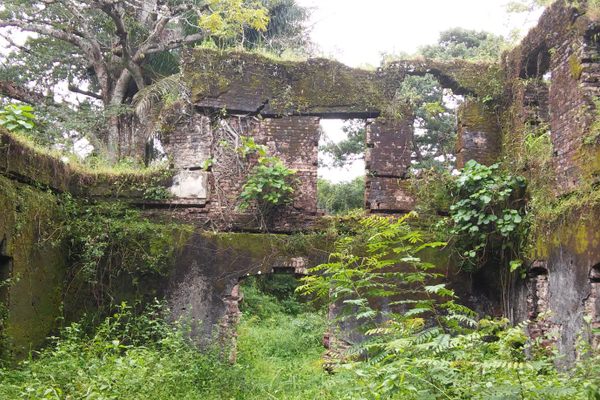
Baudelaire: From the 1500s until the late 1700s, Bunce Island had been the site of a slave castle, a place where kidnapped Africans were held before being shipped to the Americas. It was abandoned in the early 1800s, shortly after the slave trade was abolished.
Melbourne: When I first went to Bunce Island, you could see areas of the fort that needed to be stabilized. Things were falling apart, and we don’t advocate rebuilding the fort to like what it was in 1796, because even the abandonment tells a story. You know, the trees that have grown there tell a story.
Baudelaire: Bunce Island is about 13 acres, or half the size of Ellis Island in New York. Over its history, it’s estimated that around 30,000 Africans were shipped from Bunce Island to the Americas. There were Africans from several tribes on the mainland of Sierra Leone, and the British would pit them one against the other. They would fight, and often they would sell their captives to the British at Bunce Island.
Historians suggest that the tribal chiefs would do this to avoid their own people being kidnapped and taken into slavery. Bunce Island started to get a reputation among the tribes of Sierra Leone. Here’s what Mel Garber told me about a time a victorious chief took his captives to Bunce Island.
Melbourne: The story goes that whenever he came there, he was carried. He was carried. His feet never touched the ground. They would transact their business, and then put him back on the boat, and he would go. Because they had a belief that the place was cursed.
Baudelaire: Cursed? Maybe. Brutal? Absolutely. The people held there were chained in groups of tens under 24-hour watch. They were just a couple miles off the coast of their homeland, but they’d never set foot in Africa or Sierra Leone again.
In the 1700s, colonists in Georgia and South Carolina had started growing rice. The climate there was good for it. When the owners of these rice plantations heard that Sierra Leoneans were skilled at growing rice, pretty soon there was a demand for enslaved people from this area.
Melbourne: These enslaved Africans ended up being bought for a higher sum because they had a skill that was needed. And they created the plantations in South Carolina and Charleston. And in fact, for about 100 years, Charleston was the richest city in the Americas because of this rice plantation. So this is why there’s a strong connection between Sierra Leone and Charleston.
Baudelaire: That connection is still maintained to this day. In the region from the coast of North Carolina all the way to northern Florida, there are the Gullah Geechee people, a group of African Americans who, to this day, show a lot of direct connections with Sierra Leonean culture.
Like, in Sierra Leone, they make jollof rice, a red rice dish that is incredible, by the way. Well, the Gullah Geechee make red rice. In Sierra Leone, they weave these specific type of baskets called kublai. The Gullah Geechee make those same baskets and call them sweetgrass baskets.
But a connection that I really found interesting starts with this song. In 1933, an African American linguist named Lorenzo Dow Turner traveled to Georgia to record members of the Gullah community telling stories and singing songs. Decades later, a team of anthropologists traveled through Sierra Leone, going from village to village, playing this recording from Georgia. In one village, a woman started singing along. Word for word.
So yeah, the connection is strong. In the early 2000s, the Sierra Leonean government wanted to celebrate the connection and invited some of the Gullah Geechee from the U.S. to visit Sierra Leone as part of a homecoming. I had learned of this larger homecoming in my research, and it sounds pretty dope. But what I didn’t know about was this more specific homecoming. Here’s the moment in my interview with Mel Garber, where he told me about the story of Priscilla and Thomalind.
Melbourne: I don’t know if you’ve ever heard of the Ball family.
Baudelaire: I have not, no.
Melbourne: They were slave owners in South Carolina. They kept meticulous records of their enslaved Africans. In the early 2000s, they actually identified a family who lived in Charleston, who were a direct descendant of an enslaved girl who had come from Sierra Leone.
Baudelaire: Wow!
Thomalind: So here comes Edward Ball, and the person, Elias Ball, was his ancestor who owned the slaves. So he comes to the house, and my dad’s like, “I need you to come home for the weekend …”
Baudelaire: So that brings us back to the scene at the kitchen table. That was back in 1992, when Thomalind Polite was still in college. A few years later, Edward Ball published a book based on his research. He called it Slaves in the Family. It won a National Book Award, and eventually, the government of Sierra Leone heard about it.
Sierra Leone had recently hosted the homecoming of Gullah Geechee, but the story of Priscilla was next level. Sierra Leone wanted to invite Thomalind to visit the homeland of her ancestor, Priscilla. By this point, Thomalind had been out of college 10 years. She had a career and a family, and again, was just going about her business when Sierra Leone reached out.
Thomalind: They actually sent a letter that was a personal invitation to come to Sierra Leone, to come to our homeland, is how it was described.
Baudelaire: It was May of 2005 when Thomalind and her husband got on a plane. She didn’t know what to expect and didn’t really know how to feel. What you’re about to hear is from a home video that Thomalind and her family took during their trip.
Thomalind: The thing I’m looking forward most is the fact that I will get a chance to walk on the soil that Priscilla walked on. I will get a chance to see the things that she saw. I know it’s going to be emotional, an emotional experience, but it’s an experience that I want to happen.
Greetings, my brothers and sisters.
Baudelaire: When she got off the plane, the welcome was like nothing she could have imagined.
Thomalind: Thank you for welcoming me and my family today. We are now home.
There were like, I don’t even know how many people just to greet us.
And Priscilla is now home.
And had libation ceremony for the ancestors. And, you know, everyone was just, just the feel of it. It was so euphoric. And so, for me, humbling. It was like I was floating. And I was like, “Am I really here? I’m really here representing my family and representing Priscilla. I’m actually bringing back the spirit of a 10-year-old girl who was kidnapped never to return again, but yet she returned through me.”
Baudelaire: And I should mention she was pregnant at the time, so her son was there with her too.
Thomalind: Who would have thought that an actual blood relative of someone who was kidnapped would ever be able to return? And just to know that I don’t just have a connection to a place, a country, a region, but I have a connection to an actual person.
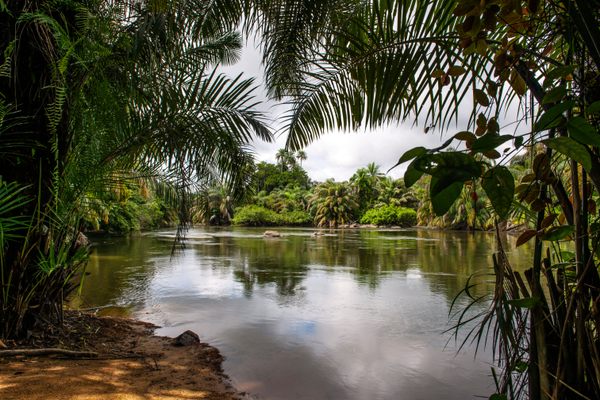
Baudelaire: For an entire week, Thomalind was escorted around by the government as a guest of honor. One day, they took her to visit that small island off the coast where Priscilla took her last steps on the African continent.
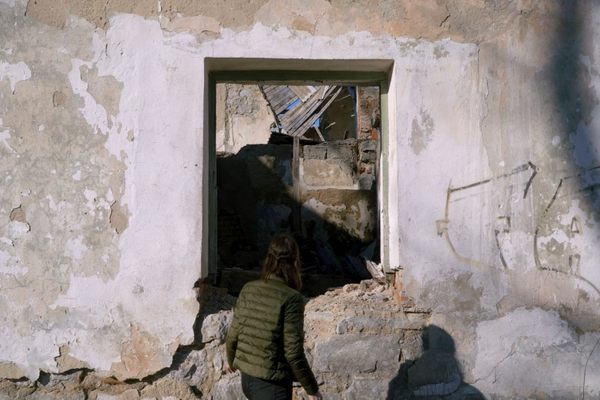
Thomalind: We visited Bunce Island. Of course, it was mostly ruins, but you could just sense the spirit there. You can just sense the injustices. You know, there were remnants of the cannons that were facing the oceans and, you know, the jetty was there. It was washed away, but it’s still, part of it was there where, you know, Priscilla and so many of the other Africans took their last steps.
Melbourne: We wanted to make sure that, you know, what is there is preserved for posterity. Hopefully for the next hundred years, people can still go there and find out more about the history.
Baudelaire: It’s not the happiest chapter in this country’s history, but it’s a history that needs to be preserved. For Thomalind, the connection to that history was very, very personal. And, you know, I got to say, after talking with Thomalind, it struck me just how incredible it is that Thomalind was the person that made this journey.
I mean, I could definitely see someone else being kind of shy and not really completely appreciating the full meaning of it all. But Thomalind, in a way, she was the perfect person. When you hear her talk about the whole experience, you could tell she came away from it with an incredible perspective.
Thomalind: You know, it took months before I can really express the meaning and how deeply moved and how life-changing that experience was. And when I was there, no one called me by my name. So I was always Priscilla anywhere I went. So it again just instilled in me that I am carrying—and they are looking at me as carrying—her spirit and bringing her finally back home.
Baudelaire: I just want to thank Melbourne Garber and Thomalind Polite for sitting down with me to discuss the history of Priscilla and Bunce Island for today’s episode. Special thanks to the Archives of Traditional Music at Indiana University, home of the Lorenzo Dow Turner Collection. In this episode, we heard the song, “A Mende,” sung by Amelia Dawley and recorded by Lorenzo Dow Turner on July 31st, 1933.
Listen and subscribe on Apple Podcasts, Spotify, and all major podcast apps.
This podcast is a co-production of Atlas Obscura and Witness Docs. This episode was edited and mixed by John DeLore. Our production team includes Dylan Thuras, Doug Baldinger, Chris Naka, Kameel Stanley, Willis Ryder Arnold, Sarah Wyman, Manolo Morales, Gianna Palmer, Tracy Samuelson. Our technical director is Casey Holford.
This story originally ran in 2022; it has been updated for 2025.





Follow us on Twitter to get the latest on the world's hidden wonders.
Like us on Facebook to get the latest on the world's hidden wonders.
Follow us on Twitter Like us on Facebook