This Musical Robot Celebrates Toronto’s Vibrant Rhythms
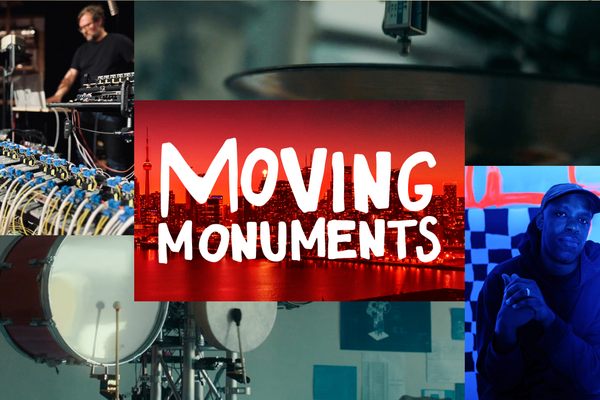
Pieced together from unassuming objects gathered throughout Toronto, “Moving Monuments” is a love letter to the city and its people.


Listen and subscribe on Apple Podcasts, Spotify, and all major podcast apps.
I’m Kelly McEvers, and this is Atlas Obscura, a celebration of the world’s strange, incredible, and wondrous places. This episode was produced in partnership with Destination Toronto. And today, I’m talking to the artist and architect Danny Shaddick and the rapper Shad about this incredible collaboration of theirs that is a tribute to the City of Toronto.
Danny and Shad have known each other since high school. They both wound up in Toronto making art together. And now they have made this thing called “Moving Monuments.” It is a musical robot that incorporates drums, actual physical pieces of the city of Toronto, and sounds of the city.
If it is hard to picture this, luckily I have them here to tell us all about it.
This is an edited transcript of the Atlas Obscura Podcast: a celebration of the world’s strange, incredible, and wondrous places. Find the show on Apple Podcasts, Spotify, and all major podcast apps

Kelly McEvers: Danny and Shad, welcome.
Danny Shaddick: Hi Kelly.
Shad: Hey.
Kelly: Okay, Shad, tell me about the first time you saw it.
Shad: Well, okay, I’m gonna go back because there’s another robot that Danny had made that he showed me.
Kelly: Got it.
Shad: We’ve known each other for years, we’ve been friends for years, so just being in his apartment, I want to say a couple of years ago now. And he takes me to a guest room. I think it’s a guest room. Danny can correct me if I’m wrong.
Danny: Yeah, yeah. I think it was just last summer.
Shad: Last summer. Opens a door upstairs to his guest room, and you can’t even step in it. It’s just all drums and percussion and wires, and it just looks amazing. It was just stunning to watch, and then he fired it up for us, and it sounded so cool. And then I also recall seeing this instrument, the one for this project, for the first time, and it was … so yeah, I remember walking into the studio where he was building that, and it was likewise so cool. It’s a little bit more compact and streamlined, but still has the mad scientist vibe.
Kelly: There’s also a Toronto element, right, to the piece. Like, what was the driving idea of that part of the piece?
Danny: Yeah, there was a really amazing book called The Inner Studio, authored by Andrew Levitt. And at the end of that book was a beautiful little essay on Toronto and sort of tracing through the history of the city and sort of what makes it unique in the context of other world cities.
So, you know, we’re relatively young, so our celebrated monuments aren’t necessarily these thousand-year-old statues and churches, they’re cultural and social events, they’re our parades and our festivals. And so that’s where the title of our collaborative piece came from, “Moving Monuments,” was referencing a subtitle from that essay, which was titled “Monuments That Move.”
Shad: Yeah, I resonated with it immediately. I just felt like the essay articulated and elaborated on something that I’ve been trying to name, I had been trying to name for a while about Toronto.
Anytime I’m having conversations with people about Toronto, I’d always been trying to articulate this idea that we get together for fun. That’s what we do. You know, we don’t have mountains to hike, we don’t have you know, I’m comparing it in my mind to Vancouver, like in terms of this participation with nature that is wonderful in its own right, but just …
No, Toronto, what we do for fun is we get together. We love large crowds, we love music, we love small crowds, we just love being together, and that essay, it just hit the nail on the head for me. We have these monuments that move.
Kelly: Yeah, I was just gonna say, like at the core of festivals and parties and playing music is people, right? It’s the people that make the city, and that is what you’re saying with this piece. So yeah, how to represent that in a physical piece that plays music and incorporates all these found objects. Yeah, Danny, how do you describe it to people who can’t see it?
Danny: Yeah, to describe the drum tower.
Kelly: Drum tower, that’s a good start.

Danny: It’s a 10-foot-tall box truss. And the truss is actually designed for lighting and stage design. So it’s a very familiar kind of structural element. And it’s just sitting vertically like a column, and then there’s about a dozen or so percussion instruments.
So actually, all of the percussion pieces in the drum tower robot have been sourced secondhand from other musicians in the city via you know Facebook Marketplace, Kijiji platforms like that. And then there was another layer to that where we were allowed access into the public transit, subway, and streetcar maintenance yards to retrieve some old bits of trains and subway trains that were set to be disposed of or that were retired from service and incorporate them into this robot to get a little bit of that kind of junkyard clangy, really fun sort of percussion sounds.
Kelly: Wow.
Danny: So there’s a big bass drum, floor tom, a couple snare drums, bongo drums, some cymbals, hi-hats, and they’re all kind of branching off of this central spine. And the lower portion of it has some of the more found objects, like some of the steel and metal elements that we salvaged.
And then there’s a layer on top of that that kind of I guess gives it that that mad scientist vibe where it’s a bunch of motors that connect to drumsticks and attached to each one of those is a whole bunch of wires, and then there’s a big brain at the back that receives all the wires, and that sort of circuit hub then connects out to a laptop, a computer. And then the whole thing can just be automated and programmed to play whatever you want it to play.
Kelly: Wow, okay.
Danny: It’s really fun to play with.
Kelly: Yeah, I want to do that. Like right now. I’m like, let me get it. So then Shad, then you come in. How does it actually work for you to make a song with this robot? Help me see that.
Shad: Okay, so yeah, I think you can imagine us in Danny’s studio that he had to build the drum tower. So it’s a big space. Obviously, you need a big space to fit this 10-foot tower so we can start cooking.
And one thing I was thinking about in terms of writing was we played with some ideas of what if it started simple then started to build up, right? So that people can really watch and appreciate that this thing is playing in real time.
Kelly: Right, so you can take the information in piece by piece, so your brain doesn’t explode, basically. Yeah.
Shad: Exactly, exactly. So I was thinking about that a little bit, and then on another level, uh, of course, it’s like an ode to Toronto. So I’m thinking about lyrics that really speak to Toronto and speak to specifically this theme of “Moving Monuments” and people getting together and that sort of thing.
Danny: One other aspect to the audio is that we layered in a bunch of field recordings that were collected throughout the last year in the city.
Kelly: Right. And are you firing those real time? Was Shad like, you know, calling for them, or were you like, “Hey, you want to hear this right here?”
Danny: We did a bit of that. We were like, “Oh, where can we have a little bit of people sounds?” Or, we threw in a little shout out to Lansdowne Station, the voice that announces the subway stops.
Kelly: Yes.
Danny: You know, it’s funny, it resulted in a few conversations about, you know, urban soundscapes and what really defines a place sonically. I mean, what’s the difference between a crowd of people talking and some cars driving by in Toronto versus Vancouver versus anywhere really? Aside from the language being spoken.
It tends to be these little sounds that are very characteristic to, in a lot of cases, public transit. You know, you hear a certain chime, you hear a certain voice, and you know, “Oh, that’s the New York City guy,” or you know, “Those are the Toronto subway chimes.” Yeah, what other sounds can really start to represent a place?
Kelly: Well, yeah, and like we were saying, it’s about people, right? The character of the city is people and people moving through the city, right? That’s how you get around, is transit. What are some of the pieces that you took from the train yard? You were talking about, you know, actual physical objects. What are those and what did they sound like?
Danny: There’s about six to eight just chunks of metal. One of them I could recognize was a threshold at the edge of one of the floors where the train meets the platform. There’s a particular aluminum piece of trim.
One of them is one of those hand stanchions, those handrail things that hang from the ceiling of the subway train. And you can really recognize that one because it’s got the little handle bit that sort of springs around. And each of them have, you know, they’re not intended to be musical, but they end up having little interesting kinds of tonalities sometimes.
Shad: Part of the fun of it for me—coming from hip hop, which is this world where anything is musical. All sounds are music, like anything can be used. You know, that’s one of the core insights and contributions of hip-hop really is we’ll sample anything when we recognize that there can be a musical quality to almost anything.
The transit sounds in a city. We don’t necessarily think of them as musical, but you know, just about anything if you repeat it, you know, if there’s some tones there and you repeat those tones, sometimes there’s a melody there, or sometimes there’s a groove there, sometimes there’s a rhythm, there’s something unexpected.
And so part of the fun for me is just listening to Danny play with some of the found sounds, some of the ground, the recordings. Then just listening for oh, that’s actually kind of a funky rhythm there that came from—I’m not sure what that was, a busker in a busy subway station. But once he’s manipulated it and looped it, man, it actually has a groove.
The announcement of Lansdown Station, if you repeat that a couple times, I don’t know. It kind of has a little bit of a hooky, hypnotic melody to it. And so let’s throw that in there, and it also speaks to home. And that’s also very much part of hip-hop, where you represent where you’re from, you know. So that’s our place. That’s our station.
Kelly: We’ve been talking so much about this song. Now I just really want us to take a second and listen to some of it. Let’s do that now.
Shad: Fun.
Danny: Shad, you’re so good.
Kelly: Wow, you guys. Wow, yeah. It’s so cool to hear it now after talking to you. One thing I wanted to—we’ve been calling it the tower. I wondered, I hadn’t asked this before, but like, does the robot have a name?
Danny: We didn’t really, I mean it just sort of took on this drum tower name.
Shad: It would be fun though to give it just a very human name.
Kelly: Yes.
Danny: Gary?
Shad: It’s just Denise, or …
Kelly: Denise!
Shad: You know.
Danny: Denise.
Kelly: I was just imagining you, Shad, going over to Danny’s house and being like, “Gonna go hang out with Denise.”
Danny: Just hanging with Denise.
Kelly: I love that. That was artist Danny Shaddick and rapper Shad. They’re both from Toronto, and they are the people behind the musical robot and song that you are hearing now. If you want to learn more about “Moving Monuments” and Denise, we actually have a short documentary about the project. You can watch it and listen to the whole song on our website. There’s a link in our episode description.
Listen and subscribe on Apple Podcasts, Spotify, and all major podcast apps.
This episode was produced by Johanna Mayer. Our podcast is a co-production of Atlas Obscura and Sirius XM podcasts. The people who make our show include Dylan Thuras, Doug Baldinger, Kameel Stanley, Manolo Morales, Amanda McGowan, Casey Holford, and Luz Fleming. Our theme music is by Sam Tyndall.
Sponsored by Destination Toronto.




Follow us on Twitter to get the latest on the world's hidden wonders.
Like us on Facebook to get the latest on the world's hidden wonders.
Follow us on Twitter Like us on Facebook