
From the east coast Corsican town of Bastia, I hopped a whirlwind ferry followed by a forgettable train from Livorno to Florence, arriving in the middle of the night. By the next morning, I was in a car on my way into the central Apennine foothills with Italian researcher Alberto Masoni. My mind must not have kept pace with the rest of my body because even as our elevation climbed, my head felt deliriously stranded at sea.
With Tuscany’s famed vineyards propagating below, we floated up into the thick tree cover of Parco Nazionale delle Foreste Casentinesi. Pulling over on the roadside, Masoni pointed uphill, where we’d begin our short trek. About ten minutes later, we approached the first mound, maybe five feet tall.
I asked Masoni how many ants might live in this bulbous dome.
"Half a million," he nonchalantly estimated.
"And that one?"
"Same."
Surveying the hillside, dotted with mound after mound after mound, I did some quick back-of-the-envelope calculations, which revealed the total population in this area to be roughly . . . 100 million? Could that possibly be right?
"Somewhere around there, yeah," he said. A fresh wave of lightheadedness overtook me.
These giant haystack-looking mounds were created by red wood ants (Formica paralugubris), intentionally transplanted by researchers in the 1950s in an effort to push back on other local insects they viewed as pests. Many wood-ant nests were moved here from the Alps, of which three or four survived. Since then, they have expanded to at least six hundred mounds in this national park alone. Masoni has mapped them all.
Each mound contains hundreds of chambers, tunnels, and rooms, Masoni said, some of which are reserved for specific times of the year. In winter, for instance, the ants will cluster themselves in the lower chambers of the nest, which are connected to the outside by tunnels that lead to the top. The heat produced inside the nest structure is sufficient to keep the mound tops snow-free.
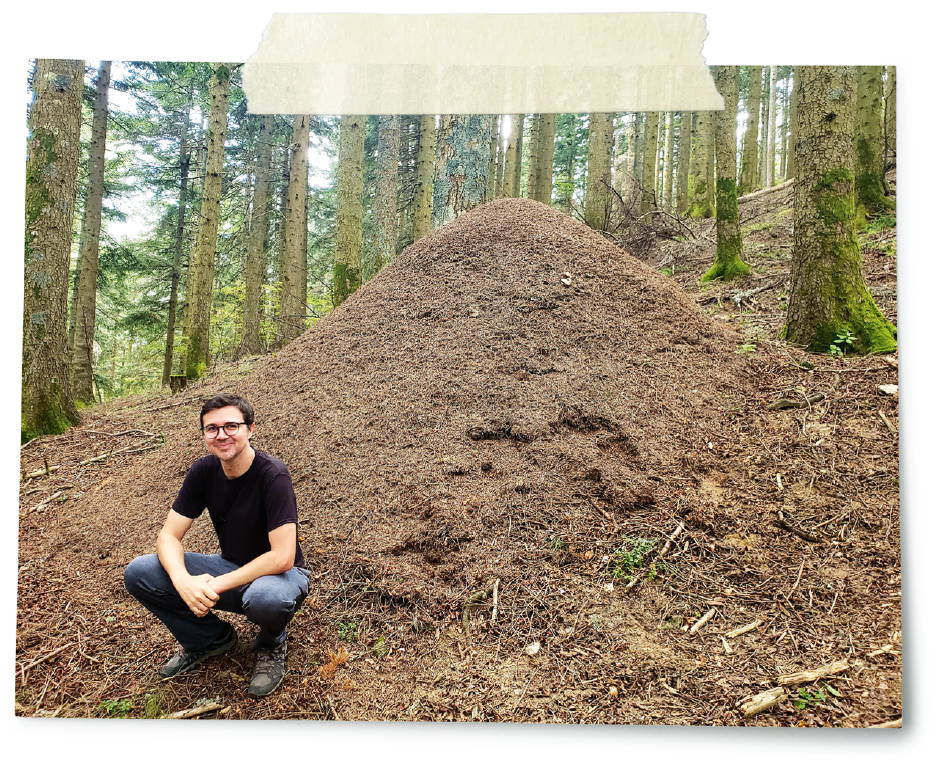
These forest cities are also interconnected by bustling pheromone highways, which facilitate free transit between central hubs. As I inched closer to a mound's surface, a dizzying operation was revealed as a seemingly infinite number of individuals popped in and out of various exterior doorways, industriously transporting and exchanging raw materials to and fro.
Wood ants tend to prey on and push out other insects who stand in their way, though thankfully they inhabit a different elevation from the notoriously competitive Argentine ants who live at sea level and maintain a 3,600-mile coastal empire from Portugal to Italy—what researchers have called "the largest cooperative unit ever recorded." As a result, the two species do not currently clash over territory. "If they did," Masoni said, chuckling and waving his hands in a fuhgeddaboudit tone, "by god, could you imagine?"
This post was adapted from the author's forthcoming nonfiction travelogue, The Hidden Nations of Animals.


