Forestiere Underground Gardens: A Hidden Oasis
In these underground gardens, you can pluck oranges from 113-year-old trees and nap under a fish pond.

Listen and subscribe on Apple Podcasts, Spotify, and all major podcast apps.
Dylan Thuras: Say you find yourself in Fresno, California, on a sweltering summer day. The temperature gauge on your car hovers around 110 degrees, and there’s sweat dripping down your face. There’s one place you can go to escape the heat, no air conditioning necessary. But to get there, you kind of have to know where to look.
Cami Cipolla: We’re very unassuming from ground level. People park, and they get out of their cars, and you’re kind of just looking around. From ground level, we don’t look necessarily like a whole lot, because everything’s really underground.
Dylan: But then, near this nondescript parking lot, you’ll see a staircase.
Cami: Once our guests start walking down our entry staircase, and they start feeling that 10 degree temperature difference, and they’re looking at these man-made walls and this citrus that’s growing 10 feet underground, they’re just blown away.
I’m Dylan Thuras, and this is Atlas Obscura, a celebration of the world’s strange, incredible, and wondrous places. Today, we are taking you to an underground oasis, a winding maze of rooms and passageways filled with lush citrus trees. But all of this is the product of one man’s dedication and work over four decades, a visit to the Forestiere Underground Gardens in Fresno, California.
This is an edited transcript of the Atlas Obscura Podcast: a celebration of the world’s strange, incredible, and wondrous places. Find the show on Apple Podcasts, Spotify, and all major podcast apps.

Dylan: Think underground gardens, and you might picture someone growing plants in their basement under a huge bank of fluorescent grow lights. A kind of dark, damp, and humid experience. But Cami Cipolla, who’s the operations manager of the Forestiere Underground Gardens, says that their garden is the exact opposite.
Cami: Because he’s got these skylights and these little, we call them peak holes, that let light in and air in everywhere. It’s very light and airy, and there’s never really that long of a passageway before you get to another room that’s nice and open or has a nice big skylight.
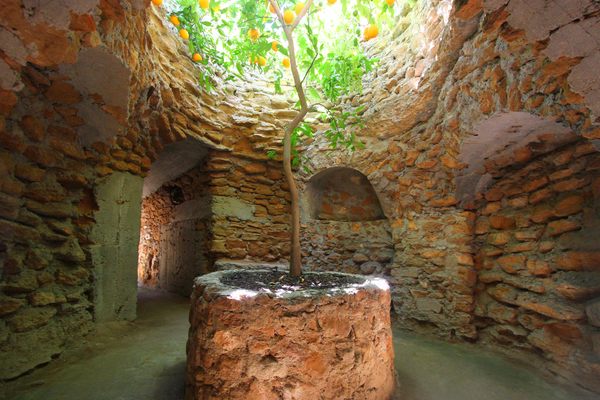
Dylan: A walk through these gardens takes you through winding, arched passageways. You’ll come across small living spaces, bedrooms, kitchens, with beautiful hand-painted frescoes. There are courtyards. There is a ballroom. And punctuating most of these spaces are these skylights, opening up, punching up into this blue sky above, letting all of that light in.
And underneath these skylights are a sight that seems pretty implausible. These citrus trees, overflowing with fruit, growing underground, reaching up through the skylights towards the sun. It’s a sight that Cami says you really have to see to believe.
Cami: Pictures, video, all of that, it gives you an idea, but it’s nothing like actually being there and, you know, smelling the citrus, seeing the lemons and the oranges growing on trees and just feeling that sense of serenity. It’s pretty amazing.
Dylan: The Forestier Underground Gardens are huge. Today, this maze of rooms and courtyards covers almost three subterranean acres. It used to be even bigger. More on that in a bit.
For now, the amazing thing to know is that these gardens were dreamed up and built entirely by one man. And his story starts not in California, but on the other side of the country. Well, really on the other side of the world.
Let’s go back in time for a second, to 1901. A man named Baldassaree Forestiere is deep underneath the city of Boston, digging a tunnel for a subway train. Baldassare is an immigrant from Sicily. His father is a citrus farmer, and someday, when his father dies, the family farm will be passed along to Baldassare’s older brother. Baldassare knows that if he wants to make something for himself, if he wants his own farm, he’s going to have to go it alone.
So that is how he ends up in America. It’s where he finds a job as a day laborer, digging these subway tunnels. But all day long, he dreams of the farm, and of citrus. One day, Baldassare hears that there’s farmland for sale out west in California. A land of plenty. And so, he starts saving up his money.
Cami: He found 80 acres that he bought for $80. And he was really excited. He was like, “Hey, there’s citrus growing everywhere. There’s stone fruit growing everywhere. There’s nuts and grapes and raisins. This is going to be perfect.”
Dylan: Then came the moment of truth.
Cami: So when springtime comes, he gets out his pick and shovel, and he’s ready to go. And …
Dylan: Baldassare does not hit lush soil ready for planting. What he hits is hardpan, a tough sedimentary rock. This hardpan makes it almost impossible to grow the citrus trees that fill his dreams. And so Baldassare is forced again to put his plans on hold.
Cami: Fast forward a few months into summertime, he gets his next big surprise, and that’s our beautiful warm summers here in Fresno. We’ll have a couple weeks at like 110, and you’re getting this hot, dry, just excruciating heat.
Dylan: Baldassare thinks, “What am I going to do?” His mind wanders back over his entire life up to that point: his childhood in Italy, his work on the tunnels back in Boston. And then he has an idea.
Cami: He later told his brother, “I just had this epiphany, okay, well, catacombs, wine cellars, it’s cooler underground. The subway tunnels I was digging back in Boston, it’s cooler underground.”
Dylan: So Baldassare starts digging, and digging, and digging. First, Baldassare’s plans are modest. To make some money, he gets a job again as a day laborer. And at night, he digs. After a while, he’s carved a little underground apartment for himself. There’s a bedroom, a kitchen, an icebox, a wood stove.
Cami: Well, and some friends that he’d been making in the area would come over after work. You know, they’ve been day laboring all day. It’s cooler at his place because it’s underground. And so he starts getting another epiphany, and that’s, “Well, what if I turn this into like an underground day resort where I can make little grottos and courtyards and the people of the valley can come here, they can eat some citrus, and they can just walk around and just get out of the heat?” So this idea of this day resort just blossoms.
Dylan: Baldassare doesn’t have any formal architectural training, but he reads constantly. And with only shovels, picks, and hand tools, he begins to carve out new spaces, new apartments, beautiful courtyard rooms that open up to the sky, the ballroom. There’s even a room underneath a fish pond so that guests down below can look up through the water and into the sky.
Cami: And in the hottest part of summer, that was the coolest room. He would bring a cot down there and fall asleep watching the fish swim overhead. At the pond level, you could sit on the bench and read a book, feed the fish. It’s pretty amazing.
Dylan: Many of these rooms and passageways are decorated with frescoes, all painted by Baldassare. And of course, in among all these rooms are the citrus trees. They’re grown underneath these skylights in planters that Baldassare filled with good soil that he found through digging or brought in from elsewhere.
Cami: A lot of times when you see citrus trees, they’re actually pretty squat, they’re pretty low to the ground. But with ours, because those trunks are reaching for that sun through the skylight, our citrus underground have these long, skinny trunks. And then they just balloon out the top, almost like if you think about Dr. Seuss’s, the truffula trees. It’s kind of like that. It’s got a long, skinny trunk, and then it’s just poofy at top with oranges and leaves.
Dylan: For 40 years, Baldassare dug, and he planned, and he dug some more, and he never actually ended up opening the gardens up as a day spot, which was what he’d once imagined. Probably because he was always learning, and once he learned something new, he would go back and tinker with the rooms that he had already built. But even so, people got curious about what this guy over in Fresno was doing down there.
Cami: His brother once said, you know, “Very rarely was there ever a time where there was not somebody there just, you know, wanting to see what he was doing and talk to him about what was going on. And, you know, Baldassare would never turn anybody away. He always was willing to share his dream and, you know, share an orange with somebody.”
Dylan: But then one day in 1946, Baldassare fell ill with a hernia, perhaps not that surprising after so many years of hard physical labor. And he went to the hospital, and he did have a successful surgery, but then he came down with pneumonia. And on November 10, 1946, Baldassare Forrestier died. He was only 67 years old.
Baldassare never mapped the full extent of the gardens before he died, so it’s unclear just how far and wide they once reached. But Cami estimates that they once spread across as much as 20 to 25 acres. But after his death, the state of California bought up much of the land that he owned.
Cami: The state came in with eminent domain and took the property to build a freeway, Highway 99. And so all of those rooms to the west of our acreage got caved in to build. What we have left, our little five acres, that’s what we have. And I mean, two-and-a-half of our five acres is all underground. It’s sometimes a little overwhelming to think that he had 10 times that much at one point. That’s, you know, that’s gone.
Dylan: Baldassare never married or had kids himself, but today the gardens are managed by a trust operated by his younger brother’s descendants. And you can come visit the courtyards and passageways that were all dug by Baldassare. And you can take a walking tour or do a yoga class or buy goods from local businesses at the artisanal marketplace events. And there is another way to enjoy the fruits of Baldassare’s labor, which is literally.
Cami: About 90 percent of our trees are original. And one thing about citrus is normally they’ve got a 40 to 50 year lifespan. We have trees that are about 113 years old. So we’ve more than doubled that lifespan on those trees just by them being a little bit more protected because their root system and their trunks are underground. And the fruit still tastes good. We always joke that it’s been aged to perfection. So it’s pretty amazing. I mean, you could walk around ground level and pluck the oranges right off the top of the tree. It’s pretty cool.
Dylan: The Forestiere Underground Gardens are open Monday through Sunday from 9:00 to 3:00. In spring and summer, they also sell three varieties of oranges, two varieties of lemons and grapefruit, all from Baldassare’s citrus trees. They even sell pomegranate in the fall. You can reserve tickets online and find out more information about their events at undergroundgardens.com. Special thanks to Cami Cipolla for telling us the story of Baldassare and his incredible, amazing underground gardens.
Listen and subscribe on Apple Podcasts, Spotify, and all major podcast apps.
Our podcast is a co-production of Atlas Obscura and Witness Docs. This episode was produced by Amanda McGowan. The production team includes Doug Baldinger, Chris Naka, Kameel Stanley, Willis Ryder Arnold, Sarah Wyman, Manolo Morales, Gianna Palmer, Tracy Samuelson, John DeLore, Peter Clowney. Our technical director is Casy Holford. This episode was mixed by Luz Fleming. Our theme and end credit music is by Sam Tyndall.
This story originally ran in 2022; it has been updated for 2025.



Follow us on Twitter to get the latest on the world's hidden wonders.
Like us on Facebook to get the latest on the world's hidden wonders.
Follow us on Twitter Like us on Facebook