
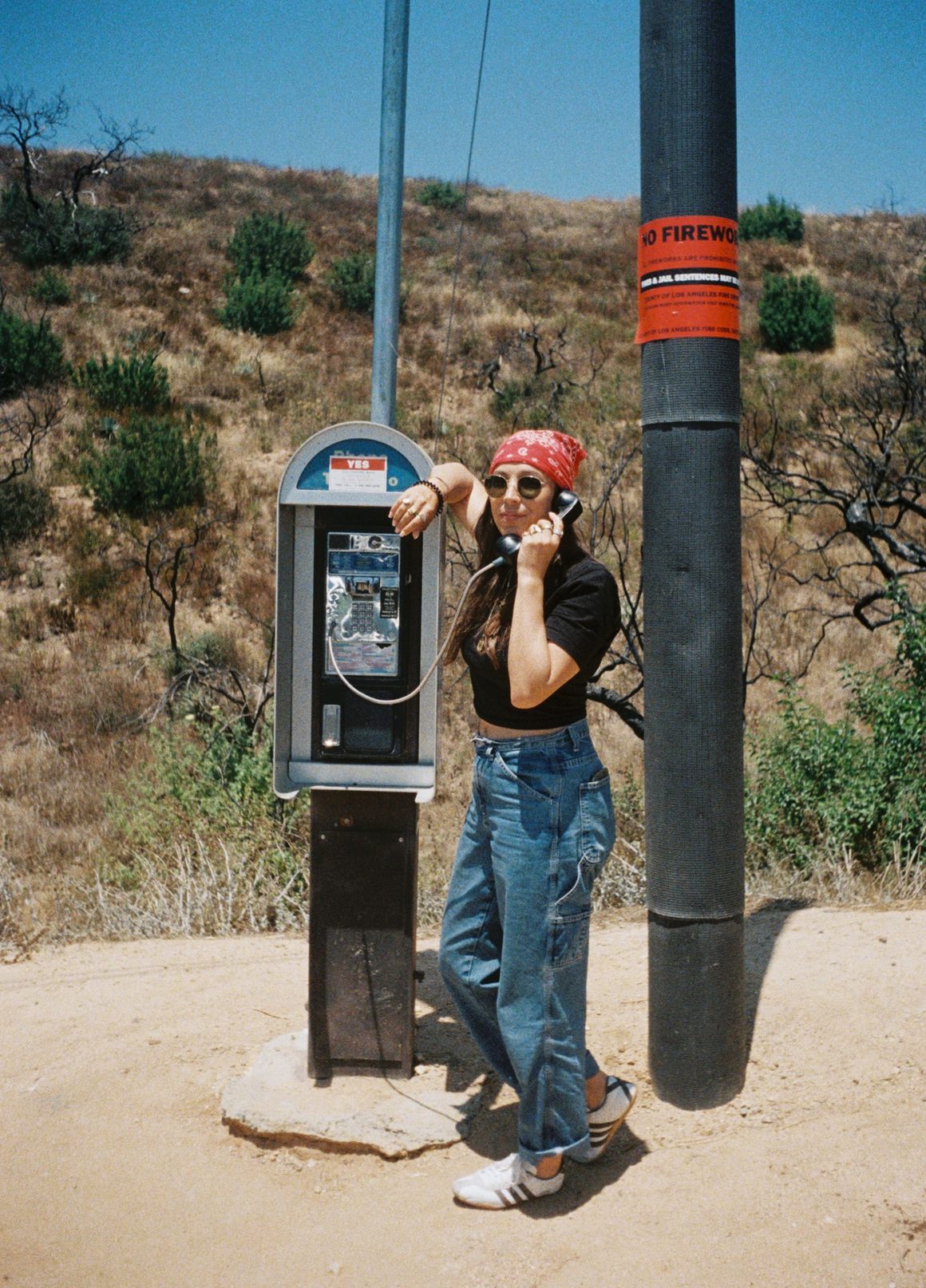
At the edge of the forest in Altadena, a payphone.
A working payphone.
A payphone in Los Angeles already feels rare. A working payphone at the edge of the Angeles National Forest, waiting dutifully for hikers and passersby, feels almost surreal. Like the city forgot to erase one small thing.
I fell in love with that phone before I really understood why.
Maybe it was the setting, a metal box with a dial tone set against dry brush and hills. Maybe it was because it felt useful and forgotten at the same time, which is, evidently, exactly the kind of object that triggers my vulnerability.
The Altadena payphone became the first physical portal for The Goodbye Line, a participatory art project Adam Trunell and I created, inviting strangers to call from working payphones and leave the goodbyes they never got to say.
So yes, this story is a little different from the other Atlas Obscura places I’ll visit this summer. I am not arriving as a total outsider. I am one of the people behind this place. Or at least one of the people who helped nudge what it could do.
Adam and I were finding payphones, checking for dial tones, and placing stickers on working relics to invite strangers to call a toll-free number and say goodbye to someone or something. The idea was simple: a public phone, already overlooked, already built for voices, could become a place to leave the lingering things people had nowhere else to put.
The phone would not answer back. It would just listen.
And the calls started coming.
Ten calls turned into hundreds, then thousands, then tens of thousands of goodbyes spanning the spectrum of human experience around the world.
They called to say goodbye to parents, friends, exes, pets, old apartments, bad habits, younger selves, and dreams they were embarrassed to still miss. They called with jokes and songs, with firm words and shaky voices. They called to say the thing they should have said years ago.
Adam often describes the line in the simplest possible way:
“The line just listens. It doesn’t judge, doesn’t interrupt, doesn’t try to make things OK.”
And it started in Altadena.
The one at the edge of the forest.
The one that changed the way I thought about phones.
But the first real person behind this place, in our story anyway, was not me nor Adam.
It was Steve Littlejohn, who owns many, if not most, of the remaining working payphones scattered around Los Angeles.
Steve is exactly the kind of colorful person you hope is still behind a disappearing piece of public infrastructure: funny, blunt, generous, irritated by bureaucracy, tender about phones, and still keeping the whole thing going, long after the business stopped making sense.
At one point he owned 2,800 payphones.
By 2015, however, he says “the wheels came off this business.” The cell phone became cheaper–in some cases free–and calls dropped fast.
“I don’t make any money at this,” he told me. “I do art projects with kooks.”
Which, in this case, meant us.
Because working payphones do not keep working by accident. Someone has to own them. Someone has to repair them. Someone has to answer when something breaks. Someone has to keep paying attention long after most of us have decided the object is obsolete.
Jeff, a technician with Littlejohn Communications, has watched that world shrink in real time.
He started working for the company in 2002, when pagers were still the shiny object in the telecom ecosystem. Simple magic, good business: someone would get paged, find a payphone. Throw a ball in the air, it comes back down.
Now, he estimates there are only 300 functioning payphones left in the Los Angeles area, many of them in county facilities like hospitals, jails, and other public sites.
And yet, the Altadena phone was always different.
“It was just off the beaten track,” Jeff said, “and I just thought this is amazing that LA County is still operating this phone.”
Steve had another way of describing it:
“It’s a cult phone,” he told me.
He meant the kind of phone people go out of their way to find, photograph, use, remember, and talk about. The Altadena phone even has Google reviews, which somehow feels both absurd and completely appropriate.
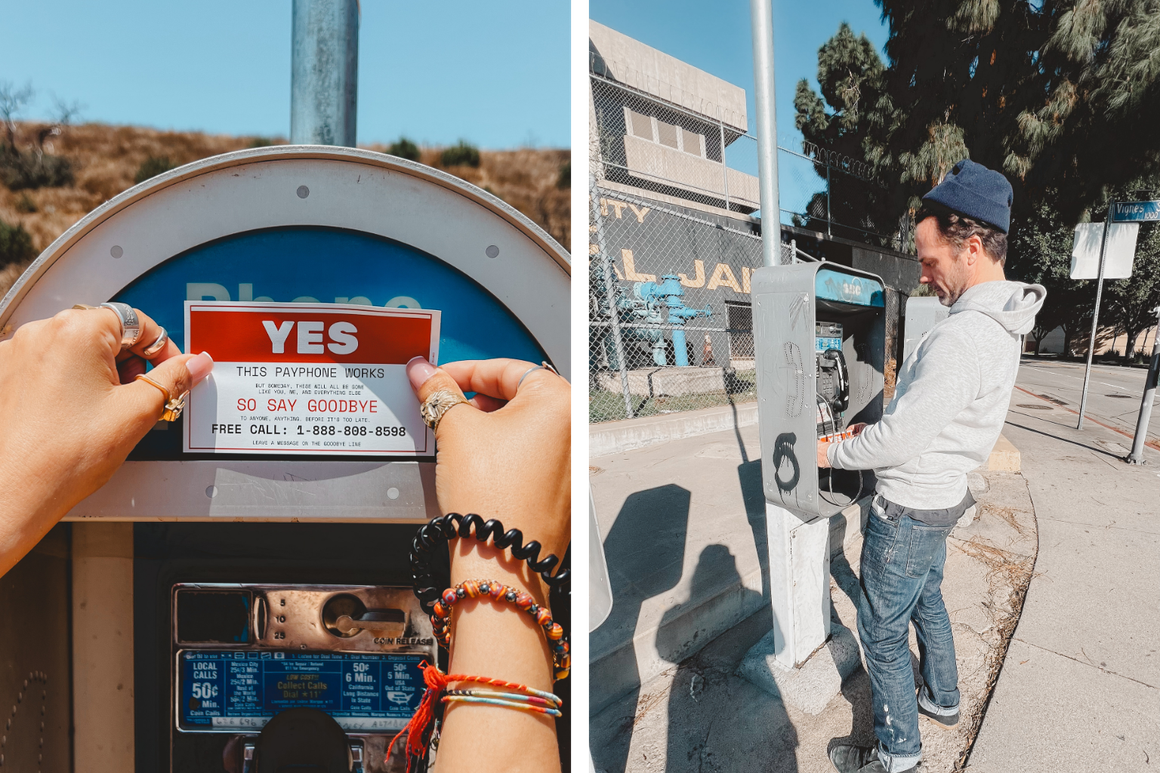
We left an impression on Jeff before we even met.
It was his job, among other things, to remove Goodbye Line stickers from the working payphones.
Which, to be fair, is the right thing to do. If your job is to keep payphones working and maintained and clean, then random, unwarranted stickers do not scream public art project with emotional infrastructure.
“I thought it was just some prankster putting stickers up,” Jeff told me.
When our project somehow ended up on the front page of The Los Angeles Times, Steve tracked Adam down, and they connected like two guys on a party line.
Steve then told Jeff to stop removing The Goodbye Line stickers, Jeff in turn asked for a stack, and the guerilla goodbye project effectively drafted the team whose job it was to take the stickers down in the first place.
That changed the project. It stopped being just Adam and me chasing payphones around Los Angeles and became something more collaborative, more alive. A little less like trespassing and a little more like being invited in.
Perched on her hill above Los Angeles, the Altadena phone cast a long shadow over her lowland cousins peppered across LA. But now we understood that it was, in fact, a family of phones, and real people behind it.
Eyes open, we found a whole payphone world.
One of the first people who helped us see that world clearly was filmmaker Ryan Green, who initiated the Payphones of Los Angeles Instagram account, and likewise, a local movement. His grassroot record-keeping helped us find phones across Los Angeles and beyond.
More importantly, it showed us that payphones were not just relics. They were part of a living, shrinking, stubborn little network of people still paying attention.
As Ryan later put it, “While it may look drastically different than it did in the ‘90s, the payphone lives on in the form of projects like yours, and in organizations that are keeping even the functionality alive.”
Jeff was more practical about it, but no less clear: Do payphones still matter, even now?
“Absolutely,” he said.
A lot of elderly people still do not have cell phones, he told me, or do not want to use them. Hospitals can have bad reception. Some people still need a public phone to call a loved one, a doctor, a prescription line, or someone who can help.
“They absolutely serve a purpose in our society,” Steve told me.
Steve has no patience for the idea that public phones stopped mattering just because most people stopped noticing them. And as far as feelings and payphones go, he’s one to talk.
Before we ever turned his payphones into a place for goodbyes, Steve’s network connected every kind of human sentiment.
At peak call volume, Steve estimates, he had somewhere between 600 to 800 phones in operation. Back then, each phone might take 15 to 20 calls a day. Do the math, and that’s roughly 9,000 to 16,000 calls a day moving through Steve’s phones alone.
Calls to parents. Bosses. Bail bondsman. Husbands, wives, and lovers. Rides home. Bad news. Collect calls. I’m running late. Are you sitting down? I love you.
Five million calls a year carrying the full spectrum of human expression; looking back, he thinks the collapse of payphones was not inevitable. It was a choice.
“The people that are in the FCC should be ashamed of how stupid they are,” Steve told me. “And I hope you write that. I hope you write that up. If there’s one quote for me, that’s it.”
Payphones, to Steve, were never only nostalgia. They were backup. Access. Public infrastructure. A way to call for help when every private device failed.
That is the part that gets lost when we talk about payphones only as nostalgia. For some people, they are still infrastructure.
“That’s why I’m just so honored that we provide a service for them,” Jeff said.
Before The Goodbye Line, I wish I could say I thought of payphones mostly as objects. But I didn’t think of them at all. After Steve, Jeff, Ryan, and the people orbiting this community, I started seeing them everywhere.
The Altadena phone was still the one I measured everything against. Lofty, serene, surreal; if there was ever a payphone that could sanctify the simple words we say to each other, she’d make the call.
That became even clearer after the Altadena wildfires.
The fires that levelled Altadena ran down from the hills where the payphone sat. Once the National Guard began letting folks back into town, we got an update: turns out, the phone and pedestal survived, but the copper lines that connected her were toast. The dial tone was gone.
Because this phone had become more than a phone to us, and to other people too, The Goodbye Line organized a community GoFundMe to help repair it.
People donated. Steve got the gear, Jeff fixed the phone, and the dial tone came back.
I keep thinking about that.
A payphone placed for emergencies became an art portal. Then, after an emergency, the community helped save the payphone.
There is a circle there I do not want to flatten into a perfect metaphor. But I feel it.
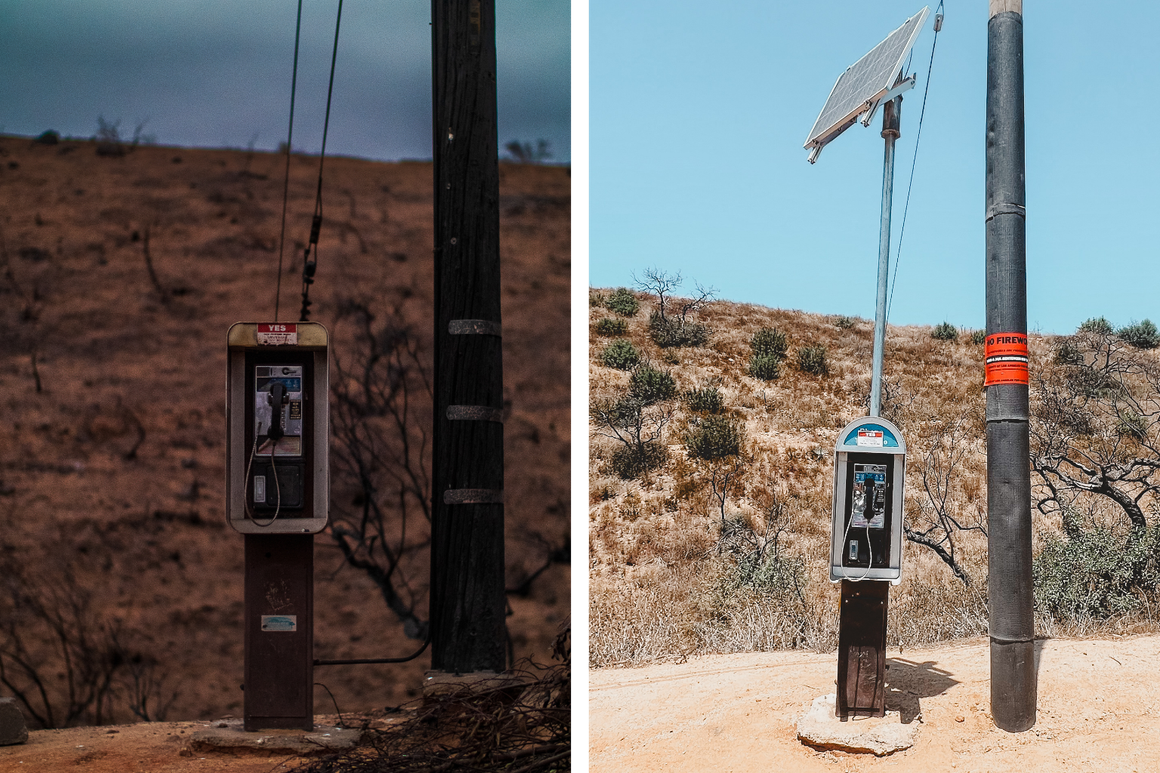
The Goodbye Line has since found working payphones across Los Angeles, in Downtown LA, Westlake, Hollywood, and other corners of the city. People have sent us locations from other states. Stickers have traveled beyond the country too, to places like Ireland, Germany, and Mexico.
Eventually, the project needed a payphone of its own.
Not just a sticker on an existing phone, but a full booth. A real one. A vintage payphone booth from the 1970s that could travel, appear at events, and give people the physical feeling of stepping into the line.
Buying the booth was one thing. Making her work was another.
And that’s how we found Patrick Schlott.
Patrick was part of this wider payphone world too, just in his own very specific way. He had been buying broken payphones on eBay, fixing them up, and putting them back out in his rural Vermont community for people to use.
I still love that. Not collecting them just to collect them. Not turning them into decor. Fixing them. Putting them outside. Letting them become public again.
When Patrick wrote back, we realized something that made the whole world feel smaller. From rural Vermont, he had already contributed to helping rebuild the Altadena payphone after the fire. He just did not know we were the people behind The Goodbye Line.
That is how tight this community is. You start by looking for one working payphone at the edge of the forest, and somehow you end up in touch with someone across the country who has already helped bring that same phone back to life.
Patrick helped Adam talk through the bridge between old phone hardware and the modern systems that would eventually hold the archive. It was old tech meeting new tech in the least sleek way possible: Wires. Testing. Troubleshooting. Calling it again. And again. And again. Standing there waiting to see if the message recorded.
Adam definitely bled on the payphone at one point, replacing glass panels. Actual blood. Which feels worth mentioning, because people talk about analog technology like it is romantic, and sometimes it is.
But sometimes it is also sharp metal, stubborn screws, and a machine from the 1970s without a manual, reminding you that it was built before user experience was a department.
Not glamorous. Very necessary.
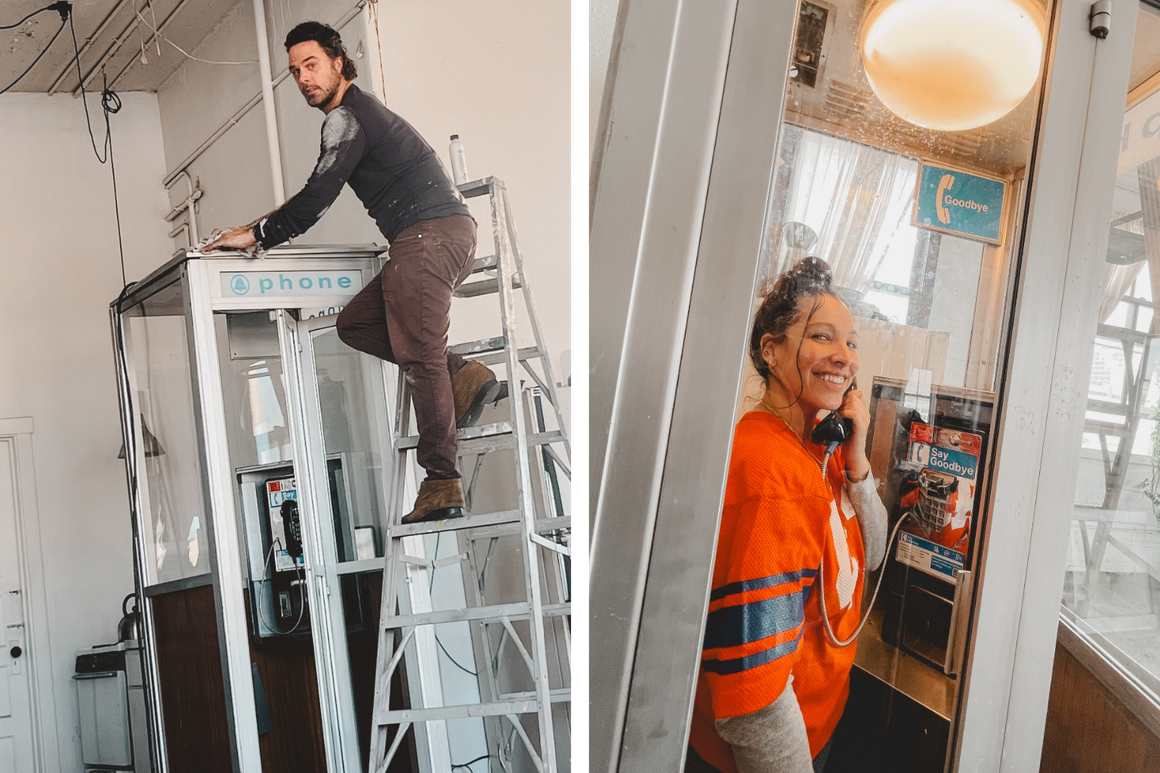
The Goodbye Line has grown beyond Altadena. It has become bigger than one payphone, one sticker, one city.
But I still think of that first phone at the edge of the forest.
Because every project has a place where it becomes real. For us, it was there. Standing next to a payphone we could not believe still worked, listening for a dial tone like a voice beyond the grave.
The project began because we were looking for what was left. Last payphones. Last dial tones. Last scraps of shared public infrastructure.
But the calls have not felt like endings. They have felt like proof of life.
People are still reaching for places to speak honestly. People are still looking for rituals. People are still full of unfinished goodbyes.
And at the edge of the forest in Altadena, one of those places is still waiting.
A metal box. A receiver. A dial tone.
Still working.
Still listening.


