About
In the Pleistocene, ponderosa pine forests extended much farther east into central Oregon than they do at present, reflecting the cooler, wetter climate then prevailing. As the climate warmed and dried, these forests were largely replaced by the current scrub vegetation, including sagebrush, juniper, pinyon pine, and similar arid-adapted species.
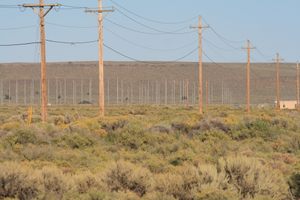
The exception is here, where a sparse stand of ponderosa pine lingers among the more typical scrub vegetation such as juniper and sagebrush. This remnant forest now lies over 40 miles from the nearest other ponderosa pine occurrences and somehow manages to survive on half the usual rainfall needed to support these trees. Nearly 9,000 acres of this anomalous occurrence were preserved in a designated research area, The Lost Forest Research Natural Area, in 1972.
The reason for the anomalous survival of the ponderosa pines proved to be straightforward. The sandy soils in which the pines are rooted are underlain by a nearly impermeable clay-rich layer, which traps rainfall in a near-surface groundwater layer that can be reached by the pines' roots. This clayey layer is a hardpan from an ancient lakebed, which is exposed farther west.
Know Before You Go
The Lost Forest lies northeast of the village of Christmas Valley, Oregon. One straightforward way to get there is to proceed 7.0 miles east on Christmas Valley Road (Co. Hwy. 5-14) from the intersection with Crack in the Ground road. Then turn left (north) on Fossil Lake Road (Co. Hwy. 5-14D), at a junction around 43.23733 N, 120.52214 W. Go 8.2 miles north to Lost Forest Lane, which makes a T-junction with Co. Hwy. 5-14D (at about 43.35560 N, 120.52143 W). Turn right and go about 7.7 miles east. The road becomes graded and winds around somewhat, and ultimately (at the edge of the Lost Forest Natural Area) becomes BLM (Bureau of Land Management) Road 6151, at about 43.35936 N, 120.37133 W. At this point, the road becomes much rougher and will definitely require high clearance. Sand Rock, a landmark rock outcrop, is about 2.2 miles farther along the road and makes a scenic destination.
There are enclaves of private land, especially off the road coming in from the west; please respect any "No Trespassing" signs. Also, camping in the Research Natural Area is restricted to designated sites. Please also do not build any campfires.
Community Contributors

Added By
Published
July 17, 2026