About
King's Lynn in West Norfolk, UK, is an inland port on the River Great Ouse, which has a long history of trade with the ports of the North Sea and the Baltic, which had, since the 12th century, joined together in a trading and mutual support bloc. Between the 12th and 15th centuries, the Hanseatic League became the dominant force in maritime trade in northern Europe. King's Lynn became one of the so-called "Kontors", extraterritorial trading posts of the Hanseatic League (alongside London, Bergen and Novgorod). In King's Lynn, for example, the Hanseatic merchants took ownership of properties in King's Lynn, and one of these, Hanse House on the quayside at King's Lynn, remained in the ownership of merchant guilds in Luebeck from the 16th to the 18th century.
This building is the only Hanseatic property remaining in King's Lynn, and inside it is a plaque commemorating the formation of the new Hanseatic League, formed in 1980, in which King's Lynn became the first British member. It is a social and cultural organisation rather than a trade body. It now has nearly 200 member towns and cities in 16 European jurisdictions.
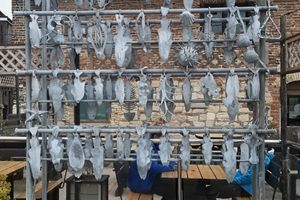
Next to Hanse House is a medieval warehouse called Marriott's warehouse, now serving as a bar/restaurant. Adjacent to the outdoor seating area of this establishment is a remarkable sculpture which was commissioned to celebrate King's Lynn's joining of the new Hanse organisation.
The unusual steel sculpture represents fish drying racks from the Lofoten Islands near Bergen. These were used to create dried fish (known as stockfish), which, during the Hanseatic period, was a regular import into King's Lynn and an important source of protein for the poor, with a long "shelf life" to allow it to be used in famine years.
It was made by members of the British Artistic Blacksmiths Association in 2009 as part of a festival. Laser-cut "blanks" of fish were used to allow local sculptors to put their own details onto the work and the public were asked what else should be on the racks. The resulting sculpture has oysters, seaweed and a mermaid's bra. There is also a rope of farmed mussels and a seagull. Some of the work was carried out at the Blists Hill industrial museum near Telford.
It now stands on the south quay as a reminder of an important part of the Hanseatic trade.
Know Before You Go
Parking in the pay-and-display zone on the quay is free for the first hour, but you must generate a ticket. After the first free hour, it gets quite expensive.
Community Contributors

Added By
Published
June 19, 2026