The Budapest Columbo Statue: From American Detective to Socialist Folk Hero
This 1970s crime show was an unlikely Western hit on Hungary’s state-owned television channel.



Listen and subscribe on Apple Podcasts, Spotify, and all major podcast apps.
Elah Feder: So, Dylan, you lived in Budapest, right?
Dylan Thuras: Yeah, for a year. I lived in Budapest. I lived in Pest. Wonderful, beautiful place. Like, an amazing year of my life.
Elah: Did you ever see the statue of Columbo by any chance?
Dylan: No. Or if I did see it, I did not know what I was seeing.
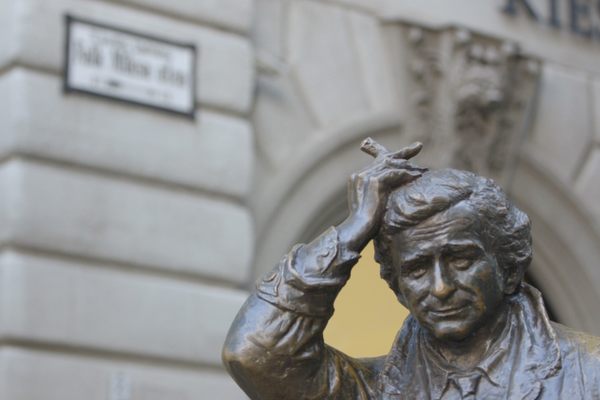
Elah: Okay, so I’m going to describe it for you and for everyone else who hasn’t seen it. So in this very busy part of town, about a 10-minute walk from the Hungarian Parliament buildings, there’s a statue of Columbo. And in case anyone’s not familiar, Columbo is the lovable TV detective from the hugely popular 1970s TV crime show. And in the statue, you see Columbo wearing his trademark raincoat. Next to him, his dog, a basset hound named Dog. And then a little behind them is a tiny crime scene. There’s a dead squirrel splayed out on the ground holding a gun.
Dylan: I feel like I would have seen this. Do you know when it went up? Because I was there in 2007, so I don’t—if it predates that, it’s insane that I didn’t see that.
Elah: 2014. So …
Dylan: Okay. This explains why I didn’t see it.
Elah: So learning about this story, I discovered that Budapest is full of incredible statues, which I guess you probably did see.
Dylan: It is. There are some amazing statues around the city.
Elah: But Columbo is kind of a weird one because it was an American show with an American star and it was filmed in American locations. So why is there a statue of him in Hungary?
Dylan: This is exactly the kind of mystery that Columbo would love to solve. I’m Dylan Thuras, and this is Atlas Obscura.
And I’m Elah Feder, and today we’re talking about why there’s a Columbo statue in Budapest. And also a Columbo restaurant. And most importantly, why in the 1970s, in communist-era Hungary, this American hit aired on state-owned communist television.
This is an edited transcript of the Atlas Obscura Podcast: a celebration of the world’s strange, incredible, and wondrous places. Find the show on Apple Podcasts, Spotify, and all major podcast apps.

Elah: Dylan, what do you know about Columbo? I’m assuming you’ve seen it.
Dylan: I have seen it. I can’t profess to being, like, an incredible fan, although my mother is an enormous fan of Columbo. I think, still watches Columbo reruns, like, on a semi-regular basis. So I have sort of a fond association with this. He’s like a rumpled detective. You know, he’s like the archetype that gives us, like, Monk and a bunch of other sort of, like, oddball, like, ruffled detective types.
Elah: Kind of like the opposite of Sherlock Holmes. He’s this lovable schlub. Big, bushy, ’70s hair, smokes this big, fat cigar. And the format is pretty cool. It’s called an inverted detective story. So that’s where you know who did it from the start. It opens up with a murderer, usually a very rich, arrogant person who thinks they’re smarter than everyone else, and they commit a murder. And then Columbo comes on, and the fun is watching this very, like, friendly, disheveled guy take down these pretentious jerks who never see it coming. He has a famous catchphrase.
Dylan: “I have one more question for you.”
Elah: That was a little Sean Connery.
Dylan: That was, I don’t, can’t—I have to work on it.
Elah: I’m going to be honest with you.
Dylan: I know. It’s not good. I was going to practice, but I didn’t. “One more thing.” You do yours.
Elah: “Just one more thing.” Is that New York? I mean, I wish we could play it for people, but for legal reasons, we’re not permitted.
Dylan: You’re just going to hear us doing it over and over again.
Elah: Yeah, apologies to the listener. So he always says this line, very innocently when he’s about to just absolutely corner the murderer. And it’s like, “You know, just one more thing I can’t get my head around. Why did she leave the chimpanzee in your care?” And it’s the thing that, like, nails them. They know they’ve been got.
Dylan: Yes.
Elah: So Lieutenant Columbo was played by an actor named Peter Falk. He was short, big, bushy, ’70s hair, a glass eye, which made him squint. Like, in many ways, not your typical TV star. But according to one of the creators, apparently lots of people found him very sexy. And he is just so Columbo. It’s impossible to imagine the show without him.
Dylan: Which, like, is part of the reason it’s so beloved. Like, he’s so lovable. Yeah.
Elah: He is so lovable. I mean, it was a problem for the show because apparently, like, they couldn’t make the show without him. And it went to his head a little bit. Made life very difficult for them, but also totally made the show. So, Columbo first actually aired as a TV movie. It was just supposed to be a one-off. But it was so popular, they decided to turn this into a proper TV show. And very quickly, Columbo is just a worldwide hit. Apparently, it aired in 44 countries. It won Emmys, Golden Globes. Peter Falk said that he would go to little villages that had maybe one TV set. And kids would run up to him shouting, “Columbo! Columbo!” Like, everybody knew Columbo.
Dylan: I believe Peter Falk is dead, right?
Elah: Yes. Which we’ll get to.
Dylan: But if I saw him, I would also run up and scream Columbo. I would be unable to stop myself. So, Columbo becomes a big hit. Why did it become so popular specifically in Hungary? Was there something happening that made it particularly, like, resonant with Hungarians?
Elah: Yes. Although first, I want to just, like, convey to you how incredibly popular it is in Hungary to this day. So, I actually joined the Hungarian Columbo fan club on Facebook in the course of recording this story.
Dylan: Impostor!
Elah: I’m a proud member, a proud English-speaking member. And I met someone named Dániel Rudolf, a journalist and film critic and mega-fan. Dániel says that even though Columbo ended more than 20 years ago, he would still put it in the top five or maybe even top three most popular shows.
Dániel Rudolf: It’s one of those shows which everyone knows in Hungary.
Elah: And in Budapest, it’s not just the Columbo statue. There’s a Columbo restaurant called Mr. and Mrs. Columbo. There’s a wax Columbo at the local Madame Tussauds. And Dániel says it’s still on TV most days, multiple times a day.
Dániel: And usually not only on one channel, but usually two or three. Sometimes even at the same time. So it happens that you surf the channels and you see an episode of Columbo, then you switch to another channel and then it’s another episode.
Elah: Modern Hungary has many channels. But back in the early ’70s, when it first aired, there was just one: the state-owned channel. And somehow Columbo gets on this channel, which is odd. In the 1970s, Hungary was still a communist country, a very restrictive place, especially when it came to any kind of Western influence. Citizens could not easily leave the country. And most Western content was banned. But Columbo, this American detective show, was welcomed behind the Iron Curtain. And it was airing on the communist government’s TV station, no less. So Dániel said that it wasn’t the only American content that made it through. There was some other stuff, but usually it was stuff that was critical of the United States. So things like movies about Watergate or the Vietnam War.
Dániel: Those movies usually were shown in movie theaters in Hungary because of that, because they were anti-U.S.
Elah: Columbo does not seem anti-U.S. Lots of big Hollywood stars, and I would say it depicts a very polite and effective criminal justice system. So I think it’s actually an idealized view of the U.S. But Dániel told me this story, which was told to him secondhand. Many years ago, his college professor went to the U.S. where he met an American who told him he knew exactly why Columbo would be popular there. He said:
Dániel: It’s sheer communist propaganda. The poor man goes into the rich man’s home and arrests him.
Elah: It kind of makes sense, right?
Dylan: It totally, yes. It’s criminal justice, but it’s like, you know, against the elites. He’s an everyman defeating the kind of rich power structures of American society.
Elah: Exactly.
Dylan: Wow.
Elah: Dániel himself, he didn’t know for sure if that’s really why the government approved of Columbo. But the theory seemed plausible to him. And I ran it past another Hungarian Columbo fan who also thought it made sense. But if the idea was to show Hungarians the depravity of capitalist excess, it might have backfired.
Dániel: People in communist Hungary could see those huge cars, those awesome clothes, that luxury. And I think they liked it.
Dylan: I will say one more thing, just thinking about Hungarians and Hungarian culture. It’s a really distinctive place and culture because it’s a little bit separate from the culture of the countries around it. Like Hungarian culture, their language they speak is not Slavic. It’s Magyarul. And they’re very intellectual, kind of. They love math puzzles and brain puzzles. And as I think about all of this, these are like Columbo type things. Like, solving a complicated puzzle using your intellect. The more and more I think about it, the more it fits.
Elah: Yeah, I know. It’s clever. It’s about the clues and not about action scenes. Yeah.
Dylan: But there’s one more missing piece of this particular mystery we’re solving, which is like that’s all fine and good. How do you get this statue? Like where does this statue come into it?
Elah: Okay. One of the key elements is that there’s a longstanding rumor that Peter Falk was related to another Falk, a famous Hungarian named Miksa Falk, who was a Hungarian politician and journalist. And so the Columbo statue is actually on Falk Miksa Street. Most people think that actually they’re not really related. But Peter Falk did say that he had Hungarian ancestry on his mother’s side. And Dániel says that for Hungarians, that’s good enough.
Dániel: If you want to know something peculiar about Hungarians, it’s that we really love when someone from Hungary becomes world famous.
Dylan: Totally.
Elah: Which, I mean, we all get that, right? Canadians are exactly the same. We know who all the Canadians are. And Dániel says that, you know, to be celebrated by Hungarians as a Hungarian, you can have a pretty tenuous connection to the country.
Dániel: Even if someone has Hungarian roots, like Tony Curtis, who was born in New York, but both of his parents were Hungarian-Jewish from a town called Mártészalka. And in Mártészalka, there is a museum dedicated to Tony Curtis. So we love them. Even if someone was not born in Hungary, we’re like, oh, my God, he’s Hungarian! Like Paul Newman, Goldie Hawn, Paul Simon, Mark Knopfler.
Elah: So that helps explain his popularity. But I think there’s another reason that the statue specifically was installed in 2014. I mean, it’s kind of a random year for Columbo history. Columbo ended in 2003. But something else happened that year, which is that the mayor of the 5th district of Budapest was up for re-election, Antal Rogán. You might have heard his name.
Dylan: Yes.
Elah: We’ll get back to him. So no one can say for sure what he was thinking, but, you know, what would be a better crowd pleaser than a statue of beloved Columbo?
Dylan: Hungarian politics, quite complicated. And Columbo feels like maybe a safe political move. Totally. Like you can get buy-in across political divides.
Elah: Oh, yeah. No. Other statues have been moved when they became politically inconvenient. This is a low-risk kind of statue. So in the end, Rogán chose a sculptor named Géza Déje Fekete. And Fekete made Columbo in his trademark coat, as we said, with his dog, with the big floppy ears. Apparently, kids really like climbing this dog.
Dylan: There’s also—where is the dead squirrel in all of this? What’s going on with that?
Elah: Okay. So the dead squirrel wasn’t part of the original installation. That was something another artist, a guerrilla artist, added four years later. And presumably, it’s like, you know, a little crime scene for Columbo to work with. It’s really cute. It’s a tiny bronze squirrel splayed out, and there used to be a chalk outline around it, though that’s faded over time.
Dylan: I love that. Oh, that’s so playful. That’s so fun. It’s like, we love Columbo, and here’s a little mystery to solve. How did this work out for the mayor? I assume he, like, won in a landslide. I mean, this is, like, what a great thing to do.
Elah: Yeah, I guess people weren’t so easily bought. He actually lost, but you don’t have to worry about him because, as you seem to know, he’s done very well for himself. He’s since risen to the top ranks of Hungarian government. He’s a close advisor to Viktor Orban, and he seems to be surviving his corruption scandals. He was actually sanctioned by the Biden administration for corruption, but Trump administration reversed that. I mean, this is a powerful, powerful guy. And I’m not sure Columbo would have really liked him if he were around.
Dylan: Yes, Columbo would be unhappy with the political situation in Hungary at the moment. Maybe I’m projecting too much, but Columbo was always, it was about balancing the scales of power. Maybe it’s a, like, you know, people will look at that statue and be like, what would Columbo do?
Elah: Yeah, it’s inspiration for a better world, potentially. And I think this is probably at the heart of the appeal of Columbo, not just for Hungarians, but for anyone. The Columbo world, despite all the murders, it seems like a kinder one. One of the things that was really important to the creators is that it wasn’t violent. Columbo is always polite. He doesn’t carry a gun, and they don’t actually show the violence on screen. So, I just watched an episode where a posh symphony conductor murders his piano-playing mistress—very Columbo. And in this moment where he kills her, he picks up a heavy ashtray to hit her in the head. But then, just as it happens, the camera cuts away to her pet cockatoo in its cage. So, it’s not gory. And in the end of each episode, justice prevails. And I think that’s what this is about, really. People find that comforting. Columbo ended in 2003, but we almost got one more episode. In 2007, Peter Falk talked about making a comeback. He’d even chosen a script, but unfortunately the TV networks all turned it down. Peter Falk was nearly 80 by then, and according to at least one insider, nobody wanted an 80-year-old lead. Later that year, Peter Falk got diagnosed with dementia. And by the time he died, he’d forgotten who his signature character was. So Peter Falk is gone, and Columbo is long over. But at least we still have reruns, and a statue that I think is worth a visit in Budapest.
Listen and subscribe on Apple Podcasts, Spotify, and all major podcast apps.
Our podcast is a co-production of Atlas Obscura and Stitcher Studios. The people who make our show include Doug Baldinger, Chris Naka, Kameel Stanley, Johanna Mayer, Manolo Morales, Amanda McGowan, Alexa Lim, Casey Holford, and Luz Fleming. Our theme music is by Sam Tindall.






Follow us on Twitter to get the latest on the world's hidden wonders.
Like us on Facebook to get the latest on the world's hidden wonders.
Follow us on Twitter Like us on Facebook