Do You Know the Marree Man?
Who created this giant geoglyph in the Australian Outback?


Listen and subscribe on Apple Podcasts, Spotify, and all major podcast apps.
Elah Feder: The first of the anonymous faxes arrived in July of 1998 and Peter Moore got one of them.
Peter Moore: You have to remember it was a fair bit of time ago and the interest at first wasn’t particularly strong and then it did become very popular.
Elah: Peter lived in Marree back then. It’s a small town in the Australian outback, though maybe town is too strong.
Peter: In those days, Marree had about 80 residents. So you’ve got a police station, you’ve got a school, you had a lovely two-story pub, you’ve got like a very small country town.
Elah: Marree is hot and dry, even in the winter. Houses sit on big red dirt lots. You could grow a lawn if you really wanted to, but fresh water is mostly reserved for drinking. You even bathe in salt water.
Peter: Yeah, the best thing we can do is use dishwashing liquid to bathe in.
Elah: Peter doesn’t live there anymore, but back in 1998 he owned the Marree Hotel, which is where he was the day that he got the fax.
Peter: One morning in the hotel, I got basically an untraceable fax saying that if I go for a fly out of Marree, there could be something of interest for me.
Elah: The title of the fax was “Tourist Attraction for Marree.” No sender name. Peter wasn’t the only one who got it. Other businesses in the area got it too. And here’s how it opened: “On a plateau 36 miles west-northwest of Marree, there is a giant drawing of an aborigine more than two miles long. This makes it five times larger than the largest drawing at Nazca in Peru, 24 times larger than the largest English chalk hill carving, and 50 times larger than any portrayal of the human form. It appears to be the world’s largest work of art.”
Elah: The fax included a map of the exact location. And the gist of the whole thing was this: You have an amazing gift waiting for you. It’s going to totally change your life. You’re welcome in advance. But Peter’s initial response was …
Peter: A load of rubbish, whatever.
Elah: Still, he had a small plane. So he hopped into it and set off for the place marked on the map. I’m Elah Feder and this is Atlas Obscura. Today, the story of the Marree Man, a drawing that mysteriously appeared in the Australian Outback 26 years ago. Ostensibly, it was a gift for the locals, though that’s not exactly how it was received.
Peter: I can honestly say all hell broke loose.
Elah: For this episode, I did what so many have tried and failed before me: I went looking for the culprit. And I was led to a piece of the puzzle that was not one I expected at all, or really in any way wanted.
Peter: This data that we were supplied had the genitals in place. Where’d the genitals come from? Where did they come from?
This is an edited transcript of the Atlas Obscura Podcast: a celebration of the world’s strange, incredible, and wondrous places. Find the show on Apple Podcasts, Spotify, and all major podcast apps.
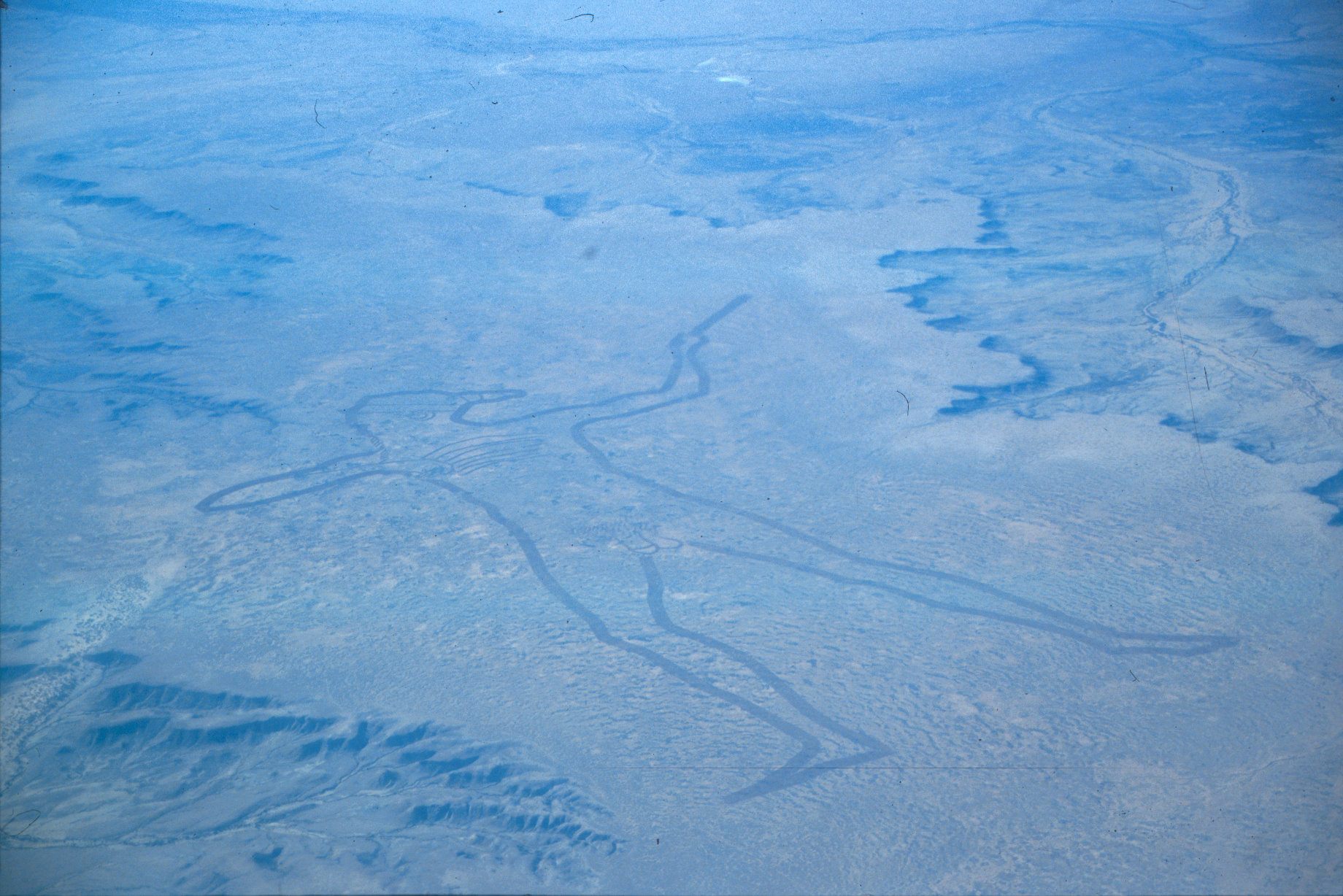
Elah: As promised in the fax, Peter found the drawing on a plateau a short flight away. On this big, flat stretch of desert, someone had carved a drawing of a man. He measured more than two miles from head to toe. It seemed like they’d done it with a plow or some other kind of machine that dug trenches in the ground.
The man had a beard, hair in a bun, and horizontal lines across his chest that looked like traditional Aboriginal scarring. He was standing in a hunting pose, like he was about to throw the spear in his left hand. Also, the man was naked. That’s going to be important later on. The mystery faxes called him Stuart’s Giant, in honour of the 19th century Scottish explorer McDouall Stuart. But pretty soon, everyone just called him the Marree Man.
It wasn’t clear exactly how long the Marree Man had been there. The anonymous faxes didn’t say. But at least since June. A pilot flying over the area had seen it and even told a few people. But apparently, it didn’t get much traction. So this anonymous artist’s masterpiece just lay there, mostly unappreciated into July. And it seems like whoever made it was growing impatient. It was time for a little PR.
The fax that Peter Moore got that morning in July was the first in a series. And whoever sent them was obviously very proud of this drawing. They called it a world-class tourist attraction. They suggested the best times of day to go look at the drawing, which were apparently morning or late afternoon. And they even offered basic care instructions.
And it worked. By mid-July, the Marree Man had everyone’s attention. Pretty soon, the press descended, and tour operators were giving flights to anyone who wanted to have a look. It really was a great tourist attraction, just like the faxes promised. But some people wanted the Marree Man to be destroyed.
I didn’t understand this at first. A really big drawing in the desert? Like, what could be wrong with that? Well, first, this wasn’t just a random patch of desert. The plateau was on land claimed by at least two Aboriginal groups at the time. A spokesperson for one of the groups said they wanted the image erased and whoever made it to face criminal charges. Which might seem like a strong reaction to a drawing in the desert, but imagine someone carved up your backyard, without your permission, called it art and invited the whole world to come see it. Except it wasn’t just your backyard. It was what was left of your ancestral land.
So that was the first problem. The second problem was environmental. Whoever made this didn’t just dig up some red dirt. There were also scattered grasses and shrubs on the plateau, and some got ripped up in the process. And Australia is very protective of its native species, as you’ll know if you ever tried to enter the country. When I flew there, they literally sprayed the plane and everyone in it with insecticide to make sure that no invasive species got in.
So we have destruction of native plant life, vandalism of Aboriginal land, and there is one more problem.
Phil Turner: The Marree man is naked. So when he was put on the ground, he had his full set of genitals in place.
Elah: Phil Turner owned the Marree Hotel for a few years. He actually bought it in 2011 from Peter Moore, who you heard at the top of the episode. And Phil is a big fan of the Marree Man. He comes up in almost every news story about the drawing. But Phil says the Marree man’s nudity offended some locals.
Phil: And they went up in their cars and did doughnuts in the dirt and scrubbed the genitals, scrubbed them all out. So the Marree Man ended up with this little airbrushed section.
Elah: Okay, so some of you might want to take the off-ramp at this point in the story because in my interview with Phil, the word “genitals” came up a lot—26 times in total. Twenty-four by Phil, twice by me. While we were talking, Phil sent me an email. The subject line, in all caps, “GENITALS.” It had no text, just a surveyor’s drawing of the Marree Man’s nether region.
But these mentions were not entirely gratuitous. We actually had to talk about them. Because as Phil explained, the genitals would be key to identifying the culprit. So to understand that, let’s start at the beginning of the investigation.
Phil: When it was first discovered, people were looking for blame. And they singled out the tour operators, reckoned it was a tourist stunt.
Elah: Tour operators, obvious suspects. I mean, these were the people who were going to make money on this. Another suspect was an artist named Bardius Goldberg, who has since died. He even told some people he did it. But most of the people I interviewed didn’t buy it. They said, nah, Bardius didn’t have the tech.
On the other hand, a local tractor driver had recently started using GPS, which wasn’t widely available then, but would have been very handy to make this kind of artwork. But the faxes themselves pointed in another direction. They pointed to Americans.
In the faxes, measurements were in imperial units, so in miles and inches. They referred to South Australia as “your state.” And when police went to the site, they found a small American flag. So all signs pointed to Americans. But which Americans?
Well, about a three-hour drive away, there was a defense facility. It had been run jointly by Australians and Americans since the Cold War. Americans, who everyone said had advanced GPS technology. So they had the means to do it, but there was nothing concrete linking them to it. And besides, what would be their motivation? Why would they care if some random community in the desert got a tourist attraction? Six months passed with no solid leads. And then, in January 1999, a new set of faxes arrived.
The new faxes were sent to local businesses and some journalists, and this time they had a bit of an edge to them. Whoever sent them had obviously been following the news and seemed to be feeling a little bit defensive. Back in July, an Australian anthropologist had publicly criticized the Marree Man as cartoon-like and culturally inaccurate. The faxes insisted that guy didn’t know what he was talking about and that the figure was an “accurate tribute to tribal Aboriginal culture.” That last part was in all caps in case anyone was on the fence.
So partly they were trying to defend their honor. But the real point of this new round of messages seemed to be to keep the game going. They announced that answers to the questions everyone had been asking had been buried at selected sites around the world. And over the next few weeks, they would reveal the exact locations. It sounded like a great treasure hunt, but ultimately it was a letdown.
Notes were, in fact, discovered in two spots, both in England, but they actually answered very little. They did say that no locals were involved in any way. That didn’t really narrow it down. And most importantly, they offered no proof. So for all we know, the faxes weren’t even sent by the same people who made the Marree Man. It was all just a big tease.
Over the years, a lot of people have tried to solve this mystery. Most notably, a wealthy businessman named Dick Smith of Dick Smith Electronics. He spent two years on the case and offered a cash reward to anyone who could solve it. But in the end …
Phil: I’m no closer to finding out who did it, but you never know. One day someone on their deathbed may admit to it and then we’ll know what the true story is.
Elah: I didn’t want to wait for someone to die. So 26 years later, here I was reopening a cold case. But there were still embers. People who obviously knew more than the press had reported. Especially Phil Turner.
Phil has given a lot of interviews. So I thought I had a pretty good sense of what he’d tell me: That there were a lot of theories, but that ultimately it was a great mystery. But that is not how our conversation went. Phil named a new suspect. Someone I’d never seen coming. And the evidence to back it up?
Phil: The genitals. The importance and the significance of the genitals is a major, major issue.
Elah: Phil stumbled on his suspect by accident. He wasn’t trying to solve this mystery. He was actually trying to save the Marree Man. Because by 2015, it had started fading considerably and was at risk of disappearing altogether. And Phil just did not want that to happen. So that year, he found himself at a meeting of the Arabana Aboriginal Corporation. By then, they were recognized as the title holders of this land.
Phil: And I happened to say to them, I said, “Look, you’re sitting on a gold mine.” That’s a thing called the Marree Man. But it’s now been there for nearly 20 years and we can only see about 20 percent of it. The rest of it’s just eroded away with time. And I said, “You should restore it.” And they said, “What a great idea.” The upshot it was, “Hey, Phil, why don’t you restore it?” And I’m like, “Gee, here we go. Okay, I’ll see what I can do.”
Elah: I did contact the Arabana Aboriginal Corporation, but they weren’t able to talk to me in time for this story, so I can’t actually confirm any of this. I don’t know if it was really them encouraging Phil or if it was more like an, “Okay, sure, Phil, follow your bliss,” not really believing he’d pull it off. I just don’t have their version of this story.
Either way, Phil got to work. He set off to restore the Marree Man. So to do that, he’d first need a map. He couldn’t just head over there and retrace the drawing with a plow, since so much of it was gone by that point. What he’d need was a detailed set of GPS coordinates that his vehicle could follow.
Phil: So I happened to engage with a quality surveyor chatting over the bar at the hotel and I told him what the problem was. And he put his hat in the ring and said, I’ll crunch all the data for you.
Elah: He did that by going online and studying all the pictures of the Mari man that he could find and basically creating some GPS coordinates to match them.
Phil: Very excited with this. This was some nine months later, towards the end of 2015, early 2016.
Elah: Okay, so whoever made the original Marree Man appeared to have done something like this. They first created an outline on the ground, marking it out with bamboo stakes. Then they would have used their digging machine to dig out the actual lines of the drawing, basically connecting the dots between the stakes. In 2016, some of the original bamboo stakes were still there. So Phil could check just how accurate his surveyor’s map was by seeing how the coordinates lined up with the stakes that were still in place.
Phil: Unfortunately, he was about 20 meters out and I said, “It’s not good enough.” I said, “We have to be true to the original work.” He said, “Well, I’ll go back and do a bit more work.”
Elah: A few months passed.
Phil: And it was in May 2016, he sent me an email to say, “Bingo, I have a set of coordinates that are extremely accurate.” So we went up again, and he was accurate to within half a meter of every single bamboo stake in the ground. And I went, holy moly, this is absolutely magic.
Elah: Now that he had the coordinates, Phil could finally start digging. He put together a team of five people.
Phil: And the surveyor’s dog. So five people and a dog.
Elah: Five people and a dog. And together, they spent 11 days out there, marking out the outline and digging out new trenches. Everything went smoothly. And when they were done, the Mare Man was back, crisper than ever. You can see it in satellite photos taken before and after. But one thing didn’t add up.
Phil: So the Marree Man data that we were originally working with was generated from historical website data, which naturally didn’t have the genitals in place. You understand where I’m going? So now go to 2016, now 2017, and this data that we were supplied had the genitals in place. Where did the genitals come from? Where did they come from?
Elah: So I actually had to listen to our interview a couple of times to understand this. But what Phil was saying was actually pretty simple. His surveyor, the one who came up with their map, he must have had help. Because to draw this map, he’d worked off of old photos of the Marree Man. Photos that apparently did not include the genitals because those had been scrubbed out. So how did the surveyor manage to redraw them so accurately? Well, Phil doesn’t think he did.
Phil: It wasn’t redrawn. These are the original coordinates for the original Marree Man.
Elah: Somehow, the surveyor must have got his hands on the original data, genitals included.
Phil: And I got in touch with my surveyor and said, “I need to know where you got this file.” And he said, “I’ve been sworn to absolute secrecy. I can’t tell you.”
Elah: But Phil couldn’t let it go, because soon, he found himself in a bit of legal trouble. Remember how protective Australia is of its native vegetation? Well, in restoring the Marree Man, Phil had disturbed the land again. And the Department of Environment took action. They investigated him for violating the Native Vegetation Act of 1991 and threatened him with a big fine if he did not turn over any and all documentation related to this transgression.
Phil: So I went back to my surveyor and said, “Listen, you’re going to get subpoenaed to reveal the source of this data. Where did it come from?” And you’ll never guess where it came from: the Department of Environment.
Elah: The very organization threatening him with a fine.
Phil: So my barrister concluded that the Department of Environment was involved with the actual creation of the Marree Man, or at least they knew about it in 1998.
Elah: Phil says that once he presented the Department of Environment with this info, they abruptly dropped the case, which does seem odd. So I wrote them. Officially they’re called the South Australian Department for Environment and Water. And I didn’t expect them to write back, but they actually responded right away. But they declined to comment on the allegation that someone on the inside was the culprit. Interesting. One thing was clear: I had to track down the anonymous person who sent the data, or at least see some proof that they existed.
The surveyor that you worked with who received the anonymous data, is he still around?
Phil: Yeah.
Elah: Like, can I talk to him?
Phil: I’d love to … I could do it to him.
Elah: No? He could be anonymous if he wants.
Phil: It’s got implications. And if they knew that he was involved, he’d be in a lot of trouble. This was Phil’s answer every time I asked to speak with one of his leads. He’d say, no, he couldn’t drag this person into it. Or …
Phil: Yeah, I haven’t seen him for some years now.
Elah: Or …
Phil: I’ve got no idea where he is. I can’t even remember his name.
Elah: Which was, frankly, a little suspicious. Why didn’t Phil help me corroborate his story? Phil Turner, who always spoke of the Marree Man with so much admiration. Phil Turner who had dedicated months of his time to restoring the drawing at his own expense.
At the same time, he was directing me to a suspect that was mind boggling. Someone at the Department of Environment? Why would they break the laws that they themselves were enforcing? All to create a tourist attraction for a town in the desert? They didn’t even work in tourism. So I started to think, either Phil did it, or he was just having a bit of fun with me.
I called up Phil Turner to ask straight up if he’d done it.
Phil: No. Absolutely no. Didn’t even know it existed, that guy.
Elah: Do you have an alibi? Where were you, June of 1998?
Phil: God, where was I then, 1998? I could actually tell you exactly, because I had kept a work diary of every day of my working life.
Elah: Phil was traveling when we spoke. But he promised to send me an account of his whereabouts in the summer of 1998. But actually, he’s pretty low on my list of suspects. Because if Phil Turner really was the original creator of the Marree Man, I don’t think he would have gone through all that rigmarole in 2016 to restore it. He would have just gone ahead and dug it out again in secret.
So after two weeks of lightly exerting myself, I did not solve the mystery of the Marree Man. I just had a long list of suspects. The artist Bardius Goldberg, still in contention. The Americans from the defense facility, highly suspicious. The Department of Environment, who wouldn’t comment on their involvement. Hell, even Peter Moore from the top of the episode, the one person I spoke to who actually lived in the area back in 1998.
I hadn’t been able to rule any of them out definitively. And I was starting to think this was like a Murder on the Orient Express situation, where everyone was in on it. That’s just the kind of wonder and paranoia that the Marree Man inspires. Which I actually think is the point.
If someone told me in 1998 that a group of locals teamed up with some Americans and used advanced GPS technology to draw a very, very big Aboriginal man, I’d think, hmm, that’s impressive, probably should have asked for permission, and then I would move on.
But the fact that we don’t know who did this, that’s what makes this a story people like me still want to look into 26 years later. And whoever sent the faxes in 1998, they were working the mystery angle hard. The anonymous messages, the buried clues. It turned a piece of art into a big game.
That summer, in their first series of faxes, they sent one they called the final press release. Though, then they came back six months later to keep going. But in any case, that final-not-final press release ended like this: Half the art is mystery. And so enduring, let it be.
Listen and subscribe on Apple Podcasts, Spotify, and all major podcast apps.
Our podcast is a co-production of Atlas Obscura and Stitcher Studios. The people who make this show include Dylan Thuras, Doug Baldinger, Chris Naka, Kameel Stanley, Johanna Mayer, Manolo Morales, Baudelaire, Gabby Gladney, Alexa Lim, Casey Holford, and Luz Fleming. Our theme music is by Sam Tyndall.



Follow us on Twitter to get the latest on the world's hidden wonders.
Like us on Facebook to get the latest on the world's hidden wonders.
Follow us on Twitter Like us on Facebook