Sam Sanders: How to Become a Nature Girly
Journalist and podcast host Sam Sanders talks national parks, themed dog meetups, and how place shapes a life.


Listen and subscribe on Apple Podcasts, Spotify, and all major podcast apps.
Dylan Thuras: So obviously we’re going to be talking about place and the way that place impacts who you are. I would love to hear about growing up in Texas.
Sam Sanders: I grew up around San Antonio in the San Antonio greater metro area. And my home-home-hometown is this little town called Seguin, Texas, which is about 30 miles outside of San Antonio. And it is the self-titled pecan capital of the world. As in like, we are pecan mecca. There were actually a bunch of pecan stores in town growing up. There were two pecan trees in our front yard in my childhood home in Seguin, Texas. And in front of the courthouse in Seguin, the sculpture in front is not like Lady Justice with the scales. It is a giant, oversized concrete pecan with the words under it, “world’s largest pecan.”
Dylan: It’s my kind of town.
Sam: Hell yeah. And it’s one of those small towns where everyone knows everybody. My father had lived there for decades. My parents were small business owners. And at points during my youth, they owned both a funeral home and a daycare. So I grew up there. And then in middle school, we moved to one of the closer suburbs. And then I ended up going to undergrad in the heart of San Antonio. But San Antonio is home. And that metro area is home. And like, in adulthood, all of the complexities of modern life that I’ve had to make peace with, I began to understand those complexities in San Antonio, Texas.
I’m Dylan Thuras, and this is Atlas Obscura, celebration of the world’s strange, incredible, and wondrous places. Today, I am talking with reporter, host, podcaster, man about town, Sam Sanders. And I asked him to tell me about his life as told in four distinct places. Sam spent 12 years at NPR. You’ve almost certainly heard his voice at some point. He’s launched shows like It’s Been a Minute. He knows a ton about pop culture and hosts podcasts like Vibe Check and The Sam Sanders Show. And along the way, throughout this career, it’s meant that he has had to move around a bunch. He grew up in Texas, moved to the East Coast, out to the West Coast. And it all started back in Texas, when he was just a kid with a growing obsession for pop culture, kind of trying to find his place in a small town near San Antonio.
This is an edited transcript of the Atlas Obscura Podcast: a celebration of the world’s strange, incredible, and wondrous places. Find the show on Apple Podcasts, Spotify, and all major podcast apps.

Sam: San Antonio is this weird place because Texas is not quite South, not quite Southwest, just Texas, and San Antonio sits right at that nexus. It is in the middle. It’s in the middle. And there are parts of my upbringing there that felt incredibly Southern, with a mother who comes from Alabama and a father from East Texas, which is basically Louisiana. But in many ways, my experience growing up felt very Southwest. And I grew up in a city that was decidedly majority minority, as long as I was there. And even now, to this day, San Antonio was about two-thirds Latino. So I also ended up growing up in this red state that is Texas in a blue oasis. San Antonio is blue. And San Antonio is a city led by people of color. And so I never had this distinct and visceral hatred of Texas because of its politics, because it’s like, oh, I actually know the politics are much more complicated. And in actuality, every big city in Texas is actually blue. Houston, San Antonio, Dallas, El Paso. I could go on. San Antonio, Austin. Those are blue cities. I want to say Houston had a lesbian mayor before it was cool. These places are progressive. And so I’ve always been able to appreciate the political complexity of a place like Texas because of San Antonio.
Dylan: Texas is like, it’s like maybe the third or it’s way up there as the most, one of the most diverse states in the union.
Sam: Have you been to Houston?
Dylan: Yeah.
Sam: It is the model UN, baby. Like it’s everything, everywhere, all at once.
Dylan: Yeah, big time. When you grew up in Texas, you grew up in a little bit of a, maybe more of a conservative or at least religious household. Is that right?
Sam: Oh my God. It was so religious. So my parents didn’t go to the same church. My father was Methodist, kind of boring black Methodist, nice upstanding, quiet church services. My mother was always churchy and loud, charismatic Christian. And by the time I was like eight or nine, we had joined the strictest version of that church. It was Pentecostal slash apostolic, but she was a church organist. The defining ethos of the church and the practice of our faith, it was like doing things that showed that we were not like, quote unquote, the world. We weren’t like the secular. So in the way we looked, acted, and the things we did, it wasn’t just to serve God, but to prove that we weren’t like the heathens.
So for instance, the women could not wear jewelry or makeup or pants and they could not cut their hair. So they all wore long skirts and had long hair in buns and wore no makeup or jewelry. We did not go to the movies or school dances because that felt too secular. I had to beg to go to prom. And my mom was like, “Don’t tell the church, but you can go.” We were not supposed to enjoy any cultural content that wasn’t focused on God. So it was a gospel music only household. And my brother and I snuck a lot to watch a lot of TV. Although my mother was such a champion of Black entertainment and Black culture, she would make exceptions for us to watch things as a family, like In Living Color or Roots, the miniseries. Because she was like, “You gotta see this. You gotta see it.” You know?
But my entire upbringing was built consuming that secular pop culture in secret. As soon as I could sneak away from my mom in the mall to go buy CDs at like Sam Goody, I would. And I would buy secular CDs. And I would bring them home in the back of my underwear. And I would listen to them on my Walkman in the bathroom for hours. I remember getting ahold of Stevie Wonder’s Innervisions in like eighth grade and sitting in the bathroom as an eighth grader for hours, just playing it over and over and over again. And I would get all these weird looks from my mom. And I was like, she thinks I’m masturbating. In a way I was. But I was just listening to Stevie Wonder. I was just listening to Stevie Wonder over and over and over again. But my entire upbringing, I snuck and listened to these CDs. I snuck and watched VH1 Behind the Music. I snuck and watched MTV music videos. And I think part of why I have a career now where I just talk about popular culture is because of that. It was forbidden fruit in my youth. So now I relish the chance to get paid to talk about it.
Dylan: Take note, parents, the boomerang effect is real. Let’s talk about some of the places that you felt kind of define some aspects of yourself.
Sam: Let’s do it. Let’s do it.
Dylan: So talk to me a little bit about the Charles River.
Sam: The Charles River. So I got my graduate degree at the Kennedy School, which is Harvard’s School of Policy and Government. And the campus, as well as my first year apartment in Harvard Square, sat along the Charles River, which meant that every day to get to class, I walked about a mile along the Charles River. I liked the walk. But within the first few weeks of walking along the Charles, I kept seeing all of these runners running along the Charles. Early in the morning, late at night, when it was raining, when it was sunny, when it was snowing. Just literally an army of happy-go-lucky, smiling white people in short shorts running. And I was just like, what the hell? What are they—what is happening? And eventually, I saw them do it enough and look so happy, I was like, I need to try this.
Dylan: They got you. They got you.
Sam: They got me. And then I started running, and I loved it. And what happened for me within those two years of being up there and embracing running along the river, it was the first time in my adult life where I said to myself, physical fitness and activity should be part of your adult life, even if it’s not part of a thing you’re doing for school or a sports club you’re involved in. You can just do it for you. And so the reason the Charles River is so important to me is because it really solidified what has become a big part of my personal practice for every day, which is, every day you should move. I kind of don’t feel like my day has started until I’ve gotten my heart rate above 150.
Dylan: I feel this. I’m a biker, and I do a bike commute to my office. It’s an eight-mile bike ride, and I very much feel the same way. It’s like, you just unburden yourself a little bit. You feel lighter and more ready for whatever is going to come next after a little bit of movement. It’s true.
Sam: And it’s meditative. I always get to a point in a run—so these days, when I do run, I try to do five miles. That’s it. No more, no less. And something happens around mile three or four, I get lost in the sound of my feet and my breath. And I’m just tracking those sounds and living in my body and hearing those sounds. And the thoughts I’m thinking are still there, but they’re in the rear view. And I say, when I get to that part, and I say this non-religiously, I say it deeply, capital S, spiritually, when I get into that flow, that’s what I’m talking to God. And I want that time. That intense, I’ve connected with my body and the world and this space, and I’m in flow. I don’t know. I don’t know. I sound hella California right now, but you know what I’m saying.
Dylan: I know what you’re saying. I know what you’re saying. I mean, speaking of California, I mean, you moved from one kind of desert-ish landscape, Texas, it depends on where you are in Texas, but to another. Now you live in LA. What is your relationship with LA, with place, with the outdoors, where you are now?
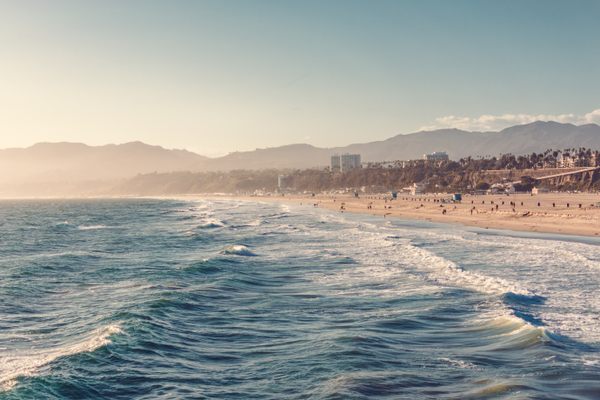
Sam: Yeah. I became a full nature girly once I got to California. In part, there was a beach right there. So I didn’t have the Charles River anymore. But for a good number of years when I was living on the Westside, my morning practice was getting up around six, making my coffee, and driving to Venice beach to do my five mile loop from the Venice part of the beach to the Santa Monica pier and back. It’s a five mile loop. It’s the best way to start your day. I would do that. And then I would sit in the sand and meditate for like five minutes. And if I felt frisky, I would jump in.
But what really made me a full nature girl in California were the national parks. I would always go home for Thanksgiving. And I’ve had a dog for most of my adult life. So on holidays, when I was going home, I’d want to take the dog with me. So I would drive home. For years, I’ve been making the drive to Texas from either DC or from LA. But I would drive past a lot of national parks. Growing up, my family wasn’t into national parks. I wasn’t really an outdoors person. I mean, I was in marching band, that kept me outside. But I was not seeking to be outdoors all the time. My father was a cattle rancher. And we had that family farm about two hours away from the house. When we’d go up there on the weekends, my brother would be out there in the brush with my dad with the cows. I literally would be in the house on the farm watching Bob Ross. I just was not an outdoors person. I had never camped. The outdoors was not part of my practice. And even though at that point I was running, you run and you go inside. You’re outside while you run, then you go inside.
All this to say, once I began making that road trip from LA to Texas over and over and over again, I would keep seeing these national parks. And I was like, maybe I should stop one day. So I’ll never forget on one of those trips home, I said, I’m just going to go into Joshua Tree National Park. It’s along the way. And I went into Joshua Tree with my dog, Zora, Zora Neale Hurston. And I was like, I remember being a little angry. I was like, how did no one tell me that this place is just here? And it’s got these trees out of outer space and you were like walking on a different planet. And it’s just like this park that you can just go hang out in. How did no one tell me? And then on another road trip, I discovered White Sands National Park, which is also like being on another planet. It’s wild. And so quickly after being in California, I made being in national parks and experiencing national parks, like part of my practice. I now have one of those all passes that gets you into every park for like 80 bucks a year. And I make it a point to plan trips where I’m just going to a national park. I did the Sequoias a few months ago and it was transcendent.
But yeah, Joshua Tree was the first place in my adult life that said to me, you can be outside for no other objective than just to enjoy the outdoors. And that’s not just cool, it’s kind of ideal. I was not a person who just hung out outside to hang out outside before I discovered Joshua Tree National Park. And now I’m like, when can I sit outside? Please, I want to be outside. I’ll have friends that want to meet up and do stuff. And I’m always like, can we go on a hike? And my adult embrace of just being outdoors was fully brought on by the beauty that is Joshua Tree National Park. I also think, and listeners thank me for this, two pro tips for Joshua Tree National Park: don’t go when it’s hot, go when it’s cold. It’s just as sunny. And the cold air makes it feel extraterrestrial even more. And then two: when you drive into Joshua Tree National Park, especially for the first time, you need to be playing U2’s Joshua Tree album. It works. Trust me, it works. It just is incredible.
Dylan: LA has given you this appreciation for nature. I love Joshua Tree, obviously for the nature. Part of this has also been, you said you had a dog. So that dog is also, I imagine, gets you out and about. Maybe talk about how that relationship, both with nature and then with taking care of an animal has evolved and how place comes into that.
Sam: Yeah, I have two dogs. I rescued a pit bull when I was living in DC from a shelter in Northeast. I rescued Zora. She was maybe like eight or nine months old. And that was probably like 2010 or 11. So she’s been around for a while with me and she’s moved across the country with me several times. And during the deepest COVID lockdown, we just road tripped across the country a few times, me and her. So she has just been a constant in my adult life. Last summer, I thought she was dying. There were a bunch of emergency surgeries and she was just old and just not with it. So in my fear of her pending death, I got a second pit bull, a little puppy with a cow colored coat. I named him Wesley Snipes. And so now I have two. When Zora was young, for a few years, she had so much energy. She would come on those five mile runs with me in DC. We’d run the monuments and back in the morning. But once I got to California with her and with Wesley, the new puppy, my favorite dog place with them quickly became Huntington Dog Beach. You know, all of California is beaches and each of them have a different personality. Huntington Beach is maybe an hour south of LA along the coast. But in Huntington Beach, there is like a mile and a half strip of that beach that’s just reserved for dogs to be off leash. And it is the closest thing to heaven on earth you’ll ever find.
Dylan: For you or the dog?
Sam: Both. The first time I went there, I didn’t know that sometimes they have themed dog meetups. So the first time I went to Huntington Dog Beach after I’d heard about it, I show up there on the morning of the pug costume meetup day. It was in October. And hundreds of pug owners brought their pugs to the dog beach and each pug was in a costume. Can you name a more beautiful scene?
Dylan: This does sound quite delightful, I have to admit. I am charmed from a distance even.
Sam: Right? And then, you know, with this beach, having a dog off leash on the beach, it always makes me just appreciate the beach in a new way. I’ve lived in LA well over a decade now and I think I know beaches, but when you see a dog off leash, on a beach, it gives you a newfound respect for the beach itself. The things you don’t notice, they do. The things they want to run around to, you don’t want to run around to it and then you see it differently through them. I imagine in the same way that, you know, parents of young kids say that like the young kid helps them see a world that felt static and boring in new and alive ways because you watch them discover things for the first time. The equivalent for a single gay man is a dog at Huntington Dog Beach.
Dylan: And thousands of pugs in costumes. No, it’s good. I like it.
Sam: And so there’s this very interesting dynamic with my young dog, Wesley Snipes. He is equal parts a goofball, but also scared out of his mind, but also wants to try to be there for his people. And he does this thing where whenever he wants to wander off and explore and go crazy, he’ll be off in his own world and then he’ll forget where I am and he’ll look back and just stop in his tracks and be like, you still there? You still there? He does it all the time. And he does it the most at Huntington Dog Beach. And it’s just this beautiful reminder that this dog who I have to fully care for—he is my responsibility, he does not pay rent—even in that power dynamic, he still wants to care about me. He still wants to make sure that I’m there. And I think having dogs, as long as I’ve had, they’re this amazing reminder that all sentient beings, one of the things that we long for most is to care for things other than ourselves. And dogs remind you of that. Because dogs don’t have to do shit. I would feed you anyway. Like you get this house anyway, but they’re always in their own little dog ways caring for me.
Dylan: All right, last question. You’ve lived a lot of places, Texas, Boston, DC, LA. Do you think, is this your forever place or do you think maybe there’s somewhere else that’s calling you?
Sam: I love LA. I love LA because it’s like one endless scavenger hunt. You’re never done discovering this city. You’re never done discovering all of the cool things there are to do here. Someone smarter than me said that you have to look at LA as not a city, but like a nation state. And it will take you years to figure it all out. And that’s the beauty of it. So I like that. I like the puzzle that is LA. I think at some point I would like to be doing something that feels off the grid, doing something that’s, you know, big old farm with eight pit bulls. I don’t know. But that will happen when it like just falls into my lap. I don’t think I’ll seek it out. If the opportunity opened itself up, I would do it. But for now, I was blessed enough to get a mortgage about a year and a half ago. I was renting this house and the owners just sold it to me. They moved to France during the pandemic. They’re like, we’re not coming back. Would you buy it? So I had to say yes.
Dylan: That’s how I got my house too.
Sam: Really?
Dylan: Yeah. Renting and the owners said, hey, we want to sell. Would you buy it? And I was like, heck yeah.
Sam: But that’s kind of what I try to let guide a lot of my decision-making about big decisions. If you just like try to have a good day, live a good life, be around good people, the opportunities that you should take part in, they kind of just present themselves to you. When I made Vibe Check with Zach and Saeed, it was kind of just this no brainer. I was like, we have to do it. This new show I just launched with KCRW, they called me. They were like, come do this thing. And so I tried to, in my adult life, not stress over the big life decisions about love, career, housing, location, because inevitably those paths kind of just present themselves. I think, I hope. I’d rather it be that way. I hate big decisions.
Dylan: I agree with that philosophy. Sam, thank you for coming on the show and spending some time chatting with me.
Sam: Thank you for indulging me. I just, I’m a rambler, as you can tell.
Dylan: I loved it. It’s great. Yeah, but you’re a professional rambler, Sam. Like this is, you know what I mean? You’re not an amateur rambler.
Listen and subscribe on Apple Podcasts, Spotify, and all major podcast apps.
This podcast is a co-production of Atlas Obscura and Stitcher Studios. This episode was produced by Tomeka Weatherspoon and the production team includes me, Dylan Thuras, Johanna Mayer, Chris Naka, Doug Baldinger, Kameel Stanley, Manolo Morales, Baudelaire, Gabby Gladney, and Talon Stradley.
Our technical director is Casey Holford. This episode was sound designed by Tomeka Weatherspoon and mixed by Luz Fleming and Sam Kass. Tomeka Weatherspoon and mixed by Luz Fleming. Our theme and end credit music is by Sam Tyndall.



Follow us on Twitter to get the latest on the world's hidden wonders.
Like us on Facebook to get the latest on the world's hidden wonders.
Follow us on Twitter Like us on Facebook