
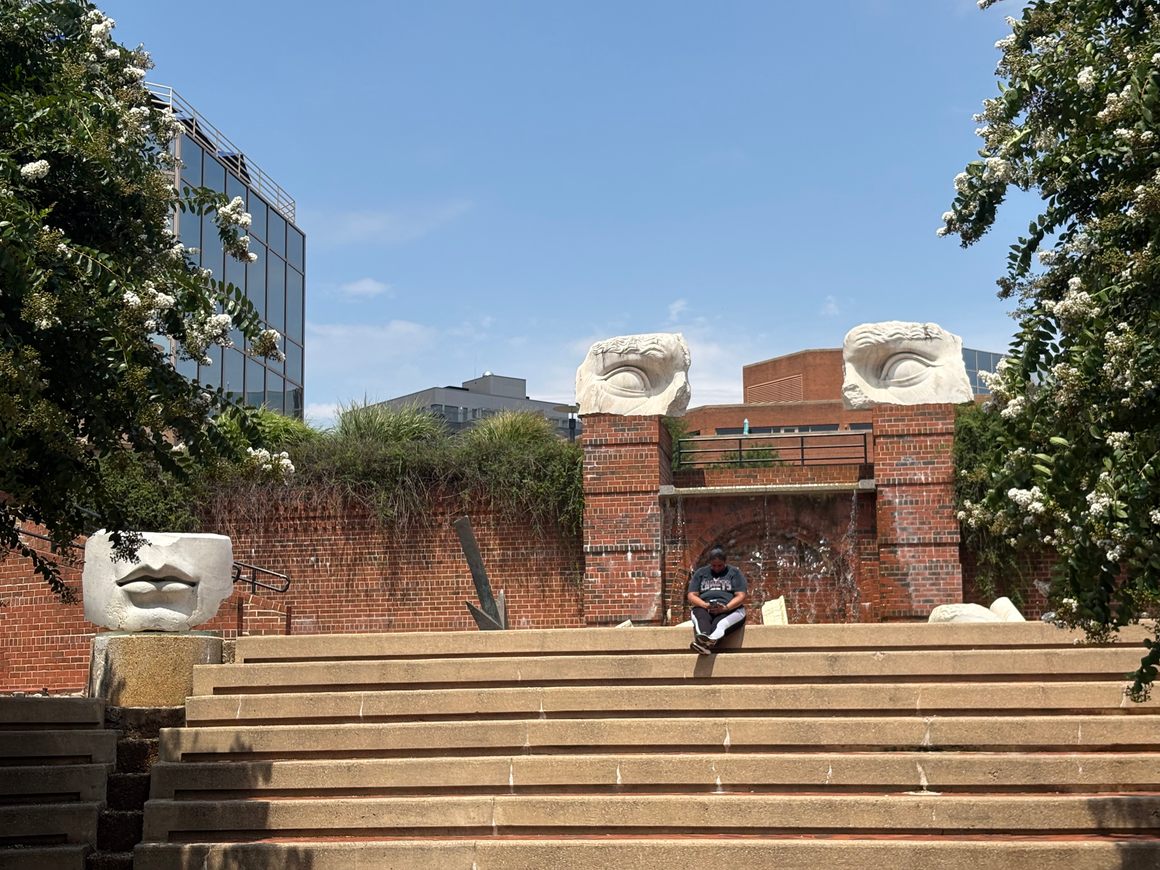
Walk toward the Potomac through Alexandria’s Canal Center and something peculiar happens: Classical civilization appears to have suffered a very strange collapse.
Enormous marble eyes peer from brick terraces. Disembodied stone lips perch beside pools and fountains. Fragments of what might be a colossal ancient statue emerge from the landscaping. At the river’s edge, a slender marble obelisk rises toward the sky—an uncanny miniature echo of the Washington Monument across the Potomac.
This is Promenade Classique, a six-acre sculptural landscape by French artists Anne and Patrick Poirier and American landscape architect M. Paul Friedberg. Dedicated in 1986, it was the Poiriers’ first major American commission. Rather than placing a sculpture in a park, its creators made the entire route to the waterfront into a work of art: a sequence of terraces, pools, fountains, waterfalls, and imaginary ruins meant to be experienced on foot.
The promenade begins at an upper plaza, where a 30-foot bronze arrow or spear appears to pierce the landscape. In the original design, water emerged there and moved downhill toward the Potomac, passing through a chain of fountains and pools. Along the way, visitors encountered the remnants of an invented classical civilization: a giant eye turned into architecture, oversized lips turned into a fountain, broken columns and sculptural fragments that seem excavated rather than installed.
More than 100 tons of marble quarried near Carrara, Italy, reportedly went into the original project. But the Poiriers were not interested in rebuilding antiquity in pristine form. They presented it shattered, enlarged, displaced, and half-buried. The effect is less like a conventional monument than an archaeological site discovered millennia after an unknown catastrophe.
The giant eyes and shattered faces are not unique to Alexandria. They belong to a visual language the Poiriers developed across a series of monumental “ruins.” Their Fontaine des Géants in Villeurbanne, France, completed shortly before Promenade Classique, similarly scatters enormous marble eyes, lips, and classical fragments beneath bronze arrows hurled by angry gods. Elsewhere, the artists have created toppled columns and monumental “eyes” representing memory and forgetting. Their work repeatedly asks viewers to imagine civilization after its monuments have fallen—when grandeur survives only in fragments.
That theme makes Alexandria an especially fitting setting. The city is one of Virginia’s oldest, yet the installation looks directly toward Washington, D.C., whose civic architecture famously borrows from Greek, Roman, and other classical traditions. Promenade Classique turns that visual relationship into a sly joke. Across the river stands one of America’s most recognizable monuments; beside the river, the Poiriers offer its fictional archaeological descendant.
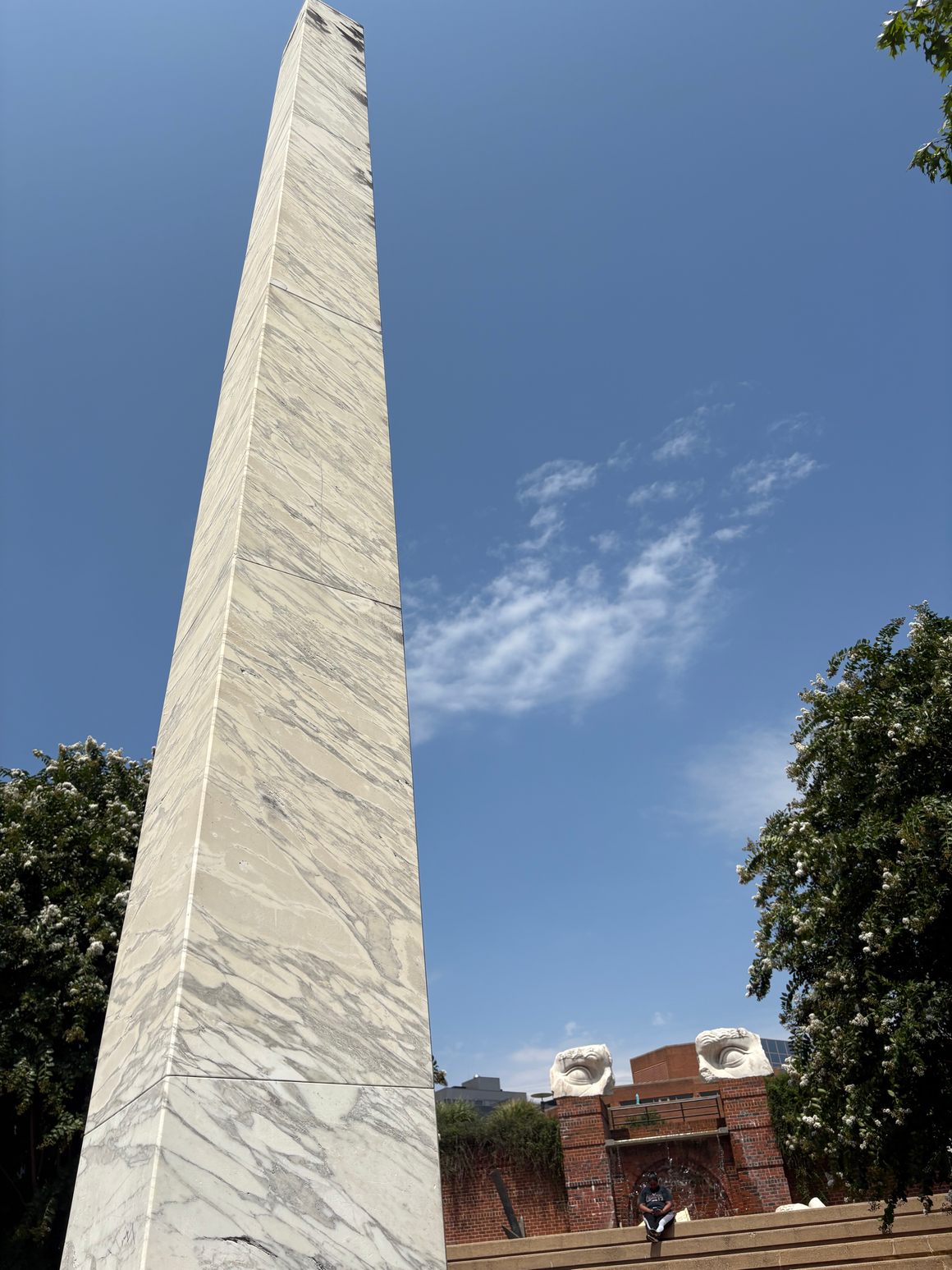
The final trick is the work’s marble obelisk. Rising about 30 feet and weighing roughly 14 tons, it unmistakably recalls the Washington Monument, though at a more human—and perhaps more vulnerable—scale. In the Poiriers’ imaginary landscape, even the most familiar national symbol becomes another relic: one more artifact left behind by a civilization that believed its monuments would last forever.
Nearly four decades after its installation, Promenade Classique remains easy to miss. It lies within an office development rather than a museum or traditional sculpture garden, and there is little on-site interpretation to explain why giant eyes and lips are watching visitors descend toward the water. Yet the City of Alexandria recognizes it as part of the waterfront’s public-art landscape, and the work remains a peculiar, open-air encounter with imagined ruins beside the Potomac.
Know Before You Go
Promenade Classique extends from Canal Center Plaza to the Alexandria waterfront in North Old Town, beside Tide Lock Park. The Public Art Archive lists the installation at 44 Canal Center Plaza & Waterfront, Alexandria, Virginia 22314; Tide Lock Park is at 1 Canal Center Plaza.
Approach through Canal Center Plaza or from the Mount Vernon Trail along the Potomac. Rather than searching for one standalone object, follow the descending terraces toward the river. The installation was designed as a continuous promenade, starting at the upper plaza and ending near the obelisk.
The fountains and pools are integral to the original design, but not all water features necessarily operate. After reaching the waterfront, continue to Tide Lock Park, where the reconstructed Alexandria Canal tide lock provides a fitting contrast: genuine local industrial history beside the Poiriers’ invented classical ruins.


