About
Is there anything more inextricably linked with the state of Maine than the lobster? For visitors, it’s an icon emblazoned on souvenirs and sought out at waterfront shacks. For Mainers, it's a lifeblood: Yards piled with traps and harbors bobbing with colorful buoys signal the endurance of a centuries-old trade.
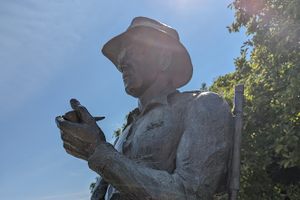
In the heart of Portland, in a plaza near the Old Port, the Maine Lobsterman statue stands as a celebration of that trade. It portrays a lobsterman at work, kneeling (a bit of artistic license by sculptor Victor Kahill, much to the chagrin of lobstermen) and wedging a peg in the lobster’s claw to prevent pinching, a precursor to rubber bands. While the figure represents an industry at large, it also represents one larger-than-life lobsterman: Elroy “Snoody” Johnson, who lived and worked the whole of his 79 years on Maine’s Bailey Island. Born in 1894, Snoody started lobstering at just 10 years old, the Harpswell Anchor reported, and worked his traps into his 70s. In the intervening years, he cofounded the Bailey Island Tuna Tournament, now one of the longest running fishing tournaments in the nation, was a pioneer in the sea moss trade, and throughout it all, served as a vocal advocate for Maine fisherman in the halls of power.
The statue was commissioned for display at the 1939 World’s Fair, but by the time the fair rolled around, Maine’s delegation had raised only $1,500 of the $10,000 needed to cast it in bronze. Ever the practical New Englanders, they slapped some paint on the plaster and shipped it off to Flushing Meadows in Queens, where an estimated 2,200,000 visitors passed through the Maine Pavilion. Back in Portland, it was displayed locally until vandalism and deterioration took hold and it was sent to languish in a Boothbay Harbor warehouse.
But after Johnson’s death in 1973, the legislature finally allotted funding to recast the statue. Artist Norman Thierrien began the process with plaster repairs and the eviction of a few squirrels, then used lost wax to cast the sculpture in 17 different pieces, which were later welded together into an 800-pound bronze figure.
Three copies were made: Besides this one in the heart of Portland, one also stands on Maine Avenue in Washington, D.C., and the third sits at the edge of Bailey Island, where Johnson lived, worked, and rests in the local cemetery, unaware that his image now represents the heart and soul of Maine lobstering for hundreds of visitors and passersby each day.
Know Before You Go
The Maine Lobsterman statue sits in a cobblestoned pedestrian plaza at the intersection of Temple and Middle Streets. It’s easily accessible and visible round the clock, but a handful of picnic tables make it an ideal warm-weather lunch spot.
Community Contributors
Added By
Published
September 10, 2025
Sources
- https://www.publicartportland.org/project/maine-lobsterman/
- https://www.pressherald.com/2024/08/16/stories-from-maine-you-dont-peg-lobsters-like-that-a-hard-fought-effort-to-move-a-statue-to-the-midcoast-2/
- https://abacus.bates.edu/muskie-archives/ajcr/1979/Maine%20Avenue%20Statue.html
- https://harpswellanchor.org/2023/04/elroy-johnson-man-of-the-people/