About
The River Ouse in the north of England has, for millennia, been an artery for transportation, including military transportation (Romans, Vikings and Normans all used it), and in 1890 the Royal Army Ordnance Corps built a depot close to the River Ouse in York to provide a storage facility for ordnance to be used in the many military training facilities in the north of England, including the nearby Fulford Barracks (since the end of WW2 called the Imphal Barracks).
The 19th-century ordnance depot included a new wharf on the river. Although steam-powered vessels were well established at this time, the transport was almost exclusively by sailing vessels with a view to avoiding an explosion and, in particular, a schooner (possibly a ketch) known as "Princess" which was locally known as the "Powder Boat". These vessels were largely carrying materials from Woolwich Arsenal in London via the North Sea and the River Humber. The wharf was equipped with a primitive, hand-cranked crane, which unloaded the vessels onto horse-drawn waggons (in this case not just for explosion prevention but because they were better able to cope with the steep gradient), running on a narrow-gauge railway which took the munitions into the depot and continued as an extensive internal railway.
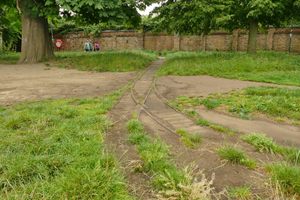
The wharf and the railway continued in use until the mid-20th century, but in WW2 much of the transportation was thought to have been switched to road because of the U-boat threat in the North Sea. The gate which the rail line passed through into the depot was bricked up, but the rail lines close to the river were not removed. However, the river at this point is very flood-prone and after the maintenance effort stopped, the tracks became covered by silt deposited in times of regular floods and it became largely forgotten.
The area along the River Ouse is a public open space known as New Walk (it is part of the Sustrans national cycle route(https://www.atlasobscura.com/places/the-golden-hand-sculpture)) and there is a fine public park across the river (Rowntree Park). To celebrate the turn of the millennium, a new bridge (Millennium Bridge) was constructed to join the two areas of public open space. The necessary works for this revealed again the historic rail track which has now been taken under the wing of a group of voluntary bodies which try to keep the historically important tracks exposed and maintained. The maintenance work is normally carried out by volunteers from "Friends of New Walk", particularly after flooding, but such is local interest, even volunteers from the local gym have contributed to the digging required to expose the tracks.
Know Before You Go
An unusual "Ice Cream Boat" called Two Hoots is usually moored here in daylight hours except in times of flood.
The former Fulton Barracks (now the Imphal Barracks) still operates as the HQ of the Northern Military Region and houses, amongst other units, the 246th Gurkha Signal Squadron. It is due to close in 2030.
Crossing the millennium foot/cycle bridge will take you into the very attractive Rowntree Park, which was a gift to the City of York by Messrs Rowntree & Co. in 1921 as a memorial to the Cocoa Works staff who fell during World War 1. A set of fine gates was added to the park in memory of those who fell in World War II.
The entire Fulford area is full of military history including numerous WD boundary markers, former and current military buildings and the Kohima Museum.
Community Contributors

Added By
Published
June 19, 2026