How Rose Valland Saved Stolen Art From the Nazis
History often overlooks this brave woman’s efforts in World War II.

Listen and subscribe on Apple Podcasts, Spotify, and all major podcast apps.
Dylan Thuras: It’s 1944, and there’s a train packed full of paintings by the likes of Picasso and Monet and Van Gogh, and it’s circling Paris. And there is a woman, desperately and secretly, trying to stop this train. So Michelle, maybe you can set the scene.
Michelle Young: So we have a woman named Rose Valland, who is an art historian in a museum called the Jeu De Pomme, which is right next to the Louvre, a modern art museum. And she’s been secretly undercover, working inside this museum that’s been taken over by Nazis since 1940. And they’re using it as really a clearinghouse for looted art that they’ve been stealing from France, predominantly from Jewish families. And as the Allies get closer and closer to Paris following D-Day, the Germans think we have one chance to get as much art out to Germany as we can. And so she’s been watching this happen in the museum, packing, moving, labeling. And now we are in the days before Liberation Day, and she has passed her information to the resistance members in France, working with the train service, as well as the resistance in London. And she’s hoping she can stop this train from leaving France.
I’m Dylan Thuras, and this is Atlas Obscura, a celebration of the world’s strange, incredible, and wondrous places. Today, we are talking to author Michelle Young about her book, The Art Spy: The Extraordinary Untold Tale of World War II Resistance Hero Rose Valland. It’s a kind of heist story in reverse. It is the story of how this French curator infiltrated the Nazi army to save art masterpieces from the Jeu de Palme Museum in Paris, how she wound up racing against a train full of stolen art to, in this case, stop the heist.
This is an edited transcript of the Atlas Obscura Podcast: a celebration of the world’s strange, incredible, and wondrous places. Find the show on Apple Podcasts, Spotify, and all major podcast apps.
Dylan: What was Rose like? What kind of person was she?
Michelle: So Rose is a pretty difficult person to get to know. She’s, for many reasons, has had to subsume her real identity. She’s also an academic, a nerd of art history and art. And you can even see in photographs from school, all the girls are kind of hanging out together, putting their arm around each other, and she’s sort of on the side with her glasses and not really fitting in. She is a very direct person, brutally honest. This can sometimes rub people the wrong way. And she’s not simpering like the other women who work in the French museums. So she’s part of the avant-garde art scene in Paris, but in the world that she wants to get a job in, she’s definitely out of place and different.
And so for this and other reasons, she has a hard time getting a job. And in fact, one of her thesis advisors, who unfortunately turns out to be the head of the École du Louvre, which is the school she ends up at to train to be a curator, is also the head of the Louvre and all of the French museums. And his rival is her mentor. And he sees this upstart woman from the countryside in France with very modern ideas, and it makes him very uncomfortable. And so he gives her a terrible grade on her thesis and says, “This is not even art history whatsoever.”
Dylan: She’s on this kind of one-woman war, Rose’s war, to move into art curation, move into this world that has been—kind of just keeps getting denied from her. No matter how educated, no matter how much she knows or has to offer, she’s just getting … But eventually, bit by bit, she kind of like, through sheer force of will, ends up there. But meanwhile, in the middle of this actual continental war is breaking out. So how are—as Rose is trying to do this personally, and this is happening all around her—how does she and the museum start preparing for this coming disaster?
Michelle: Yeah. So first, it’s lists, lists, lists. And this is what these art historians are trained to do, lists of different types. And so their job is to select which art needs to be moved out into the countryside. These are the most important works, but they can’t move everything. So they have different levels of priority. And finally, those that will stay in the museum in a protected state.
Dylan: Let me ask a stupid question: Why do they need to move all this stuff? What are they afraid of?
Michelle: That’s a great question. And it’s not looting. It is the fear of the art being damaged by bombs, incoming troops, and such. And that is the same for the Jewish art collectors in Paris. If they moved their art collections, it was not in fear of the Germans stealing it. They did not know that was going to happen. It was in fear that it would be damaged.
Dylan: So it seems like they’re getting ready to … They’re making lists. They’re figuring out how to get the most valuable stuff out of the museums and somewhere else. When do they actually start doing stuff? When do they start moving stuff? When do they feel like, okay, we have to start now?
Michelle: They start doing it about a week before war is declared. Basically, the countries, England and France, declare a war alert. And that means certain actions can now be taken by the government, emergency declaration. They can start to move the artwork, start to pack it, and then move it.
Dylan: What is Rose doing during all of this? Is she participating in this crazy art evacuation?
Michelle: She’s participating from Paris, from her museum. And once she’s packed everything up, and it’s very clear, as usual, she’s extremely efficient, so she’s done very quickly with the packing. And then it’s about how do we protect the museums? And so the Jeu De Pomme has these huge double-story windows, and they repeat throughout the whole both facades, long facades of this building. And so they need to sandbag and tape up these windows in case of bombing. So that doesn’t completely shatter and injure someone, kill someone, or damage things in the museum. And she’s moving things into the basement. At some point, they realize that the statues are just way too heavy and cannot be moved into the museum or the basement. So they have to sandbag all of those. She is also working with the guards in her museum. Those are French guards, and she’s worked with them for six years. So she’s liaising with them. And she also just knows intimately how this building works. So likely she’s checking that the fire system is operating and the electrical system is working.
Dylan: And then after, so this is all prep. It’s like, get the art out of here. It’s like, cover the things that can’t be moved or try and make them slightly explosion-proof, you know, tape up the windows so shattering glass doesn’t fly in and whatever. But then, you know, war’s coming. Do they need to get themselves out of town?
Michelle: The first bomb alerts happen, air raid alerts happen within days of war being declared. So Rose, at this point, has been sleeping in the museum in a straw mattress.
Dylan: Wow. So the museum’s like empty or mostly empty. And she’s kind of like staying behind like a captain going down with the ship kind of vibe.
Michelle: Yeah, because her boss has been recalled to the Air Force. He’s a World War I aviation hero. So he’s been gone for a month. So she’s in the museum completely in charge, and she gets some straw mattress. And they’ve configured a bomb shelter. It’s not very robust, but they’ve configured a place they can go to in the basement. And you’re right, the rest of the museum is eerily empty.
Dylan: Okay, so at this point, Rose and the museum staff have basically been preparing for war to break out, which seems inevitable. And then that summer, things kind of come to a head at the museum. And then Rose finds herself, I guess, leading this massive evacuation of the Jeu De Paume. Can you tell me about that?
Michelle: Yeah, so she gets a call the morning of June 13th as the Germans are about to breach Paris. And her boss says, “Leave the museum immediately,” and puts her in charge with evacuating 150 museum employees, their families by boat along the Seine on a flat bottom boat, basically a barge. And so you have to imagine the city at this point is virtually empty. Everyone who was able to flee has left. There’s basically just like stray dogs and sheep wandering around.
And that’s the scene you’ve got, right? And by the time Rose’s boat leaves from where they’ve started, the Seine is also empty. So she writes that there’s only like abandoned boats floating by. And so it’s a really eerie scene. And they make it all the way to the industrial outskirts of Paris, at which point a huge boat traffic jam appears. And it’s backed up for miles. And they’re worried that they’ll just be sitting ducks at that point because the German planes are starting to come in. They get word from the river lock, which is why there’s a backup, everyone has to go through the lock one by one. And they’re told it’s going to be another day before you can get through here.
And so Rose and another woman, a young woman who works in the museums, make the decision that they’re going to go back to the Louvre on foot to tell the guy in charge there to help them get trucks to evacuate this huge barge of employees. And so they do this, you know, just as the Germans are coming in, and they’ve only got a few hours to get there and back. And they go on foot. I think they like, hail a car at some point for part of the way. They get there. They get agreement to get the trucks.
They come back to that intersection, and the boat is gone. And so all the museum employees, the barge, the captain of the boat—who’s actually just an editor of the Louvre publications, he’s not a real boat captain—he’s also gone. And of course, there’s no phones. There’s no way to get in touch. And so here you have these two women who need to make it out of Paris to the Loire Valley. And it’s hundreds of miles away. And so thus begins a very treacherous journey by foot, by wagon, by any means possible for these two women to get to the Loire Valley, full of near-death scenarios.
Dylan: I assume they make it, or this would be the end of the episode.
Michelle: Yeah, yeah. That would be the end of the book, I guess, because there would be no more Rose. So they do make it, but it’s just incredible what they see and experience along that journey.
Dylan: And then it seems like, you know, not that long after that, like less than a year after this very dramatic evacuation, where she’s told to leave the museum, Rose finds herself back in the Jeu De Paume, but under these extremely different kinds of circumstances. So Rose evacuates from the Jeu De Paume Museum. She makes it out to the countryside. She spends some time in this region of France, but then, less than a year later, she is called back to Paris and back to the Jeu De Paume. Although the Germans had taken Paris, the museum was still technically managed by the French National Museum. And they wanted folks there keeping an eye on things during the occupation. So Rose, having escaped, now returns. Returns to Paris, returns to the Jeu De Paume. But at this point, this city looks very, very different from the one she left.
Michelle: The Germans are setting up shop. They’re changing the signage in Paris to have to be German signs. And it’s starting to feel like a new Germany. The Nazis in any country they invaded, they basically set up shop and started looting art at the same time, because they already knew in advance. They already had lists, their wish lists of art they felt rightly belonged to them. Maybe it had been plundered in a war by Napoleon. Maybe they had unfairly, in their opinion, given it up in the Treaty of Versailles. Or they just wanted it.
And so in the case of France, they had a list of the 15 major art galleries, predominantly owned by Jewish dealers, and they liquidated those in a week with commando units. And the art is quickly piling up in the German embassy, all the stolen art, and there’s now almost no room. So they request a new location to put it in, and it’s going to be in three rooms of the Louvre.
And so at that point, they tell the French museums, we need our own place to store and catalog this art, mostly because they didn’t want anyone to be seeing what they were doing. And so Rose’s boss offers up her museum, the Jeu De Paume, likely because he already knows there’s someone in there who can spy. And at the end of October, he’s given her that order to remain at all costs at the Jeu De Paume, an order she takes very seriously for the next four years.
Dylan: So once she was ordered to leave, immediately leave, and now they’re like, you must stay. So what is she doing there? She’s trying to work effectively at this museum, but it’s under this kind of Nazi administration, and they’re bringing other art that they are sort of looting to that museum. And she must presumably know, like, this isn’t good, like it’s not going to end well for the art. So what is she kind of doing? What is she keeping an eye on? Is she actually spying?
Michelle: Yeah. So it’s really an uneasy marriage that’s going on between France and Germany, because they’ve only signed an armistice. That’s a temporary truce. And the Germans believe that the British will surrender imminently, at which point there will be a final peace treaty, and the art that they’ve looted will now be used as reparations for the damage done to them, not done to France, right?
So it’s sort of this whole temporary situation, and therefore they needed official permission to take over this museum. And Rose’s boss, Jacques Jaujard, gives his permission with one stipulation. That is: The French get to do their own inventory of everything that’s coming in. So her initial role on day one is, yes, again, to make more lists of the art that’s coming in. But she’s immediately shut down by a very devious-looking Nazi, and he shuts her notebook roughly and says there will be no inventory, and anyone else who’s in this museum who’s French need to leave. He can’t get rid of her because it’s part of the agreement that’s being made.
And so initially, she is just trying to understand what’s going on. Who are the players? And you can see in her notes, she’s listening phonetically to the German that’s being spoken. She does have a secret weapon here, and that is that her life partner, Joyce, here, they’ve been living together since the mid-1930s, if not earlier, is half German and has partially grown up in Germany.
And so she’s figuring out their names and what they’re doing. And then over time, she becomes more daring. And so she starts to steal documents from the museum, taking them out of garbage cans. She’s made duplicate keys of the building and the safes inside the building. She steals negatives of the photographs of all the art they’ve been taking and these very corny, almost portraits that the staff have taken of themselves, with props.
Dylan: Selfies. Selfies. They’re taking selfies with the art. Yeah. Okay.
Michelle: Yeah. So she’s stolen all these negatives. And somehow at night, she’s having them developed and then putting them back carefully into the files the next day. And then later, she’s trying to decipher where the art is going. So not just which families they’re coming in, what the art is, who the artists are, but then when the Germans start shipping them off to Germany, she wants to record if she can.
And there are several times where she comes into a lot of danger. And there’s one time that she is caught trying to decipher a label. And her nemesis, that art dealer, Bruno Loza, catches her doing it and tells her, “Well, you know what could happen if you’re caught doing something like this. You could be shot.” And she answers him point blank, staring at him, she had really like nerves of steel.
Dylan: She’s, yeah, what she’s doing is quite risky. Is there a chance, like, do they know that she’s doing this?
Michelle: I think they suspected, but she was careful enough not to reveal what she was really doing. And one of the things was that she could have a plausible cover just wandering around the museum, whether it was for maintenance reasons or art historical reasons, preservation reasons. And so she herself says that she could pass it off as the bumblings of a curious employee. And she also would start to make some mistakes to hamper their efforts in various things, which also kind of made her look less smart. And then she trained the other people that worked for her to do similar little pieces of sabotage.
Dylan: Rose spends the next four years at the Jeu de Paume museum under Nazi occupation. It is dangerous and terrifying, but she is spending all of her time doing everything she can to make sure the art is being protected. She’s willing to take almost any risk to assure that it stays safe, that it stays there, it does not fall into the hands of the Germans and is taken out of the country. And here is where we enter the train scene.
Michelle: So one thing to note is that the Germans hated modern art. They had a catchy phrase for it called Entartete Kunst, or degenerate art. And so since the ’30s, the Germans have been trying to figure out how to get rid of this art. So in Germany, they took it out of museums, they burned some of them, they sold some. So in France, similar problem. They would loot all these collections, take all the old masters, which had value because it’s what Hitler wanted and what Göring wanted following suit.
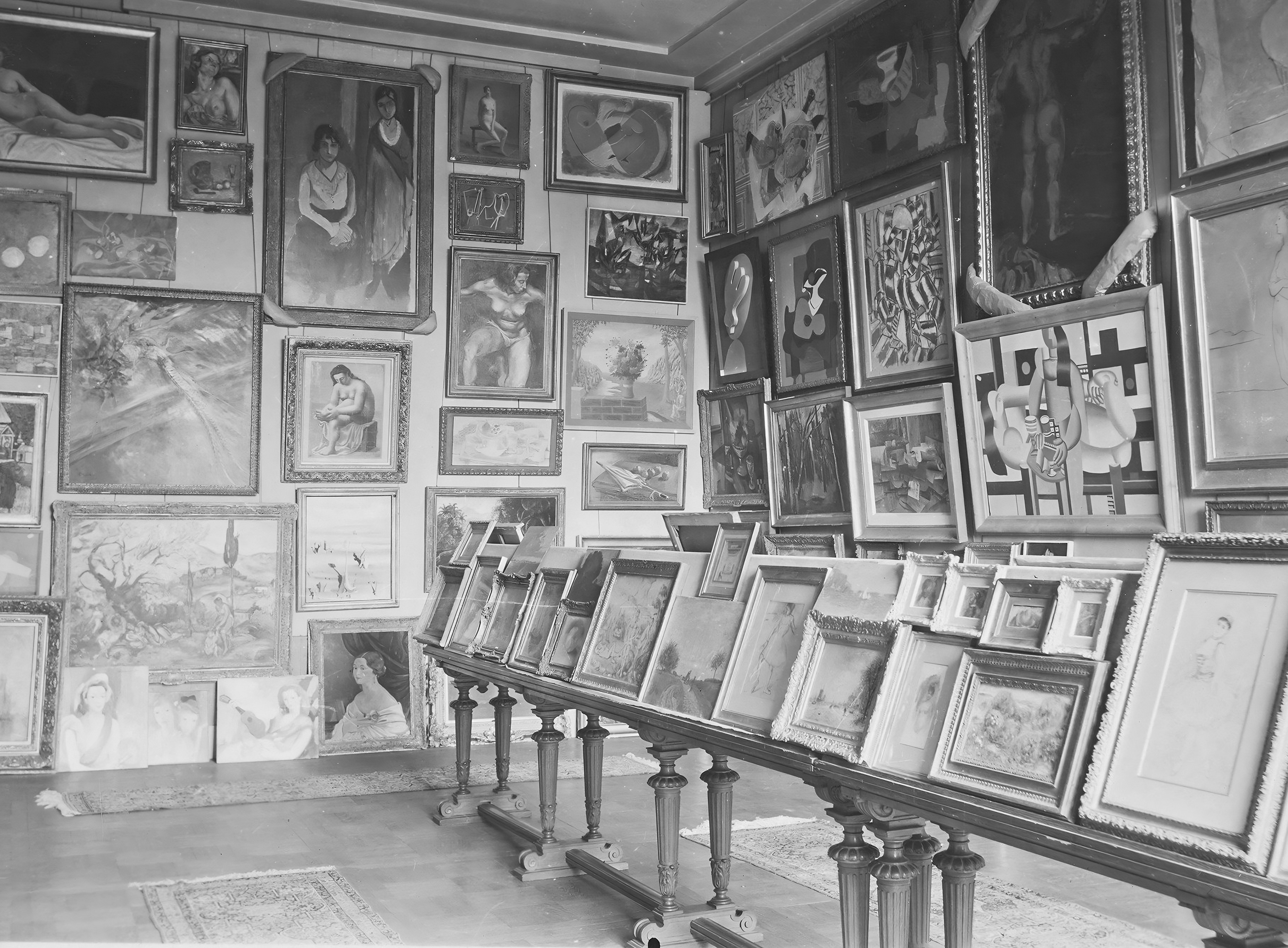
And then, uh-oh, what do we do with all these Picassos? And so they stuffed them into one room of Rose’s museum. And it was called the Room of the Martyrs, the Salle des Martyrs. And it just gradually got filled floor to ceiling, every available space with art because they didn’t know what to do. And occasionally, they would do these exchanges. So Bruno Loza, that art dealer, came up with this idea. What if we exchange, like, 20 Picasso and Matisse paintings for one Vermeer? And now we can liquidate it quickly.
So they were doing that, and Rose was really concerned about this and really concerned about the fate of the art in that room. But then, yes, we come to early August 1944, and this room is still full of modern art. And she’s really worried about it. She sees activity going on, and she realizes they’re trying to make one last transport. So they fill this rail car.
And I also want to mention that the guy in charge of the Jeu de Paume is a Nazi out of central casting. He’s got one glass eye, and he wears long coats, military coats with wolf hair colors.
Dylan: You’re describing, like, an Indiana Jones nazi. This is a ridiculously cartoonish villain.
Michelle: Yes. And if you saw that in a movie, you’d be like, oh, come on.
Dylan: A little much, everybody.
Michelle: But I looked at his photos. I was like, indeed, glass eye.
Dylan: Yeah. You know, fur, trench coat. Yeah. Okay.
Michelle: Exactly. So he is hell-bent on getting this artwork out because he knows it can be sold not in Germany but in Switzerland and other places for a lot of money. But not only does he want this artwork, he thinks, why don’t I take additional 47 trained cars of furniture, bric-a-brac, things like linens and forks, everything that they’ve taken really, because they would go into these Jewish apartments right after they were deported and liquidate it completely. So they just had so much stuff.
This last train car is 52 cars long of cargo wagons, right? So it’s sitting in a train station on the outskirts of Paris. And this nazi, Kurt von Behr, is pacing up and down the platforms, trying to get this train loaded. Finally, it’s ready, but it’s too heavy. Or the train system tells him it’s too heavy. But at the same time, Rose has made contacts with her resistance networks. So she’s told her boss, Jacques Jaujard, who is connected to the London-based resistance network, and then Rose has her own resistance contact who works with the train system, which was rife with resistance operatives in World War II.
So she’s trying every method possible, whether it’s through the civil service, bureaucracy, through the resistance network, how do we stop this train? And so the resistance steps in and does everything it can. So the train is too heavy. The engine is broken. The signals are broken. And so it kind of stumbles along from train station to train station with things breaking down all the time.
Then a few days before the liberation, they remove the engine altogether. Oh, sorry, we were unable to fix it. And it will have to await a new locomotive, because they’re just delaying it in any way possible. And finally, I don’t know if I should give out what happens, but …
Dylan: I think we have to know. Okay. We have to know.
Michelle: Okay. So the final act of resistance was to disable another train, kind of like blow it up a bit so that it would block the path that this train could take.
Dylan: They succeeded. Okay. So I guess through this combination of administrative and on-the-ground resistance, Rose and her colleagues are basically able to stop this train from leaving Paris.
Michelle: Exactly.
Dylan: And what happens to the art on the train? Like what is it—who gets it at that point? Or does it sit there? Like, when does the war end?
Michelle: They call on the Allies, the Allied Forces, in the end, the free French, and say, we need you to go and come in near this train sitting in the outskirts of Paris. So when they go, at that point, the German guards have abandoned it, but there’s a few still in the train, and the door opens, and they stumble out, all confused. And then they see that inside, it’s full of artwork crates that are labeled with, like, Picasso and Monet and Van Gogh. So it’s this, like, cinematic moment while the rest of Paris is being liberated.
Dylan: Right. So Rose, they succeed. They manage to stave off the shipping of all of this art out of Paris for long enough for allied soldiers to get there and kind of rescue the art. What about Rose? What is sort of the end of her story? What happens to her after all this?
Michelle: So she writes that she ran, so I don’t know if it’s physically ran, but that she ran to the station to see the train for herself. And then she helps move the art back to the museum, the Jeu De Paume museum. So it makes this really nice full circle moment. And she says she lays down all the artwork flat to spend one last moment with them before they get sent back to their rightful owners.
And then a year after, when Germany is defeated, she is sent as a captain in the French army and then also the U.S. army to work as what they call now a monuments woman in post-war Germany and Austria, working on art restitution. So she spends eight years there working on art restitution. At some point, she pops back to France and serves as an interrogating witness at a war crime tribunal of her nemesis, Bruno Loza, an art dealer.
Dylan: Oh, wow. She gets like the last word a little bit there. That’s, yeah. Okay.
Michelle: Yeah. Which contributed to his enduring hate. Then she returns back and she gets, well first, she’s told that she can’t keep the same pay she had in Germany. So she has to return to her previous title and pay level.
So she has to go back to that. And there’s all this attempt to try to get her a better position. And in the 1960s, early ’60s, she publishes her memoir. It becomes a movie not long after. And so she has this big brush with fame in the ’60s into the ’70s. She is awarded lots of medals.
But when she dies in 1980, there’s almost nobody at her funeral. She got lost from the record, basically between 1970 and 1980. She became a real inconvenient witness to what happened in the war, to collaborators that she still wanted to see justice done. And she was reminding people that there was still art that was looted that needs to be returned.
And the world was in the Cold War and everyone kind of felt, we’ve already dealt with the worst criminals from World War II and Nuremberg. So why don’t we move forward? I think for many reasons, both society changing, but also a deliberate silencing of her, she was forgotten by the 1980s.
Dylan: Yeah. I mean, it’s interesting because the sort of Monuments Men is a pretty well-known story at this point. And I think her piece in all this is much less known. So thank you for telling me that story, Michelle.
Michelle: Yeah. Thank you so much. This was a blast.
Dylan: That was Michelle Young. She’s the author of the new book, The Art Spy: The Extraordinary Untold Tale of World War II Resistance Hero Rose Valland. It is a really dramatic book. It is full of incredible historical details, and we are just scratching the surface here. Go check it out. We are going to put a link in the show notes, and you can still visit the Jeu De Paume museum today where you can walk through those exact same halls where Rose Valland fought the good fight. Okay. I will see you next time.
Listen and subscribe on Apple Podcasts, Spotify, and all major podcast apps.
This episode was produced by Manolo Morales. Our podcast is a co-production of Atlas Obscura and Stitcher Studios. The people who make our show include Doug Baldinger, Kameel Stanley, Johanna Mayer, Manolo Morales, Amanda McGowan, Alexa Lim, Casey Holdford, and Luz Fleming. Our theme music is by Sam Tyndall.









Follow us on Twitter to get the latest on the world's hidden wonders.
Like us on Facebook to get the latest on the world's hidden wonders.
Follow us on Twitter Like us on Facebook